
Stories
I Found My Mother Freezing Outside a Hospital After Her Husband Took Everything From Her — Then I Made Them Pay
May
At 3:07 a.m., my phone shattered the silence like a warning from another world.
I woke instantly, disoriented, staring into the darkness of my apartment while snow battered the windows hard enough to sound like fists against glass. Chicago had disappeared beneath the blizzard, every streetlight outside swallowed by white.
Then I heard my mother’s voice.
Weak. Trembling. Terrified.
“Lena… help… me…”
The call cut off.
No goodbye. No explanation. Just dead silence.
For a second, I couldn’t move. My pulse thundered so violently it hurt. My mother never called in the middle of the night. Never sounded afraid. And she especially never asked for help.
She lived three hundred miles away in Cedar Hollow with my stepfather, Richard Hale.
Richard with the polished suits.
Richard with the expensive smile.
Richard who shook hands like a politician and lied like breathing was part of his bloodstream.
I called back immediately.
No answer.
Again.
Nothing.
Again.
Straight to voicemail.
By the seventh call, my hands were shaking. By the tenth, I already knew something was horribly wrong. On the thirteenth attempt, someone finally answered.
Not my mother.
A nurse.
“St. Agnes Hospital,” she said cautiously.
My stomach dropped. “Where’s my mother?”
“Are you family?”
“Yes.”
A pause.
Then quietly: “Your mother was admitted earlier tonight… but her husband removed her from the hospital.”
I sat upright. “Removed her?”
Another pause, heavier this time.
“Against medical advice.”
The words hit like ice water down my spine.
I was out of bed before she even finished speaking.
Four minutes later, I was fully dressed.
Before leaving, I crossed my apartment and unlocked the safe hidden behind my bookshelf. Inside sat a black folder, a flash drive, and my bar card.
Richard loved introducing me to people as “the quiet legal researcher in Chicago.”
He never mentioned the truth.
I was the chief fraud investigator for the state attorney’s office.
And men like Richard were exactly the kind of predators I spent my life destroying.
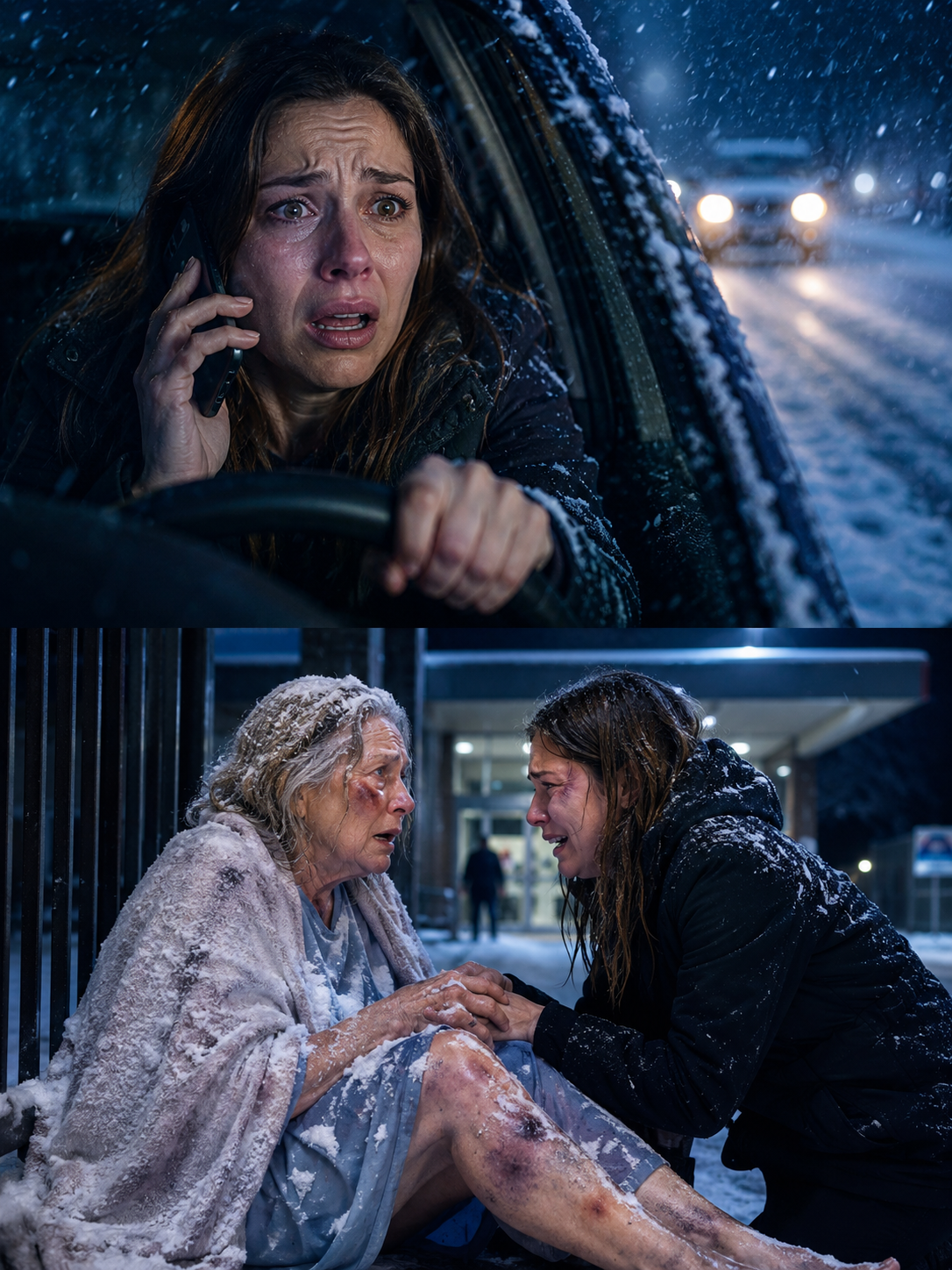
At 3:26 a.m., I drove directly into the storm.
The highway looked apocalyptic. Snow erased lane markings. Abandoned cars littered the shoulders. Semi-trucks lay jackknifed in frozen ditches like dead animals. The wind slammed against my car hard enough to make the steering wheel vibrate in my hands.
Still, I drove faster.
Every mile, I heard my mother’s voice again.
Help me.
I hadn’t heard fear like that since I was sixteen years old and Richard first moved into our lives pretending to be a savior after my father died.
Back then, he arrived with flowers and sympathy.
Then slowly, quietly, he took everything.
My mother’s confidence.
Her friendships.
Her finances.
Even the way she spoke.
By the time I graduated law school, Mom apologized before expressing opinions.
Richard called it “keeping peace.”
I called it control.
The snow finally began to fade at sunrise as I reached Cedar Hollow.
I went straight to St. Agnes Hospital.
My mother wasn’t inside.
A nurse recognized me instantly and rushed me toward the side entrance.
That’s where I found her.
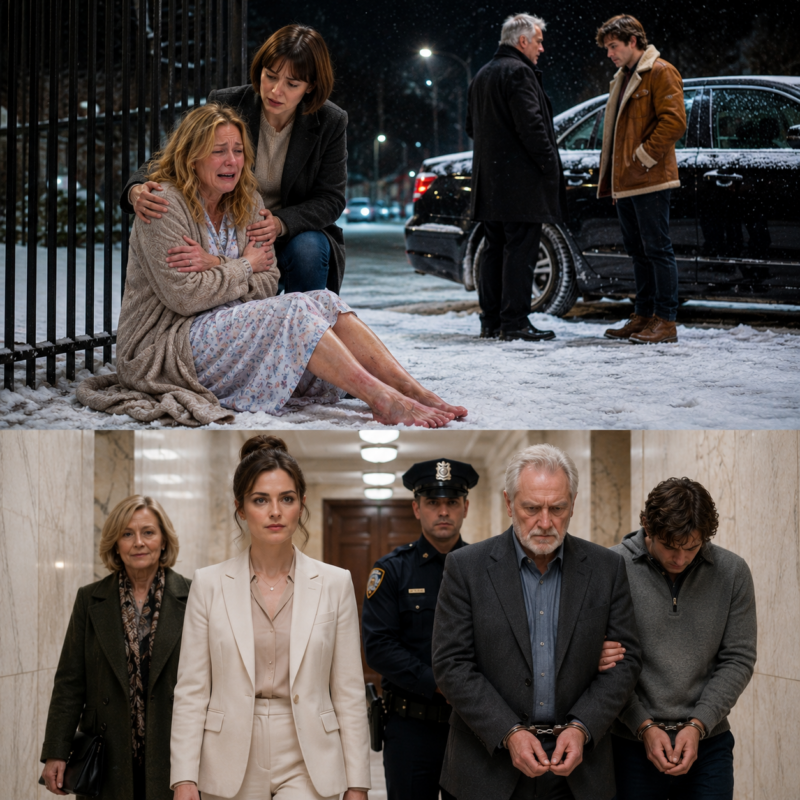
Curled against the frozen concrete near the hospital gate.
Barefoot.
Wearing nothing but a thin hospital gown.
Bruises darkened her arms and cheekbones. Her lips were blue from the cold. Snow clung to her hair and eyelashes like frost.
For one horrifying second, she looked dead.
“Mom.”
Her eyes slowly opened.
And what destroyed me wasn’t the bruises.
It was the fear in her face when she saw me.
As if she thought I might hurt her too.
Then she broke into sobs.
“They left me.”
Rage exploded through my body so violently I nearly blacked out.
I carried her inside myself, screaming for help before the doors even opened fully. Nurses rushed toward us. Doctors barked orders. Someone wrapped heated blankets around her while another checked her pulse.
But my mother never let go of my sleeve.
Not once.
Hours later, beneath cold fluorescent lights, she finally told me everything.
Richard had taken her phone weeks earlier “to simplify things.”
Then her debit cards.
Then her medication.
Caleb—my half-brother, Richard’s golden boy—had driven her to the hospital after she collapsed in the kitchen.
But when nurses started asking questions about the bruises, Caleb panicked and called Richard.
Richard arrived with paperwork.
Power-of-attorney documents.
He told the staff my mother was mentally unstable. Confused. Dramatic. Emotional.
Then he signed refusal papers, dragged her out of the hospital, took her belongings, and abandoned her outside in the storm.
“She was embarrassing us,” Mom whispered brokenly. “Caleb said… I should’ve died quietly.”
Something inside me went cold.
Not hot.
Not explosive.
Cold.
The kind of cold that settles into people right before they ruin lives.
I drove to Richard’s house before my grief had the chance to become tears.
My mother’s house.
Richard opened the front door wearing a silk robe, holding a mug of coffee like the world belonged to him.
“Well,” he said smugly. “The little librarian came running.”
Caleb appeared behind him grinning.
“What are you gonna do, Lena?” he mocked. “Write a strongly worded complaint?”
I looked past them into the house.
My mother’s paintings were gone.
Richard’s golf trophies lined the walls instead.
The family photographs had disappeared too.
Like they were already erasing her before she was even dead.
I smiled softly.
“No,” I said. “Nothing loud.”
They laughed in my face.
That was their first catastrophic mistake.
People always underestimated quiet women.
They mistook silence for weakness.
What they never understood was this:
Quiet people hear everything.
Quiet people notice everything.
And quiet people collect evidence while everyone else is busy talking.
Richard stepped into the doorway to block me from entering.
“Your mother is unstable,” he said sharply. “You’re upsetting her.”
Caleb folded his arms. “She signed everything over already. House. Accounts. Medical rights. You missed your chance.”
I stared at him calmly.
“Did I?”
For the first time, Caleb’s smirk flickered.
Richard lowered his voice. “Listen carefully. Your mother has no money, no home, and no family besides us. She’ll come back when she apologizes.”
I wanted to break every tooth in his mouth.
Instead, I nodded once.
“I understand.”
Caleb burst out laughing. “God, you really are weak.”

I walked away without another word.
By noon, my mother was admitted under protective hold.
By one, I had detailed photographs of every bruise.
By two, I had signed statements from hospital staff.
By three, I obtained security footage showing Richard dragging a barefoot woman through a side exit while Caleb carried her purse.
At four, I called Judge Morrison.
At five, emergency injunction paperwork was filed.
At six, every financial account tied to my mother’s name was frozen.
Richard discovered this while entertaining clients at an upscale steakhouse.
His credit card declined in front of everyone.
Caleb found out at a luxury dealership while attempting to purchase a black Corvette using money stolen from my mother’s retirement account.
The salesman walked away mid-conversation after receiving the fraud alert.
They called me minutes later.
Richard was screaming before I even answered.
“You vicious little witch—”
“Hello, Richard.”
“Do you have any idea who you’re dealing with?”
“Yes,” I replied calmly. “A retired insurance executive running shell companies through fake caregiver contracts and forged legal documents.”
Silence.
Heavy silence.
Then Caleb snapped, “You can’t prove that.”
I looked at the flash drive beside my laptop.
“You sure?”
They had chosen the wrong daughter to betray.
For over a decade, I had dismantled men exactly like Richard.
Men who stole through paperwork.
Men who abused through manipulation.
Men who hid cruelty behind polished manners and practiced smiles.
I knew where money disappeared.
I knew how forged signatures looked under magnification.
And most importantly—
I knew arrogant men always got careless eventually.
Richard got very careless.
He used Caleb’s email for forged transfers.
Caleb accessed my mother’s investment accounts from Richard’s personal laptop.
They transferred funds the exact same night Mom was hospitalized.
They even pawned her jewelry at a shop with crystal-clear surveillance cameras.
The next morning, Richard stormed into St. Agnes Hospital with Caleb and two police officers.
“There she is,” Richard announced dramatically, pointing at my mother’s hospital bed. “My wife is mentally incompetent. Her daughter kidnapped her.”
Mom physically recoiled behind me.
Caleb smirked. “Game over.”
I handed the officers a court order.
One officer read it silently.
Then his expression changed.
Richard frowned. “What is that?”
“An emergency protection order,” I answered. “You are legally prohibited from contacting her.”
Caleb’s grin vanished instantly.
I stepped closer.
“And Richard?”
His jaw tightened.
“The fraud division opens at nine.”
At exactly 9:02 a.m. the next morning, Richard Hale entered the courthouse dressed like a man still convinced he could charm his way out of anything.
Caleb followed behind him wearing sunglasses and my mother’s stolen watch.
By 9:17, both of them were sweating through their tailored clothes.
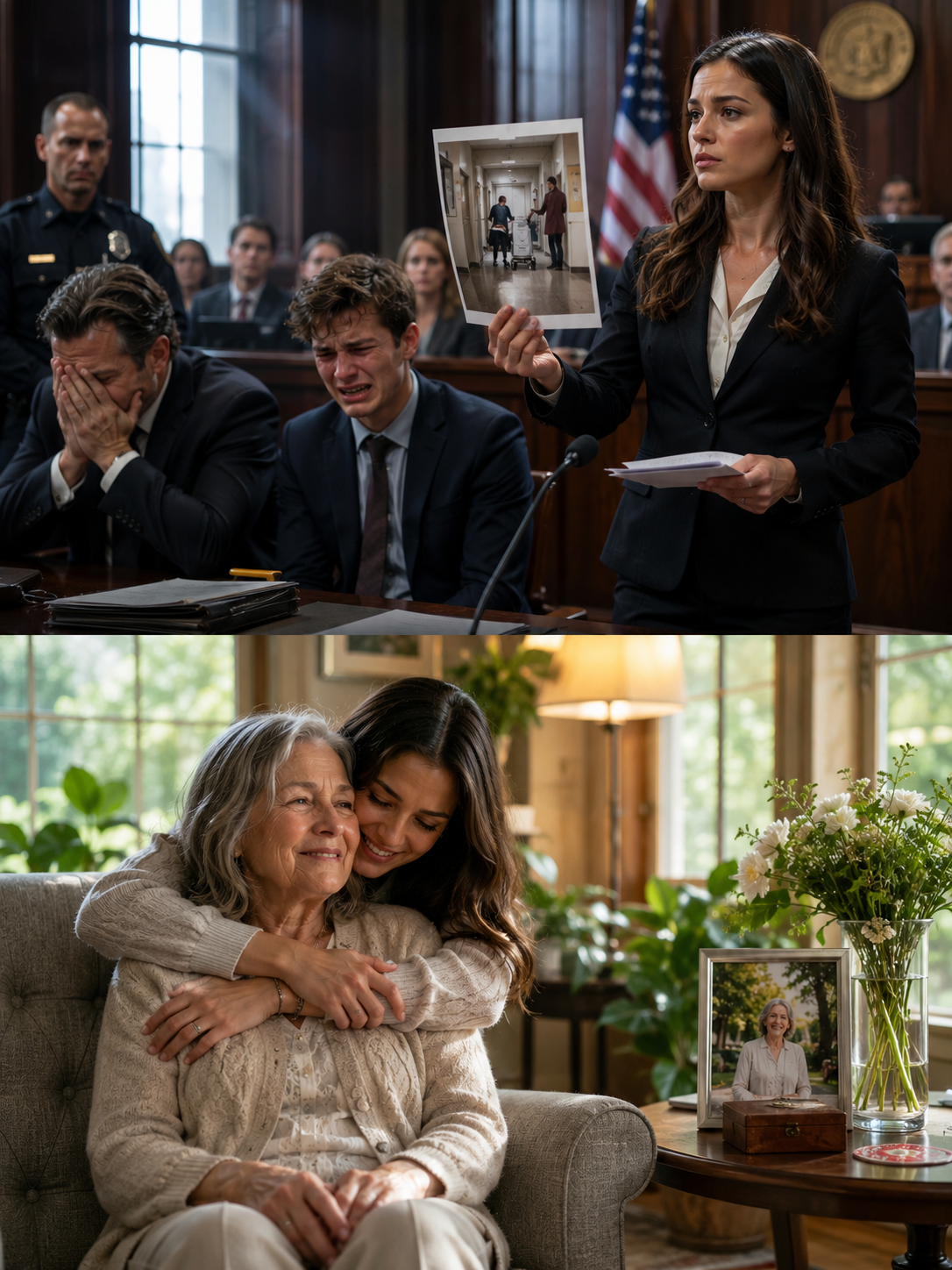
The courtroom watched the hospital footage first.
Richard dragging my mother barefoot through the side exit.
My mother stumbling weakly.
Caleb laughing while holding the door open.
The silence afterward was suffocating.
Even the judge looked disgusted.
Richard’s attorney stood quickly. “Your Honor, my client acted under valid power of attorney.”
I calmly placed two documents on the evidence table.
“The authentic document,” I explained, “names me as medical representative. It was signed four years ago, witnessed, notarized, and filed properly.”
Then I slid the forged version beside it.
“This version naming Richard was created last month using a notary seal belonging to a woman who died in 2021.”
The courtroom froze.
Richard looked at Caleb.
Caleb whispered nervously, “Dad…”
Then came everything else.
Bank records.
Email chains.
Wire transfers.
Fake caregiver invoices linked to a company registered under Caleb’s girlfriend.
Pawn shop surveillance footage.
And finally—
The voicemail Caleb accidentally left on my mother’s confiscated phone.
His voice echoed through the courtroom speakers.
“Let her freeze for an hour. She’ll stop talking.”
My mother covered her mouth and started crying silently beside me.
Richard exploded to his feet.
“This is a setup!”
The judge slammed the gavel so hard the room jumped.
“Sit down.”
For the first time in my life, Richard looked afraid of me.
Not annoyed.
Not dismissive.
Afraid.
I looked directly at him.
“You spent years telling people I was weak,” I said quietly. “Maybe you should’ve asked what I actually do for a living.”
The hearing was over before lunch.
Richard was arrested for elder abuse, fraud, forgery, unlawful restraint, and reckless endangerment.
Caleb was arrested less than two minutes later after screaming that my mother “owed him” for raising him.
An officer removed my mother’s watch from his wrist right there in the courtroom.
Their assets were frozen immediately.
The house was legally restored to my mother.
Every stolen dollar became part of the restitution order.
Richard’s country club revoked his membership before sunset.
Caleb lost his dealership job by the end of the week.
Three months later, Richard accepted a plea deal because a public trial would have destroyed what little reputation he had left.
He went to prison.
Caleb received jail time, probation, restitution payments, and a criminal record that poisoned every future opportunity he touched.
Six months later, my mother and I stood together in her living room repainting the wall where Richard’s trophies used to hang.
The house finally felt warm again.
Alive again.
She was healing slowly.
Walking without assistance.
Laughing sometimes.
Sleeping through the night without fear.
Outside, spring sunlight melted the last dirty piles of snow along the sidewalks.
Mom touched my arm gently.
“I’m sorry I didn’t call sooner.”
I dipped my paintbrush into soft blue paint and smiled at her.
“You called,” I said softly. “I came.”
A year later, Richard mailed a letter from prison asking for forgiveness.
I sent back exactly one thing.
A photograph of my mother standing barefoot in her garden beneath the sunlight.
Healthy.
Smiling.
Free.
On the back, I wrote four words.
She survived you.
Then I moved on.
Note: This story is a work of fiction inspired by real events. Names, characters, and details have been altered. Any resemblance is coincidental. The author and publisher disclaim accuracy, liability, and responsibility for interpretations or reliance. All images are for illustration purposes only.
