
Stories
He Hid Her Away in Shame—But Her Cooking Told a Story No One Could Ignore

May
Thirty flawless porcelain plates lined a long white marble table. Thirty crystal glasses shimmered beneath an extravagant chandelier. Thirty napkins folded with near-painful precision.
And behind the swinging kitchen door, swallowed by heat, steam, and the scent of spices… was me.
Lily Bennett.
The wife of the man who owned the house.
But that night, in his eyes, I wasn’t his wife.
I was “the help.”
The one meant to stay unseen.
The one who shouldn’t speak.
The one who wasn’t supposed to exist in that room.
Sweat slid down my back as I stirred the mole in the clay pot I had carried from home. My grandmother’s worn green apron was tied tightly around my waist, the air thick and heavy against my lungs.
Outside, laughter drifted in—smooth, polished, effortless.
Inside, every simmering bubble reminded me who I was… and everything Adrian had spent years trying to erase.
It hadn’t always been like this.
When we first met, it was my cooking that made him look at me like I was something rare. At a small gathering, he tasted my mole, closed his eyes, and said he had never felt something reach both his mouth and his heart like that before.
I believed him when he said my roots would never embarrass him.
I believed him when he promised that in the city, I would never have to lower my head.
I believed him…
Until he began correcting the way I spoke.
Until certain dresses were suddenly “too small-town.”
Until he stopped bringing me anywhere that mattered.
Until the night he introduced me—smiling—as someone who helped around the house.
I smiled too.
But something inside me cracked that night and never truly healed.
This dinner was the most important night of his career. I could see it in the way he spent days issuing orders, inspecting every flower, every plate, every bottle as if his future depended on perfection.
“Don’t ruin anything tonight,” he told me earlier, barely looking at me. “Make something refined. Subtle. No strong smells. None of… your style.”
My style.
As if it were something shameful.
As if the women before me—my mother, my grandmother, my aunts grinding spices with tired hands—were something to hide.
I lowered my head.
And said yes.
But I didn’t mean it.
Because while he polished silverware, I roasted dried chiles until the kitchen filled with memory. I ground almonds, sesame seeds, cinnamon, cloves, cacao. I built a sauce thick, alive, impossible to ignore.
I didn’t cook to impress them.
I cooked because it was the only way I could still exist.
The first plate went out.
Then the second.
Then the third.
And then… something shifted.
The laughter faded.
From the kitchen, I couldn’t see clearly—but I felt it. Not disappointment.
Impact.
The kind of silence that settles when something reaches places people forgot they had.
I peeked through the door.
No one spoke.
Men used to control sat frozen, forks suspended midair. Women forgot their posture. Eyes shimmered. Plates were empty.
At the head of the table, Victor Hale—the man everyone respected, feared, obeyed—set his utensils down slowly.
Adrian forced a smile.
“Everything alright, Mr. Hale?”
Victor didn’t answer.
He took another bite.
Closed his eyes.
And something in his expression changed.
Not just surprise.
Recognition.
Pain.
Memory.
He stood.
The room held its breath as he walked straight toward the kitchen.
Adrian hurried after him. “Sir, if you’d like, I can have someone—”
But Victor pushed the door open.
He walked in.
Stopped in front of me.
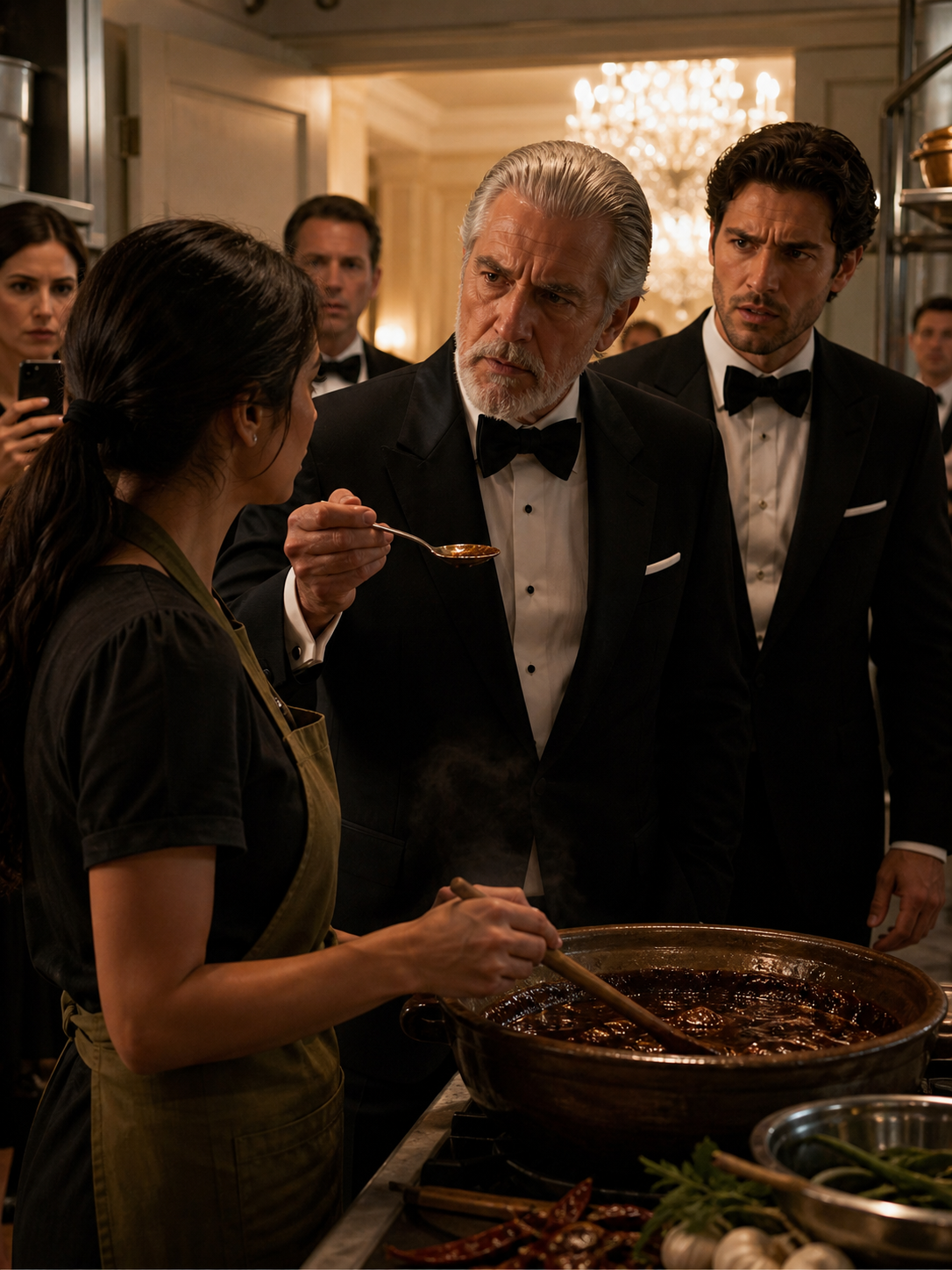
I was still holding the spoon, steam rising between us.
Adrian stood behind him—pale, tense, smiling in a way that no longer held.
Victor dipped the spoon into the pot again, tasted it slowly, then looked at me as if he had just found something he had been searching for his entire life.
“Who taught you to cook like this?” he asked.
The kitchen felt smaller.
Adrian opened his mouth to answer for me.
Victor raised a hand.
Silencing him.
“My grandmother,” I said. “And my mother.”
“Where are you from?”
“A small town.”
“What was your mother’s name?”
Adrian let out a tight laugh. “Sir, maybe we should go back—”
“I told you to be quiet.”
The air went cold.
I looked at my husband.
For the first time, he lowered his head.
And for the first time, I didn’t feel small.
I felt something else.
Justice.
“My mother’s name was Margaret Bennett,” I said.
Victor closed his eyes briefly.
“Margaret…” he whispered.
Not like a name.
Like a wound.
“Your cooking tastes exactly like hers,” he said slowly.
My heart pounded.
“You knew her?”
He looked at me—truly looked at me.
“I loved her,” he said.
The words cut through everything.
Adrian tried to take control again. “This is inappropriate—”
“Because you’ve been stealing from me,” Victor said calmly.
Silence exploded.
A woman stepped forward—Naomi, his assistant—holding a phone.
“We traced the transfers. Fake contracts. Hidden accounts.”
Adrian’s face drained of color.
He looked at me.
And for the first time, I saw fear.
Real fear.
“I love you,” he said suddenly.
But I felt nothing.
“You loved what I gave you,” I said. “You were ashamed of who I was.”
Security entered.
Adrian was escorted out.
No one followed him.
No one defended him.
And I stayed there, still wearing my grandmother’s apron, hands stained, chest burning—not because of him, but because of everything I had silenced for years.
Victor stood in front of me, no longer untouchable.
“I failed your mother,” he said quietly.
“Then you’ll tell me everything,” I replied.
“I will.”
Naomi stepped closer. “You need legal protection immediately.”
I nodded.
For the first time, I wasn’t “the help.”
I was myself.
Victor placed a card on the counter.
“I want to rebuild everything—with you leading it. Your name. Your story.”
Naomi added, “Majority ownership.”
I held the card, my fingers still marked by sauce and memory.
“I don’t want gifts,” I said. “I want the truth. And I want my mother’s name where it belongs.”
“It will be,” he said.
I untied my apron slowly.
Folded it carefully.
Pressed a kiss to it.
And walked out of the kitchen.
Not to serve.
Not to hide.
But to sit.

I walked straight to the table—the same table where I wasn’t meant to exist.
I took the head chair.
Looked at every face watching me.
And said calmly:
“If you’re going to eat what I cooked… you’ll do it looking at me.”
And that night, everyone learned my name.
Lily Bennett.
The woman they tried to hide.
The woman they tried to erase.
The woman who refused to disappear.
Note: This story is a work of fiction inspired by real events. Names, characters, and details have been altered. Any resemblance is coincidental. The author and publisher disclaim accuracy, liability, and responsibility for interpretations or reliance.
