
Stories
For 3 Years I Cried at My Son’s Grave… Until a Stranger Revealed the Terrifying Truth
May
The first thing I saw when I woke up was a white ceiling blurred by tears.
Then came the pain.
It lived everywhere — in my chest, my legs, my skull. Machines beeped around me, and someone whispered my name like they were afraid I might disappear again.
“Emma… can you hear me?”
I turned my head slowly and saw my husband, Daniel. His eyes were red, his face hollow.
And then I remembered.
Rain.
Screaming tires.
My son Oliver in the back seat singing along to the radio.
The truck.
“Oliver?” I croaked.
Daniel broke.
He covered his face with both hands and sobbed so hard his shoulders shook.
That was how I learned my seven-year-old son was dead.
The grief nearly killed me faster than the accident had.
I spent months learning to walk again after the coma. My left leg barely worked. My body healed slowly, but my heart never did. Every morning I woke up expecting to hear Oliver racing down the hallway in dinosaur pajamas.
Instead, there was silence.
Daniel became my caretaker. He cooked, cleaned, helped me through physiotherapy, and every Sunday he drove me to the cemetery.
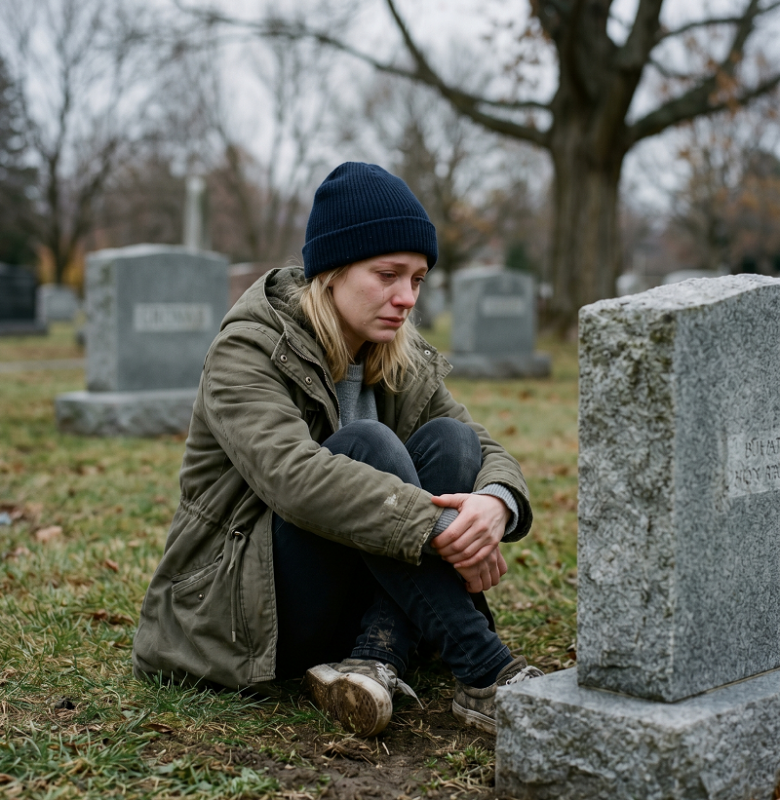
Oliver’s grave sat beneath a maple tree.
Beloved Son. Forever Seven.
I would kneel there for hours, tracing the letters with trembling fingers.
But something always felt wrong.
There were never flowers.
No toys.
No signs that anyone else had visited a little boy’s grave.
Not even Daniel stayed long. He usually stood several feet away with his hands in his pockets, staring at the ground.
Sometimes I would whisper, “Do you think he knows I’m sorry?”
And Daniel would answer too quickly.
“It wasn’t your fault.”
But I could see the blame hiding behind his eyes.
And worse — I blamed myself too.
For three years, I lived like a ghost.
Then one rainy afternoon, everything changed.
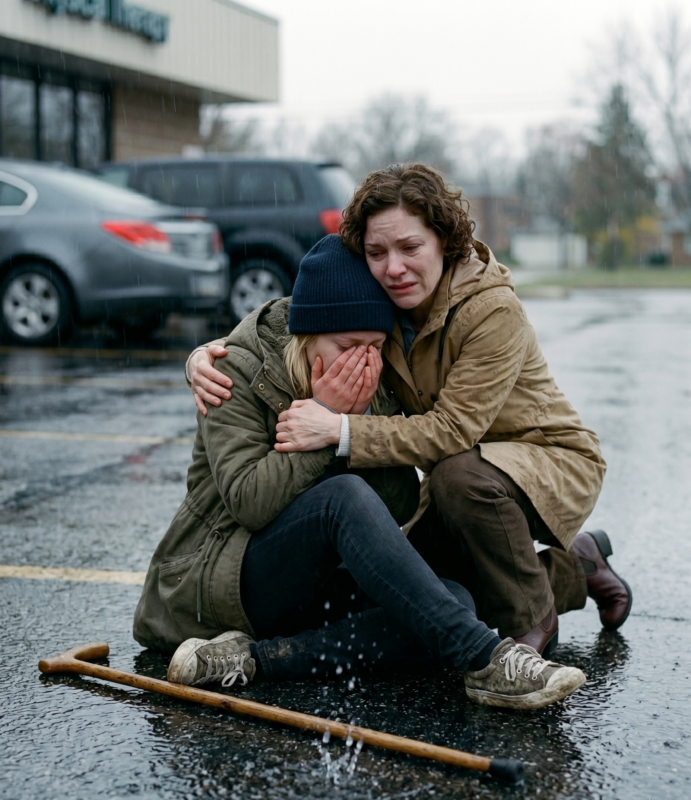
I was leaving physical therapy when a woman approached me in the parking lot. She looked nervous, clutching her purse so tightly her knuckles were white.
“Emma?”
I nodded cautiously.
Tears filled her eyes instantly.
“My name is Claire,” she said softly. “I was a nurse at St. Mary’s Hospital the night of your accident.”
Something about her trembling voice made my stomach tighten.
“I know this is impossible,” she whispered, “but your son survived.”
The world stopped.
I stared at her, unable to breathe.
“No,” I whispered.
“He lived.”
My knees gave out beneath me.
I remember hitting the wet pavement.
I remember screaming.
And I remember Claire crying as she held me.
For nearly an hour, she explained everything.
After the accident, Oliver had survived with only minor injuries. But Daniel had fallen apart emotionally. He blamed me completely for the crash. And when doctors told him I would need months of rehabilitation after waking from the coma, he made a decision on his own.
He sent Oliver away.
Daniel’s sister, Rebecca, lived several hours away in another city. Unable to trust me with our son after the accident, Daniel told everyone — even hospital staff — that it would be better for Oliver to disappear from my life completely while I recovered.
Claire had argued with him.
She had begged him not to do it.
But legally, Daniel was the child’s father. And at the time, I was unconscious and unable to speak for myself.
For years, Claire carried the guilt.
Then one day she saw me at physical therapy.
Alive.
Still grieving a child who wasn’t dead.
“I couldn’t stay silent anymore,” she sobbed. “I’m so sorry.”
I drove home shaking so hard I nearly crashed again.
When Daniel walked through the front door that evening, I was waiting for him.
“You lied to me.”
His face drained of color.
The silence between us felt endless.
Finally, he sat down and buried his face in his hands.
“He was supposed to come back,” he whispered. “Emma, I swear to you… it was temporary.”
I could barely look at him.
“You let me mourn our son for three years.”
Tears streamed down his face.
“You blamed yourself so deeply. You could barely survive physically or emotionally. I thought if I brought Oliver back too soon, you’d break completely.”
“You decided I wasn’t his mother anymore.”
“No,” he cried. “I was terrified. I lost control. I thought I was protecting him.”
I wanted to hate him.
Part of me did.
But another part saw the broken man sitting in front of me — drowning in guilt, fear, and grief just like I had been.
The next morning, I drove to Rebecca’s house.
When she opened the door and saw me, confusion crossed her face.
Then a small voice shouted from inside.
“Aunt Becky, where’s my soccer ball?”
And suddenly there he was.
Oliver.
Taller.
Older.
Alive.
For a moment, neither of us moved.
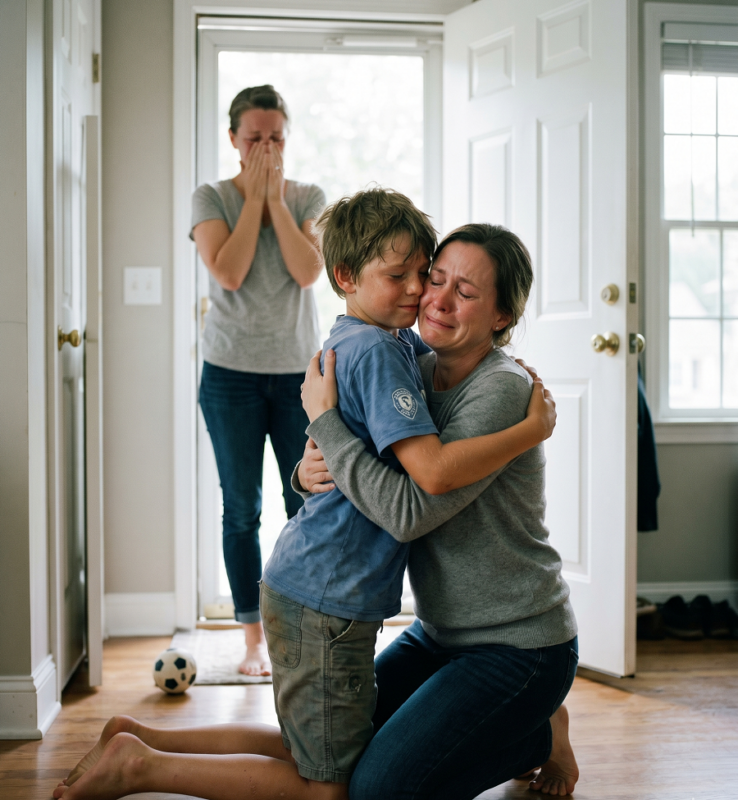
Then his eyes widened.
“Mom?”
I collapsed into tears before he even reached me.
He ran into my arms so hard we both nearly fell.
I held him against my chest, breathing in the scent of shampoo and sunshine and little boy sweat. Real. Warm. Alive.
Rebecca started crying too.
She had no idea Daniel had lied to me. He’d told her I knew everything and agreed Oliver should stay with her while I recovered.
That day shattered us.
But it also rebuilt us.
Today, Oliver is ten years old. He loves soccer, comic books, and terrible knock-knock jokes. Rebecca remains one of the closest people in our lives.
And Daniel?
Forgiveness didn’t happen overnight.
Trust had to be rebuilt piece by piece.
But eventually, I understood something important:
Broken people sometimes make terrible choices while trying to survive impossible pain.
I forgave him not because what he did was acceptable — it wasn’t — but because anger would have poisoned the life we fought so hard to reclaim.
Claire, the nurse who finally told the truth, still sends Oliver birthday cards every year.
She says she isn’t a hero.
But she is.
Because sometimes the greatest act of courage is choosing compassion when silence is easier.
And sometimes, one stranger’s kindness is enough to bring a family back home.
Note: This story is a work of fiction inspired by real events. Names, characters, and details have been altered. Any resemblance is coincidental. The author and publisher disclaim accuracy, liability, and responsibility for interpretations or reliance. All images are for illustration purposes only.
