
Stories
My Sister Vanished 16 Years Ago—Then I Saw Her Jacket at a Gas Station at 2 A.M.
May
I was halfway through a six-hour drive home when exhaustion finally caught up with me.
At 2 a.m., I pulled into a nearly empty gas station just outside a small town I barely noticed on the map. The fluorescent lights buzzed overhead while cold wind pushed wrappers across the pavement. I remember standing there, pumping gas, staring blankly into the dark, thinking only about coffee and sleep.
Then I saw the jacket.
A woman was walking out of the convenience store carrying a paper cup in both hands. She wore an oversized denim jacket with a torn left cuff and a faded sunflower pin near the collar.
My heart stopped.
I knew that jacket.
Amy had worn it everywhere when we were younger. She wore it on camping trips, to concerts, even in family photos. Mom used to beg her to throw it away because the sleeves were frayed beyond repair.
But Amy loved it.
I hadn’t seen that jacket in sixteen years.
Before I even realized what I was doing, I shouted across the parking lot.
“Amy!”
The woman froze.
Slowly, she turned around.
For one impossible second, my heart convinced me it really was her.
But it wasn’t.
This woman was older, thinner, exhausted-looking. Her face carried years of hardship my sister never lived long enough for me to imagine.
Still, when she looked at me, her expression suddenly turned pale, almost frightened.
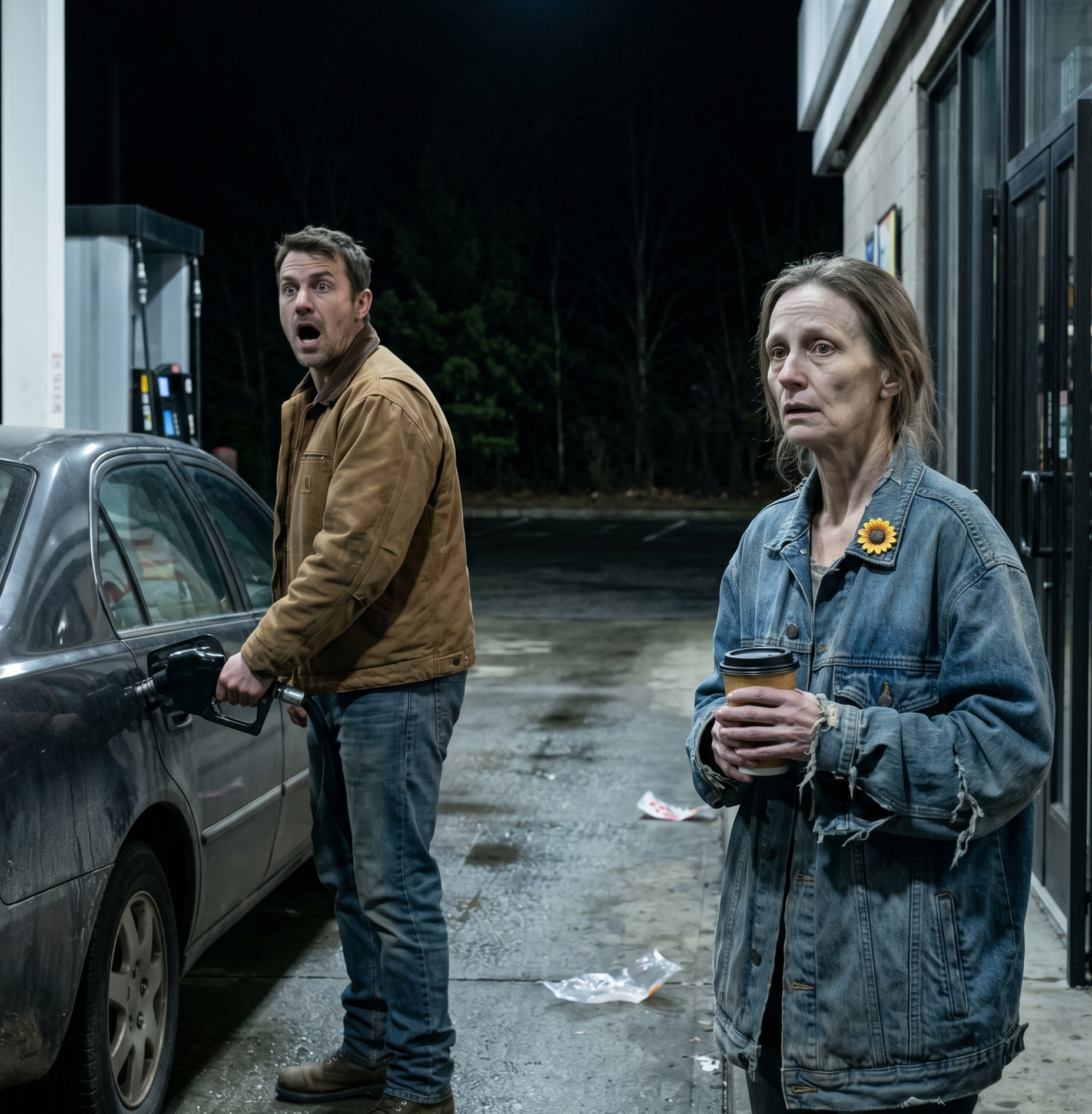
“I’m sorry,” I said quickly, walking toward her. “I thought you were someone else.”
She clutched the jacket tighter around herself.
I stood there shaking, staring at the sunflower pin.
Then my phone buzzed.
It was a text from Mom.
“Your sister would’ve turned 40 today. I lit a candle for her tonight.”
I stared at the screen as guilt crashed over me.
I had forgotten.
After sixteen years of missing posters, police reports, searches, tears, anniversaries, and heartbreak… I had forgotten Amy’s birthday.
The woman started walking away.
Something inside me snapped awake.
“Wait!” I called out.
She stopped again.
“Please… where did you get that jacket?”
For a moment, she just studied me carefully, like she was deciding whether to trust me.
Then her shoulders softened.
“A woman named Amy gave it to me,” she said quietly.
I felt my knees weaken.
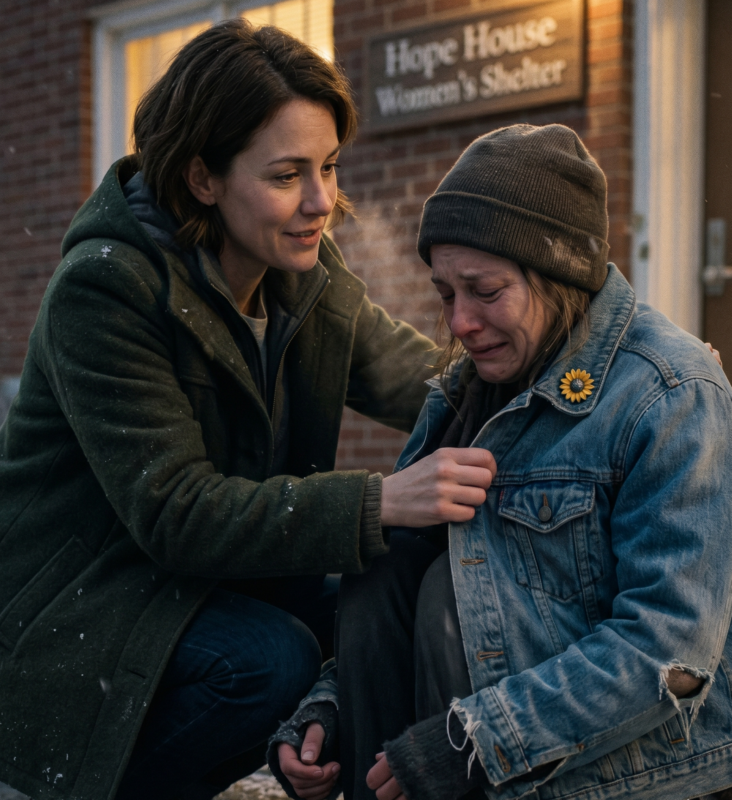
“She volunteered at the women’s shelter downtown every weekend. Three winters ago, I showed up there with nothing except the clothes I was wearing.” She touched the torn sleeve gently. “I was cold, angry, embarrassed… honestly, I didn’t want to keep living.”
Her voice trembled slightly.
“She took this jacket off and wrapped it around me herself. Said someone who loved her once gave it to her. Then she said, ‘Now I’m giving it to you because sometimes surviving is hard enough already.’”
I couldn’t breathe.
“Amy,” I whispered. “My sister’s name was Amy.”
The woman’s eyes widened slowly.
“You’re her family?”
I nodded.
My throat burned.
“Where is she?” I asked. “Please tell me where she is.”
The woman looked down at the coffee in her hands.
Then she said the words that hollowed me out completely.
“She passed away from cancer three years ago.”
The world went silent.
Not missing.
Not hiding.
Gone.
I don’t remember getting back into my car. I only remember driving through empty streets toward the shelter the woman told me about.
The building was small and worn but warm inside. Even at nearly three in the morning, a volunteer welcomed me kindly after hearing Amy’s name.
And there she was.
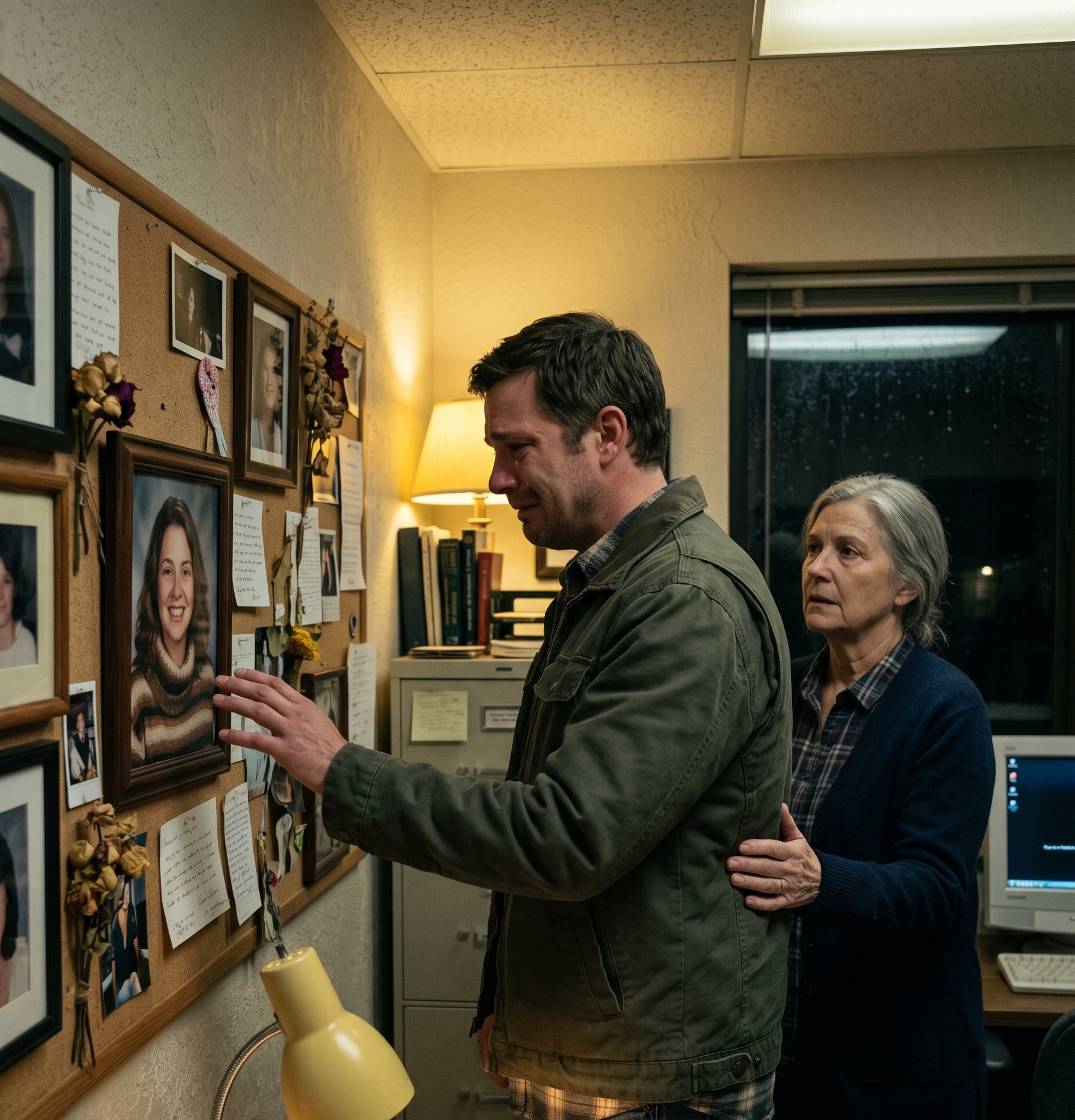
A framed photo on the wall near the front desk.
My sister.
Older than the last time I’d seen her. Her hair was shorter. Tiny lines framed her eyes. But her smile was exactly the same — warm, stubborn, impossible not to love.
I broke down right there in the lobby.
The shelter director sat with me for nearly two hours and told me everything.
Amy had been trapped in a deeply abusive relationship none of us knew about. By the time she escaped, she felt ashamed, broken, and terrified. She believed coming home would only burden us with her pain.
So instead, she disappeared.
She changed cities. Started over with nothing. Eventually she began volunteering at the shelter because she understood the women who arrived there carrying fear in their eyes and bruises hidden under long sleeves.
Then volunteering became her life.
“She saved people here,” the director told me softly. “Not with money or grand gestures. With compassion. She stayed up all night talking women through panic attacks. She helped them find apartments, jobs, childcare. She remembered every birthday. Every child’s name.”
Hundreds of women had passed through those doors.
And somehow, my sister had helped many of them believe life was still worth living.
Before she died, Amy left behind boxes of handwritten letters for women arriving at the shelter after she was gone.
The director handed me one.
On the envelope, in Amy’s handwriting, were the words:
“For anyone who believes they’re too broken to begin again.”
I cried harder than I had in sixteen years.
For so long, I believed my sister vanished because she abandoned us.
But the truth was so much more heartbreaking.
The world had broken her first.
And instead of letting that pain destroy her, she spent the rest of her life helping strangers survive theirs.
I never got to hug my sister again.
I never got to tell her we would’ve welcomed her home no matter what.
But somehow, on her 40th birthday, I found her anyway.
In a denim jacket on a stranger’s back.
In a photograph on a shelter wall.
In the lives she quietly saved long after we lost hope of finding her.
And for the first time in sixteen years, our family finally felt peace.
Wherever you are, Amy… we are so proud of you.
Note: This story is a work of fiction inspired by real events. Names, characters, and details have been altered. Any resemblance is coincidental. The author and publisher disclaim accuracy, liability, and responsibility for interpretations or reliance. All images are for illustration purposes only.
