
Stories
A Homeless Woman Accepted Food From a Little Girl — Then One Sentence Changed Everything
May
Snow fell over the city with the kind of indifference that made people feel smaller.
It buried sidewalks, coated parked cars in white, softened the sharp edges of buildings, and turned the late afternoon streets into something strangely quiet. From inside warm cafés and apartment windows glowing gold against the gray sky, the storm looked almost beautiful.
But beauty felt different when you had nowhere to go.
The woman sitting alone on the narrow park bench near the end of Mercer Street no longer noticed the snow piling onto her shoulders. She had stopped brushing it away nearly an hour ago. Her body had already surrendered to the cold in small ways—first her fingers, then her feet, then the aching stiffness spreading slowly through her back and chest.
Her name was Elara Vance.
At least, it used to be.
Months earlier, people had still said it with warmth. Friends. Neighbors. Someone who once kissed her forehead in the kitchen while coffee brewed in the background. Someone who once promised she would never face the world alone.
But time had a cruel way of stripping names from people.
Especially people who disappeared quietly.
Now most strangers saw only another homeless woman sitting in the snow with worn clothes, trembling hands, and exhaustion carved into every line of her face. No one looked long enough to wonder who she had been before life unraveled around her.
Elara kept her shoulders hunched tightly inward, as if folding herself smaller might somehow protect her from the wind slicing through the torn fabric of her coat. Her shoes had fallen apart weeks ago. Pieces of cardboard inside them did almost nothing against the frozen pavement beneath her feet.
Still, she stayed there.
Because sometimes having nowhere to go becomes easier than searching for places that no longer want you.
People passed constantly without slowing down. Some avoided looking at her entirely. Others glanced for only a second before pretending they hadn’t seen her.
Elara had learned not to blame them.
It hurt less that way.
She stared at the snow gathering near the curb, trying not to think about food, warmth, or memories. Memories were the worst part. Hunger faded after enough time. Cold became familiar.
But memories stayed alive.
And some nights they became unbearable.
She didn’t notice the footsteps at first.
Why would she?
Most footsteps kept moving.
But these stopped directly in front of her.
Elara slowly lifted her head.
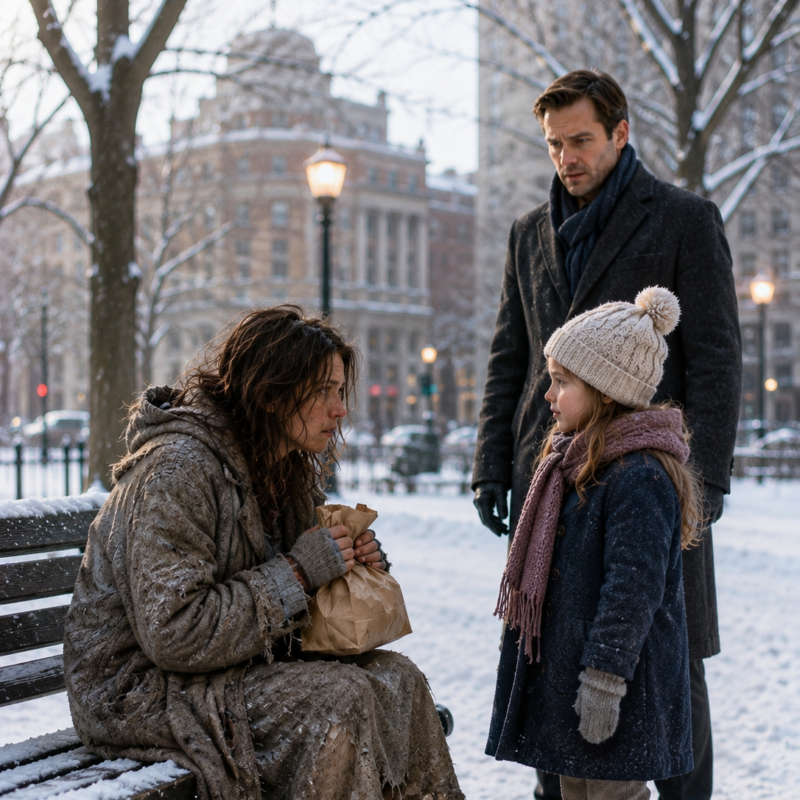
A little girl stood there, no older than seven or eight, wrapped in a bright mustard-yellow coat that looked almost too cheerful against the storm. Snowflakes clung to strands of dark hair peeking out beneath her knitted hat. Her cheeks were pink from the cold, but her eyes were focused entirely on Elara.
Not with fear.
Not with pity.
Just attention.
Behind the girl stood a tall man in a dark wool coat, his hands tucked quietly into his pockets. He stayed several steps back, watching carefully without interfering.
The little girl tilted her head slightly.
“Are you cold?”
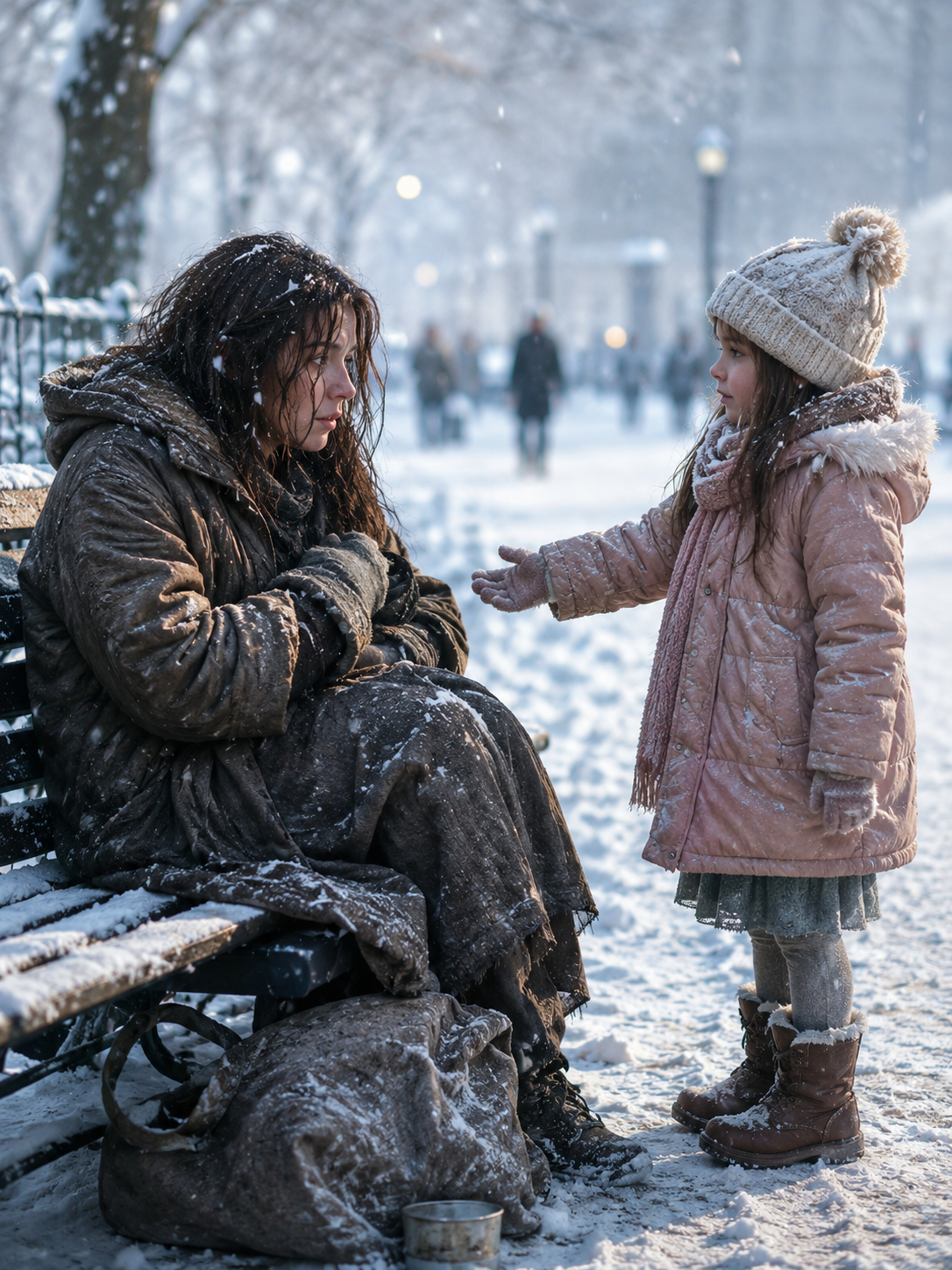
The question was simple.
But something about hearing genuine concern again after so long made Elara’s throat tighten unexpectedly.
For a second, she almost ignored her.
Experience had taught her that kindness rarely stayed. Sometimes it arrived only to satisfy guilt. Sometimes it disappeared the moment things became uncomfortable. Sometimes it came with invisible strings attached.
And Elara had nothing left to give anyone.
Still, the child kept waiting patiently.
“A little,” Elara answered softly at last, though the truth was far worse. “But I’m okay.”
It was the same lie exhausted adults always told children.
I’m fine.
I’m okay.
Don’t worry about me.
The girl studied her face carefully, as though she already understood that adults often hid the truth behind tired smiles and quiet voices.
Then, without another word, she extended a small brown paper bag toward her.
The top had been folded neatly. Warmth still radiated faintly through the paper.
“This is for you,” the girl said firmly. “My dad bought them for me, but you need them more.”
Elara stared at the bag.
The smell reached her first—fresh bread, something warm, maybe soup inside a sealed container. Real food. Hot food.
Her stomach twisted painfully.
For one humiliating second, she nearly cried.
Not because of the food itself.
Because someone had thought she mattered enough to give it.
Her fingers hovered uncertainly in the air. Accepting help should not have felt so difficult, yet something deep inside her resisted automatically. Pride didn’t disappear easily, even after life destroyed everything else.
“You should keep it,” Elara murmured weakly. “It’s freezing out here.”
“I know,” the little girl replied. “That’s why you need it.”
The answer was so innocent. So direct.
No judgment.
No hesitation.
No performance.
Just kindness.
Slowly, Elara reached forward and took the bag.
Their hands touched briefly.
The contrast startled her instantly—the girl’s gloved warmth against Elara’s freezing skin. The contact lasted less than a second, yet it shook something loose inside her chest that had been numb for far too long.
“Thank you,” she whispered.
The words came out unsteady.
The girl smiled softly, as though gratitude wasn’t necessary.
Behind her, the man still said nothing.
Elara glanced at him only briefly. Tall. Calm. Maybe mid-thirties. Dark hair dusted lightly with snow. There was something familiar in the shape of his eyes, though she couldn’t place why.
He didn’t move closer.
Didn’t interrupt.
Didn’t rush the moment.
And somehow that silence carried more respect than most conversations she’d experienced in years.
Elara lowered her gaze to the bag in her lap, allowing its warmth to spread slowly into her frozen fingers. For the first time all day, she felt something dangerously close to comfort.
Then the girl spoke again.
“You need a home,” she said quietly.
Elara looked up.
“And I need a mom.”
The words hit her harder than the winter wind ever could.
Everything inside her froze.
The street noise faded.
Even the falling snow seemed distant for one impossible second.
Elara stared at the child, certain she must have misunderstood.
“What?” she breathed.
But the girl didn’t laugh or look embarrassed. She remained completely serious, standing there with small snow-covered boots planted firmly in front of the bench.
The man behind her shifted almost imperceptibly, yet still he said nothing.
Elara’s chest tightened painfully.
Children sometimes said strange things. Random things. But this didn’t feel random.
It felt personal.
The girl took one tiny step closer.
“My dad gets sad sometimes,” she said softly. “Especially at night.”
Elara swallowed hard.
“And when he thinks I’m asleep,” the girl continued, “he still looks at your picture.”
The air left Elara’s lungs slowly.
A strange ringing filled her ears.
No.
Impossible.
The child studied her face carefully, almost nervously now, as though she realized the conversation had suddenly become important in a way she didn’t fully understand.
Then came the sentence that shattered what little composure Elara still had.
“He still keeps your blue scarf.”
The world tilted.
Not dramatically.
Not loudly.
But deep inside her chest, something cracked open so suddenly it hurt to breathe.
The blue scarf.
Her scarf.
A flood of memories slammed into her all at once—cold mornings wrapped in navy wool, laughter near a train station café, fingers intertwined beneath winter gloves, a man smiling at her across crowded streets as though she had always been the easiest person in the world to find.
Gabriel.
The name surfaced violently in her mind after months buried beneath grief, exhaustion, and survival.
Elara’s trembling hands tightened around the paper bag.
Slowly—almost afraid to—she lifted her eyes toward the silent man standing behind the little girl.
And truly looked at him for the first time.
The years had changed him.
There were faint lines near his eyes now. More weight in his expression. A sadness that hadn’t existed before.
But it was him.
Gabriel Hart.
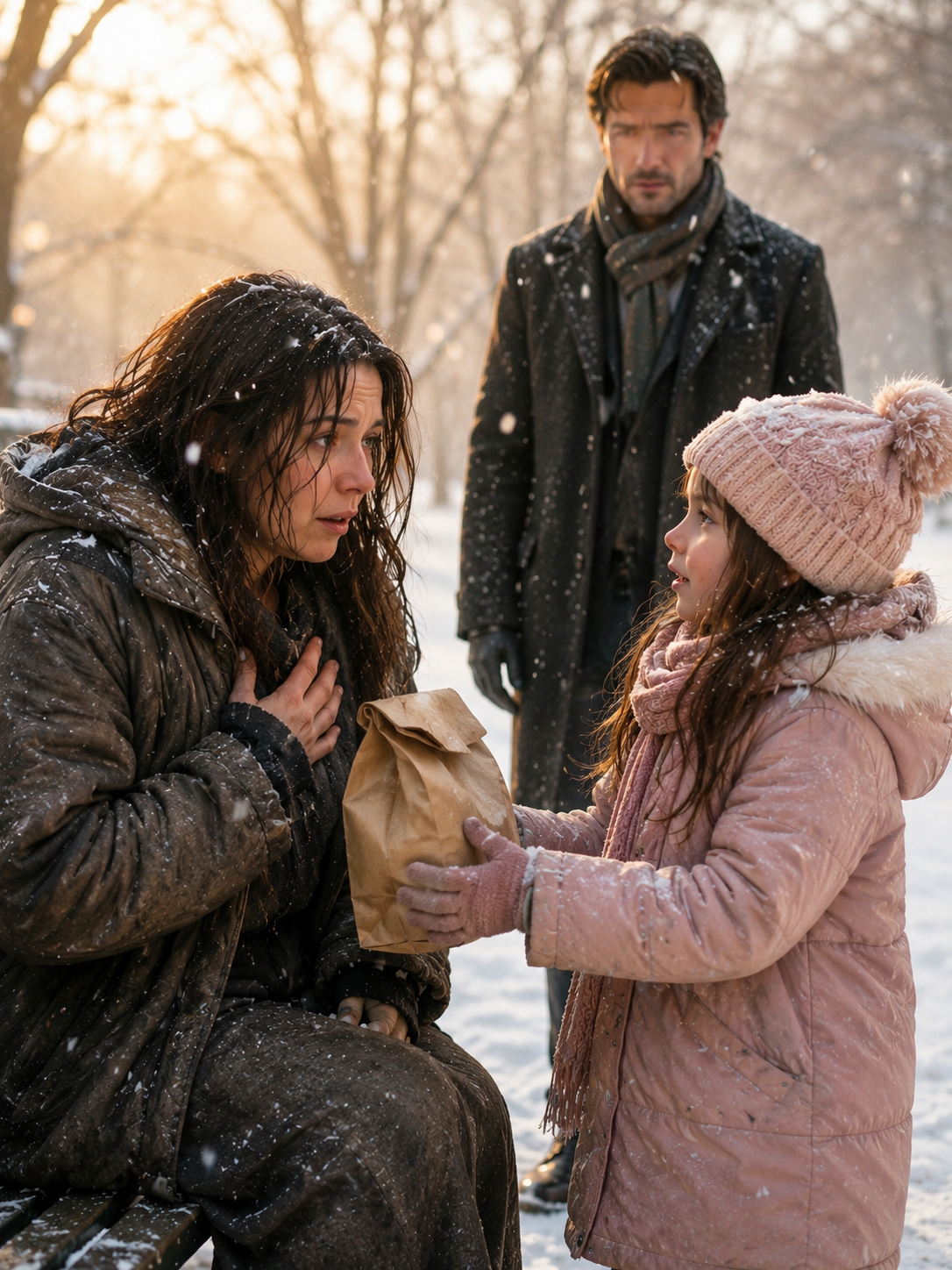
The man she once planned to marry.
The man she disappeared from.
The man she thought had forgotten her long ago.
Their eyes locked.
Neither spoke.
For a moment, neither seemed capable of it.
Gabriel’s face remained controlled, but emotion flickered unmistakably behind his eyes—shock, pain, disbelief, and something else buried even deeper.
Hope.
Elara’s pulse pounded painfully in her ears.
She remembered the last time she had seen him. The hospital bills. The debt collectors. The panic attacks. The collapse of everything she thought she could handle alone.
She had left because she believed ruining her own life was easier than ruining his too.
And then one terrible decision became another.
Weeks turned into months.
Months became years.
And shame kept her away long after pride should have died.
Gabriel finally stepped forward.
Not too close.
Just enough.
“Elara,” he said quietly.
Hearing her name in his voice again nearly broke her.
She looked away immediately, ashamed of everything he was seeing—the torn coat, the hollow cheeks, the exhaustion she could no longer hide.
“You shouldn’t see me like this,” she whispered.
Gabriel’s expression tightened instantly.
“Then how should I have seen you?” he asked softly. “At your funeral?”
The words sliced through her.
The little girl looked between them, confused but sensing the emotion surrounding her.
“I told you she was real,” she said proudly to her father, as though she had solved a mystery no adult could.
Gabriel let out a breath that almost sounded like a laugh, though grief sat heavily beneath it.
“You did,” he murmured.
Elara blinked rapidly, trying to steady herself.
“How long?” she asked weakly. “How long have you been looking?”
Gabriel stared at her for several seconds before answering.
“Long enough to stop believing coincidence existed.”
Snow continued drifting around them.
Cars moved slowly through the street nearby.
Somewhere in the distance, a siren echoed faintly through the city.
But on that bench, time felt suspended.
“I searched for you for almost two years,” Gabriel admitted. “After you vanished, nobody knew where you went. Your landlord said you disappeared overnight. Your phone was disconnected. Your friends hadn’t heard from you.”
Elara lowered her eyes.
“I thought you hated me.”
Gabriel’s face hardened instantly.
“Hated you?” he repeated quietly. “Elara, I thought you were dead.”
The little girl’s expression fell.
Her small hand slowly slipped into her father’s.
Elara suddenly looked painfully fragile sitting there beneath the snow, like someone carrying years of punishment no one else could see.
“I lost everything,” she whispered. “After the hospital… after the debts… I couldn’t keep up anymore. I kept thinking I’d fix things before coming back.”
Gabriel listened silently.
“But things kept getting worse,” she continued shakily. “And after a while… I didn’t know how to return without becoming another burden in your life.”
For the first time since arriving, Gabriel’s composure cracked.
“A burden?” His voice broke slightly. “You think loving you was a burden?”
Elara’s eyes filled instantly.
She looked away before tears could fall.
The little girl squeezed Gabriel’s hand tighter, then slowly stepped toward Elara again.
“You can come home with us,” she said gently, as though the solution were obvious. “Dad still makes too much pasta anyway.”
A broken laugh escaped Elara before she could stop it.
It turned quickly into quiet sobbing.
Not loud.
Not dramatic.
Just the exhausted kind that comes from holding pain inside for too many years.
Gabriel moved closer carefully this time.
“Elara,” he said softly, kneeling slightly in front of her, “look at me.”
She hesitated.
Then finally did.
“You were never forgotten,” he said. “Not for one day.”
The words destroyed whatever walls she still had left.
Because surviving hardship was one thing.
Being remembered through it was another entirely.
Elara covered her mouth as tears spilled freely down her face.
For years, she had convinced herself she had disappeared from everyone’s life.
That she had become invisible.
Disposable.
Gone.
But standing there in the snow was proof that somewhere, somehow, someone had continued carrying her memory long after she stopped believing she deserved one.
The little girl smiled gently and reached for Elara’s freezing hand again.
This time, Elara held on.
And as the storm continued falling quietly around them, something warmer than the paper bag in her lap finally began finding its way back into a heart that had spent far too long believing it no longer belonged anywhere at all.
Note: This story is a work of fiction inspired by real events. Names, characters, and details have been altered. Any resemblance is coincidental. The author and publisher disclaim accuracy, liability, and responsibility for interpretations or reliance. All images are for illustration purposes only.
