
Stories
We Adopted a 10-Year-Old Girl—Then My Father Saw Her Bracelet and Turned Pale
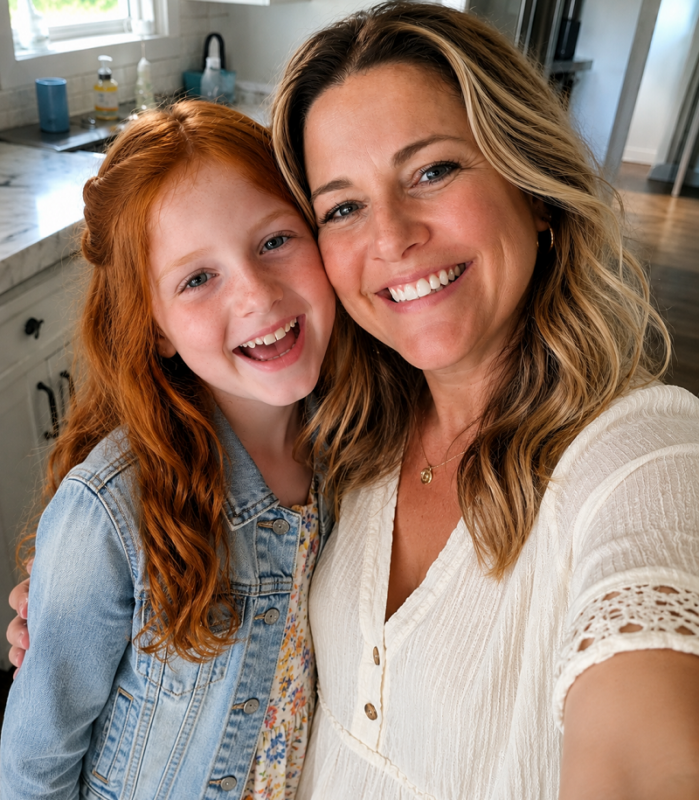
May
After eight painful years of infertility, I believed the worst heartbreak was already behind me. My husband, Ben, and I had endured endless doctor appointments, failed treatments, and the slow exhaustion that comes from hoping too long. Eventually, I stopped imagining a child in our home because it hurt less that way.
Then one evening, after another silent dinner filled with disappointment, Ben looked at me and quietly said, “What if our child is already somewhere out there, waiting for us?”
That single sentence changed everything.
Soon after, we began the foster-to-adopt process. We completed the classes, the background checks, the interviews, and the home studies. Visiting the children’s home was only supposed to be another step in a long journey.
Instead, it became the moment our lives truly began.
Ben and I arrived carrying toys, stuffed animals, and treats for the children. The younger kids immediately ran toward us, laughing and reaching for candy and attention. Ben smiled easily among them while I fought back tears.
And then I noticed her.
She sat quietly near a window, apart from the others. She looked older—about ten years old—and far more reserved than the rest. Her hands rested neatly in her lap, and she watched everything carefully without asking for anything.
I walked over and knelt beside her.
“Don’t you want to choose something?” I asked gently.
She glanced at the younger children before answering softly, “I’m older. The little ones should have them first. They need them more than I do. There’s already so little here.”
That was the moment my heart shifted.
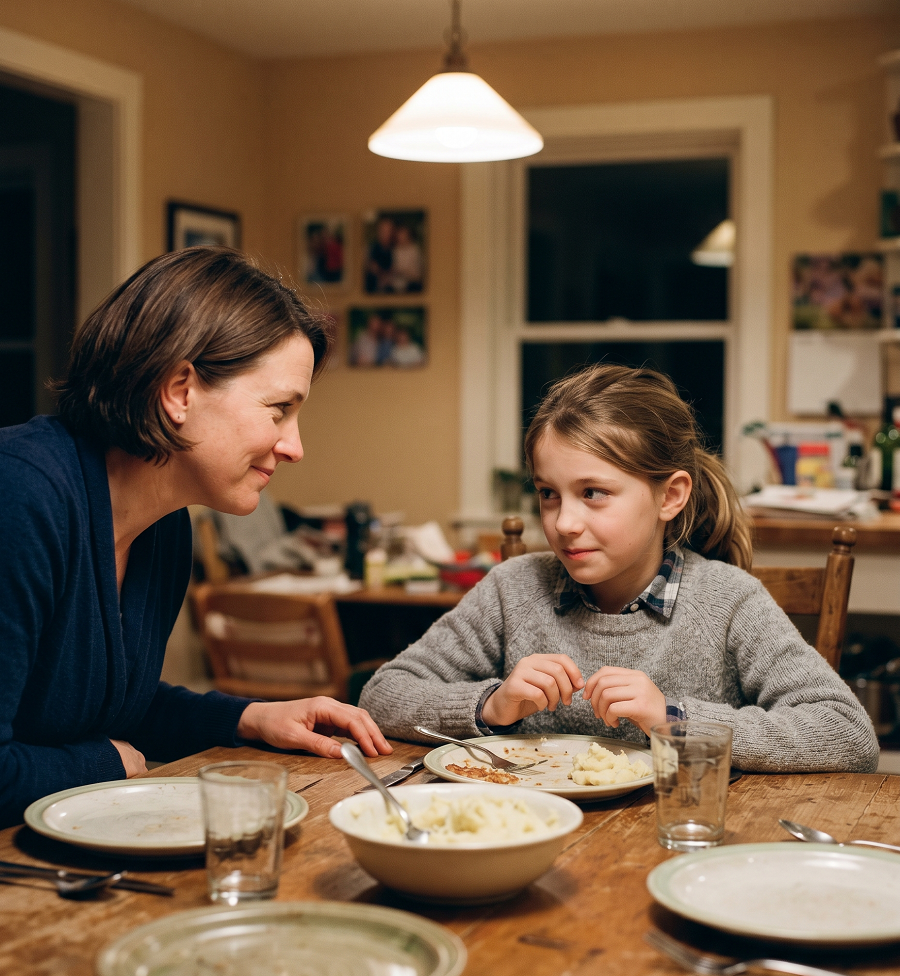
Six weeks later, she came home with us as our foster-to-adopt placement.
Her name was Lily.
I fell in love with her faster than I ever expected. There was something heartbreaking about how careful she was with everything. She folded her clothes into perfect stacks. She thanked me for every meal. She even hesitated before taking a second helping of food.
One night, when she quietly asked permission for more potatoes, I smiled and told her, “You never have to ask for more food in your own home.”
She stared at me in confusion, as if she didn’t fully understand the idea of belonging somewhere.
Then she whispered, “Oh.”
A month later, Ben and I hosted a family dinner so everyone could meet her. Lily was nervous the entire afternoon, smoothing her skirt again and again.
“What if they don’t like me?” she asked quietly.
I touched her cheek and said, “Then they’ll have to answer to me.”
That finally made her smile.
The evening started beautifully. My relatives welcomed her warmly. My aunt kept offering her extra bread rolls, and my cousin’s daughter Ava promised to show Lily the upstairs game room if she felt overwhelmed.
Then my father arrived late.
He apologized about traffic, kissed my cheek, and followed me into the living room.
“Dad,” I said happily, “this is Lily.”
Lily stood politely. “Nice to meet you, sir.”
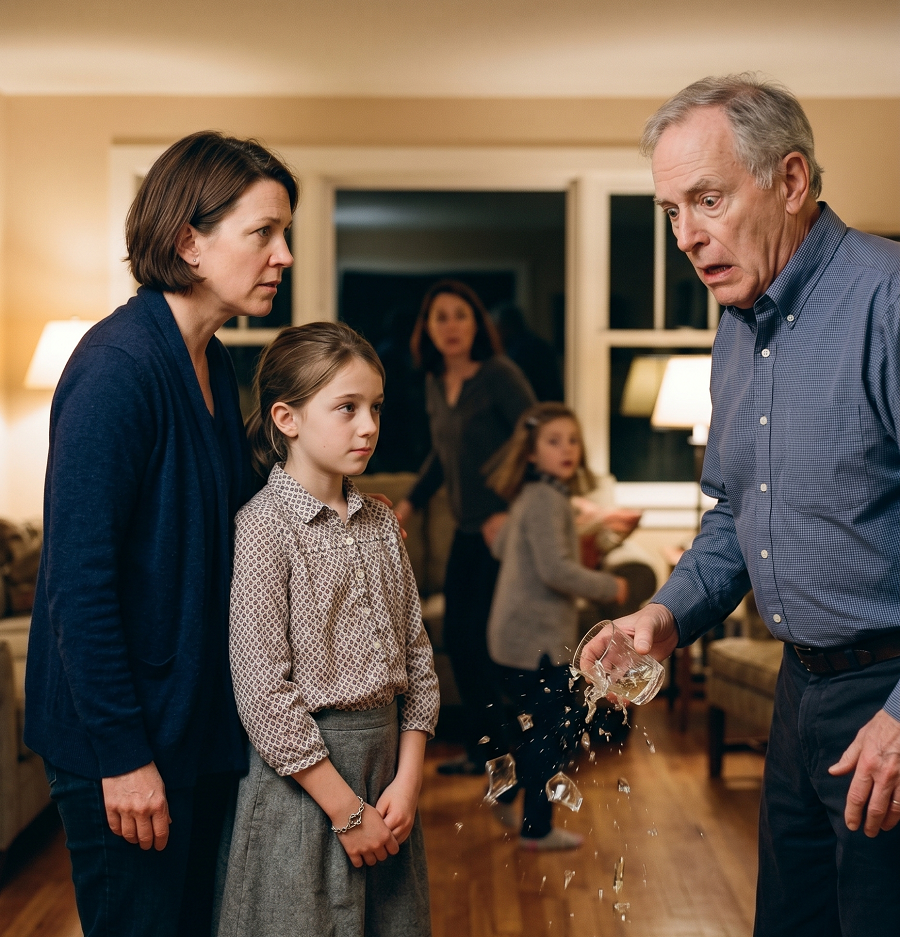
My father looked at her face.
Then his eyes dropped to her wrist.
The glass in his hand slipped and shattered against the floor.
Everyone jumped.
“Dad?” I asked. “Are you okay?”
But he wasn’t okay.
He looked terrified.
Not confused. Not angry. Terrified.
After a long moment, he said quietly, “I need to speak with you. Now. Away from her.”
The entire room fell silent.
Ben immediately stepped forward. “Ava, could you take Lily upstairs for a little while?”
Ava nodded and gently led Lily away.
I pulled my father into the kitchen and shut the door behind us.
“What is going on?” I demanded.
He looked pale.
Five years earlier, he explained, he had volunteered at a small chapel that sometimes handled burial services for children in state care—children who had no family to claim them.
“There was one little girl,” he said shakily. “Around five years old. Hardly anyone attended. Just me, the chapel director, and a worker from the children’s home.”
I stared at him. “What does that have to do with Lily?”
He swallowed hard.
“At first, I thought it was only a resemblance. But then I saw the bracelet.”
My stomach tightened.
“What bracelet?”
“The silver bracelet with the flower charm,” he whispered. “The social worker said it belonged to the little girl who died.”
I barely slept that night.
The next morning, I sat beside Lily on her bed and carefully asked about the bracelet she always wore.
She touched it automatically.
“I’ve had it as long as I can remember,” she said.
When I examined it closely, I noticed a tiny engraved letter inside the charm.
Not L.
M.
I immediately contacted the children’s home and demanded Lily’s complete records.
At first, the director insisted we already had everything.
But when I mentioned the bracelet and the county my father remembered, her voice changed instantly.
“Come in person,” she said quietly.
Ben drove us there while I studied Lily’s paperwork more carefully than ever before. The records were filled with strange gaps. Missing dates. Incomplete transfers. Contradictory information.
One page called her Lily.
Another older document had a different name partially crossed out:
Mara.
That was the moment we hired an attorney.
At the children’s home, the director finally admitted she had noticed inconsistencies years earlier but had been told the records were “sufficient.” The person who approved everything was a caseworker named Diane.
My father froze.
“Diane was there at the burial,” he whispered.
Two days later, our attorney gained access to dependency records from the county.
What we discovered changed everything.
Five years earlier, a child named Mara had officially been recorded as dead during a severe illness outbreak at a poorly managed children’s home.
Three months later, a child named Lily suddenly appeared in another county using incomplete transferred records.
Same birth year.
Same scar beneath the chin.
Same child.
When Lily saw the old intake photograph, she whispered in disbelief:
“That’s me.”
Our attorney eventually located Diane living alone in a small apartment above a laundromat.
When she opened the door and saw Lily standing there, her entire face crumbled.
“You shouldn’t be here,” she whispered.
Ben answered firmly, “She deserved the truth years ago.”
Inside the apartment, Diane finally confessed.
Years earlier, the children’s home had been collapsing under neglect and investigations. During a disease outbreak, another little girl died. Records became chaotic. In the confusion, Mara’s file was mistakenly closed as deceased.
But instead of correcting the mistake, Diane panicked.
Afraid Mara would disappear into endless hearings and unstable emergency placements, she secretly transferred her using an abandoned file from another child named Lily.
“You let a living child remain legally dead?” I asked in horror.
Diane burst into tears.
“I thought I was protecting her.”
“You erased her,” I said.
Then Lily quietly asked the question that silenced the room.
“What was my real name?”
Diane looked at her through tears.
“Mara,” she whispered. “Your mother named you Mara.”
Lily blinked.
“I had a mother?”
“Yes,” Diane said softly. “And she loved you very much.”
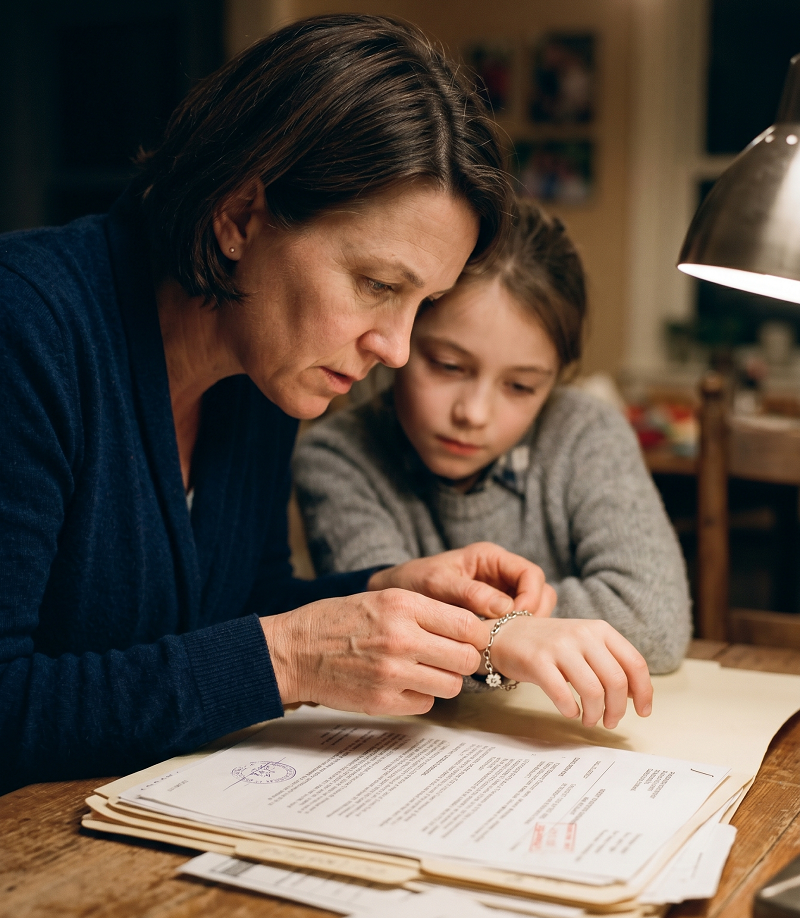
From that moment forward, our lives became consumed with searching for the truth.
We turned our dining room table into a mountain of paperwork, notes, timelines, and photographs. Lily helped too, offering tiny memories whenever they surfaced.
A yellow kitchen.
Cinnamon toast.
A song about sunshine.
A woman wearing red work shoes.
One clue eventually led us to an old neighbor who remembered Lily’s mother working at a diner.
Her name was Nora.
We found her living two states away.
I went alone first.
When I showed Nora a recent photo of Lily, her hands began shaking. But when I showed her the silver bracelet, she nearly dropped the coffee pot she was holding.
“Where did you get that?” she whispered.
Carefully, I said, “I think your daughter may still be alive.”
Nora stared at me in complete shock before tears filled her eyes.
“They told me she died,” she whispered brokenly.
Two days later, Nora met Lily.
It wasn’t dramatic like the movies. Nobody ran into anyone’s arms.
Lily stayed close to me and Ben.
Nora stood several feet away, crying quietly.
“I’m not here to take you away from your family,” she said softly. “I only wanted to see your face again.”
Then Lily asked the question that shattered every heart in the room.
“Did you look for me?”
Nora broke down completely.
“Every single day,” she cried. “Until they convinced me there was nowhere left to look.”
I started crying too.
So did Ben.
But Nora did something extraordinary after that.
Despite everything stolen from her, she told the court:
“I want my daughter to have her truth back. But I don’t want to destroy the life she has now.”
Because of that, our adoption was allowed to continue. Nora received legal contact rights and slowly became part of Lily’s life again.
Later, when the judge asked what name she wanted on her corrected records, Lily answered:
“I want to stay Lily.”
Then she paused before adding softly:
“But I want Mara too.”
So Mara became her middle name.
Today, my father keeps a small wooden memory box he made for her by hand. Inside are her bracelet, her corrected birth records, and a family photograph of all of us together—me, Ben, Lily, Nora, and Grandpa.
A year later, we returned to the children’s home carrying toys and treats.
This time, Lily didn’t sit quietly by the window.
Instead, she walked directly toward an older boy sitting alone.
“Why aren’t you getting anything?” she asked him gently.
He shrugged.
“I’m too old. The little kids should go first.”
Lily smiled warmly and placed a stuffed bear in his hands.
“That’s what I used to think too,” she told him. “But sometimes the thing meant for you is just waiting until you’re ready to reach for it.”
Standing in the doorway beside Ben, watching her comfort that lonely little boy, I finally understood something I never knew before.
I used to believe becoming a mother meant choosing a child.
Now I understand the truth.
Sometimes your heart doesn’t choose at all.
Sometimes it simply recognizes the person it has been searching for all along.
Note: This story is a work of fiction inspired by real events. Names, characters, and details have been altered. Any resemblance is coincidental. The author and publisher disclaim accuracy, liability, and responsibility for interpretations or reliance. All images are for illustration purposes only.
