
Stories
“This is what happens when you disobey me.” Six years later, I showed him what happens next
Apr
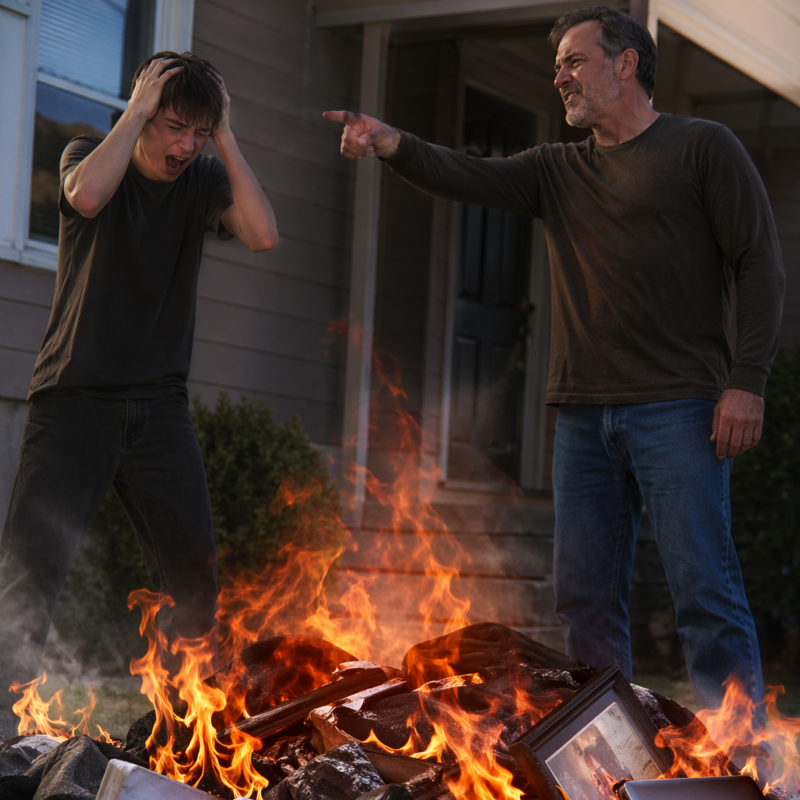
I was nineteen when my father burned my life in our backyard.
Not just a few things—everything.
Clothes, notebooks, work boots, the old coffee mug that belonged to my mom, the framed photo from my graduation, even the secondhand laptop I had paid for with long days roofing in the summer heat. He dragged it all into a metal barrel behind our house in Dayton, Ohio, and set it on fire like he was purifying something.
“This is what happens when you disobey me,” he repeated.
I watched the flames rise and stayed silent.
The argument had started because I told him I was leaving. I had been accepted into a trade program in Columbus and already secured a part-time job with a construction crew. But my father, Walter Hayes, had other plans. In his mind, I wasn’t a son with a future—I was labor that belonged to him.
He couldn’t stand that I made a decision without asking. What angered him more was that I didn’t back down. He called me selfish, weak, stupid, ungrateful. When words didn’t break me, he turned to humiliation.
I remember everything too clearly—the suffocating heat, the crackle of burning paper, the smell of melting plastic, the metallic clink of my belt buckle hitting the barrel. He stood there with his arms crossed, as if he were teaching a lesson instead of destroying what little I had.
What he didn’t know was that I had already moved the only things that mattered earlier that day—my documents, the money I’d saved, and my acceptance letter tucked inside a manila envelope in the trunk of my friend Nate’s car.
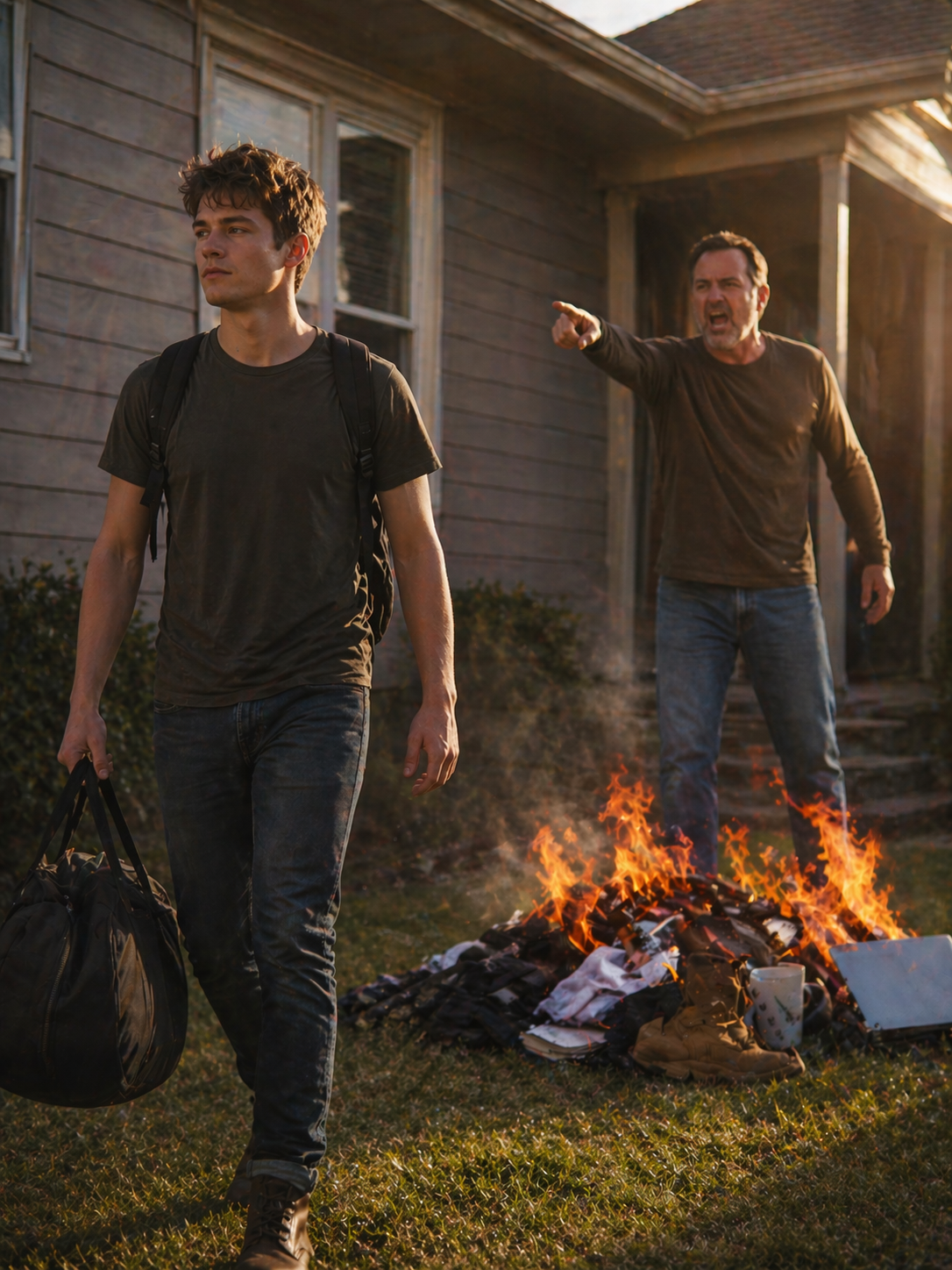
So when the fire burned out, I pulled out my phone, called Nate, and asked him to come get me.
My father laughed when he heard.
“You walk out that door,” he said, stepping close enough for me to smell the beer on his breath, “you don’t come back.”
That was the moment I finally looked him in the eye.
Six years later, I called him and said,
“Check your mailbox.”
That photo didn’t come from revenge alone.
It came from a promise I made to myself that night—standing in front of that fire—that if I ever had power, I would never use it the way he did.
Nate picked me up with nothing but a backpack, forty-three dollars, and that envelope from his trunk. I slept on his cousin’s couch for two weeks before the program began. During the day, I worked demolition for a contractor who hired kids nobody else would. At night, I studied estimating, safety, and scheduling.
I learned fast because I had to.
The first year was survival—rent, food, gas, tuition. I bought cheap jeans, discounted boots, and said yes to every job. Winter framing, spring roofing, summer drywall in brutal heat. I paid attention—who knew their craft and who only knew how to shout.
By twenty-two, I was leading small crews. By twenty-four, I had my contractor’s license and a used pickup with my company name on the side:
Hayes Restoration & Build.
I kept the last name. Not to honor him—but to redefine it.
People trusted me because I showed up, finished clean work, and treated everyone with respect. A retired couple recommended me to a realtor. That realtor connected me to an investor. The investor gave me properties nobody wanted—damaged, neglected, falling apart.
I took the worst jobs and made them work.
It wasn’t overnight success. Most years felt like dragging myself forward one invoice at a time. But things changed—slowly. Two employees became five. A small office opened. Credit built. I learned auctions, liens, taxes, and how pride can cost someone their home.
I never heard from my father directly.
Only through neighbors and public records.
At first, he told people I had failed. Then he said I disappeared. Eventually, no one asked anymore. Meanwhile, he missed tax payments, borrowed against the house, and let it decay. The man who once ruled that home couldn’t keep it standing.
The auction listing appeared on a rainy Thursday morning.
Address. Parcel number. Minimum bid.
I stared at the screen for a long time.
What I felt wasn’t happiness.
It was something colder.
The realization that the moment he used to break me had come full circle.
This time, I held the match.
The auction took place in a dull county room—fluorescent lights, metal chairs, stale coffee. Only six bidders showed up. To them, the house was just another damaged asset.
To me, it was every slammed door, every insult, every silent dinner, every night I dreamed of leaving.
The bidding started low. One investor dropped out quickly. Another hesitated over repair costs and liens. I stayed steady—I had already done the math.
Financially, it made sense.
Emotionally… it was something else.
When the hammer fell, no one reacted.
But I did.
Not outwardly. I signed the papers, shook hands, and walked out to my truck. I sat there for a full minute, letting it sink in.
I owned the house.
Not because life was fair.
Not because he gave me anything.
Because I left, worked, learned, failed, adapted—and kept going long after anger stopped being useful.
I drove back to Dayton that afternoon.
The house looked smaller. The porch leaned. The paint had faded. The backyard—the same place he burned everything—was patchy and lifeless.
I stood there, set my phone on the hood, and took a photo.
Then I called him.
He answered on the fourth ring. “What?”
I said,
“Check your mailbox.”
And hung up.
I mailed the photo. No note. No explanation.
Just the image—me standing in front of the house, keys in hand.
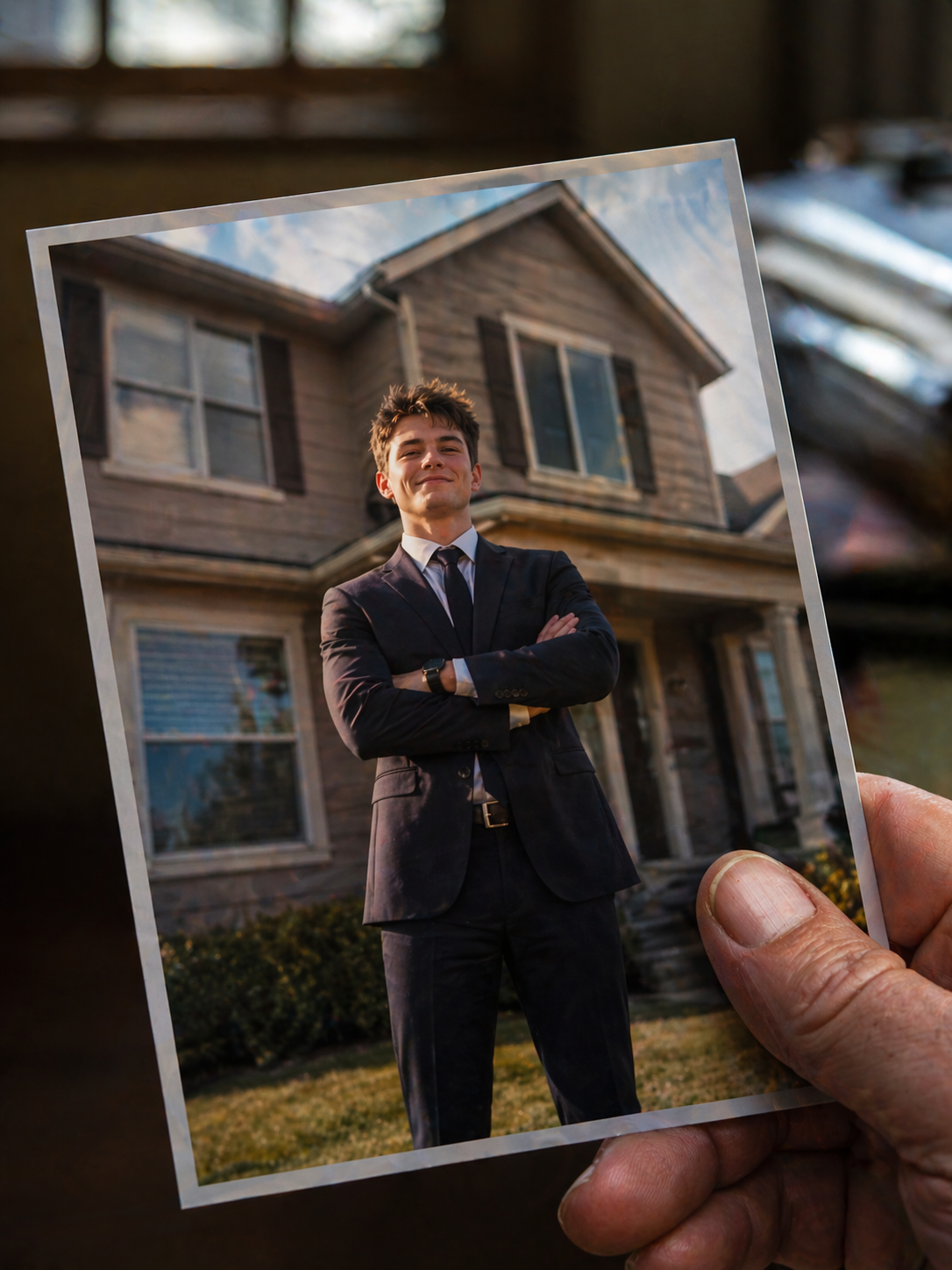
A fact. Not a threat.
I didn’t throw him out immediately. There was a legal process, and I followed it. That mattered. I wasn’t going to become him with better paperwork.
When he finally called back—furious, breath shaking—I let him speak until there was nothing left.
Then I said the only thing I had waited six years to say:
“You showed me what power looks like in the wrong hands. Thank you for teaching me what never to become.”
A month later, he was gone.
I renovated the house, sold it, and used the profit to help repair transitional housing for young people aging out of foster care.
It felt better than revenge.
Cleaner.
Final.
Some people believe the best ending is making someone suffer the way they made you suffer.
I used to think that too.
Now I see it differently.
The real victory is building a life so strong that their worst moment becomes part of your foundation—not your future.
If this story hit something real for you, what matters more—revenge, closure, or rebuilding?
Note: This story is a work of fiction inspired by real events. Names, characters, and details have been altered. Any resemblance is coincidental. The author and publisher disclaim accuracy, liability, and responsibility for interpretations or reliance.
