
Stories
My Husband Left Me Alone In Labor To Go Party — What His Elderly Grandmother Did When He Returned Shocked Everyone

May
When I found out I was pregnant only weeks after graduating high school, I was terrified.
Not because I didn’t want the baby.
But because suddenly, the future felt enormous—and I had nobody left to help me carry it.
My parents had both died when I was younger. By eighteen, grief already felt like a permanent roommate sitting quietly in every corner of my life. So when Jack looked at me with wide eyes after I showed him the pregnancy test and said, “Marry me,” I clung to those words harder than I probably should have.
I thought love meant safety.
I thought marriage meant someone would stay.
At the time, Jack felt like the only family I had left in the world.
We got married quickly. No big wedding. No honeymoon. Just paperwork, borrowed clothes, nervous smiles, and promises we were far too young to understand.
Afterward, we moved into his grandmother Rose’s house.
Rose was ninety years old, sharp-minded, silver-haired, and impossible to fool. She walked slowly with a cane but somehow noticed everything—every unpaid bill, every lie, every mood shift before either of us even spoke.
“We’ll help each other,” she told me warmly when I moved in. “That’s what family is supposed to do.”
We didn’t have money for our own place, and she insisted we stay while preparing for the baby.
Jack always treated the house like it was already his.
As her only grandson, he assumed one day everything inside those walls would belong to him anyway.
At first, life almost felt normal.
Not perfect.
But manageable.
Jack had always been immature, though I kept convincing myself it wasn’t serious. He forgot bills constantly. Left dishes everywhere. Promised to fix things and never did. Some nights he came home so late I’d already fallen asleep on the couch waiting for him.
But every time I got upset, he’d flash that easy smile and wrap his arms around me.
“You knew I wasn’t perfect when you married me,” he’d joke.
And somehow, I always let it go.
Because I was pregnant.
Because I was scared.
Because I needed to believe becoming a father would change him.
Everyone said men grew up once the baby arrived.
I held onto that sentence like a lifeline.
Then the day before my due date, everything cracked apart.
I came home exhausted from my final prenatal appointment, my back aching so badly I could barely stand upright.
The house was quiet.
Too quiet.
No television.
No music.
No Jack.

At first I assumed he’d gone to the store.
Then I noticed the folded piece of paper sitting on the kitchen counter.
My stomach tightened before I even opened it.
The note was short.
Casual.
Cruel in the most effortless way possible.
It said he’d gone away with friends for a few days because he needed “time to clear his head.” He mentioned that he’d asked Rose to check on me if I needed anything.
Then, at the bottom, almost like an afterthought, he wrote:
Try not to go into labor without me lol.
I stared at the note for a long time.
My hands started shaking.
At first I couldn’t even process what I was reading.
Then came the anger.
Hot.
Humiliating.
Sharp enough to make my chest hurt.
I grabbed my phone and called him immediately.
No answer.
I called again.
Straight to voicemail.
Again.
Voicemail.
I sent text after text.
I’m due tomorrow.
Where are you?
Are you serious right now?
Jack, answer me.
Nothing.
Hours passed.
Nothing.
I sat alone in the kitchen staring at the empty doorway, feeling something cold slowly settle inside me.
Not panic.
Not sadness.
Something worse.
The terrifying realization that when things became real—truly real—my husband had run away.
At 2:17 a.m., a contraction hit so violently that the glass I was holding slipped from my hand and shattered across the kitchen floor.
Pain ripped through my stomach so hard I dropped to my knees.
And suddenly the reality hit me.
I was alone.
Completely alone.
I remember looking around the dark kitchen, breathing hard, one hand gripping the counter while pieces of broken glass glittered across the floor beneath me.
I wanted my mother.
For one impossible second, I wanted to be a child again.
Instead, with trembling fingers, I called Rose.
She answered immediately.
Not groggy.
Not confused.
Alert.
The second she heard my breathing change, her voice sharpened.
“Are you alone?” she asked.
“Yes,” I whispered.
Another contraction tore through me before I could say more.
“Listen carefully,” she said calmly. “I’m calling emergency services right now. Then I’m coming to the hospital. Unlock the front door if you can. Sit down. Breathe slowly. Don’t panic. Do you understand me?”
I started crying.
Not because of the pain.
Because someone had shown up.
“Yes,” I managed.
By the time the ambulance arrived, Rose was already on her way.
And when they wheeled me into the hospital under those blinding fluorescent lights, she was waiting there.
Ninety years old.
Standing with her cane beside the nurses’ station like an exhausted guardian angel who had decided absolutely nobody was going to fail me tonight.
The moment she saw me, she came straight over and took my hand.
“I’m here,” she said firmly.
And unlike her grandson, she meant it.
Jack never came.
Not during the first hours.
Not when the contractions intensified.
Not when I vomited from pain.
Not when I screamed into the hospital pillow because I thought my body was splitting apart.
Rose stayed through every second.
When nurses took too long, she pushed them.
When I started panicking, she steadied me.
When I cried that I couldn’t do it anymore, she leaned close and said, “Yes, you can. Women stronger than kings have done this for centuries.”
At one point, between contractions, I broke down completely.
“He was supposed to be here,” I whispered.
Rose squeezed my hand tighter.
“I know.”
“He left me.”
A long silence passed.
Then she said quietly:
“I know that too.”
There was heartbreak in her voice.
But beneath it?
Rage.
Hours later, after pain so intense I thought it might kill me, my daughter was finally born.
The second I heard her cry, something inside me shattered open.
The room blurred with tears.
Rose cried too.
The nurses wrapped the baby carefully and handed her to Rose first while doctors finished helping me.
I will never forget the look on her face.
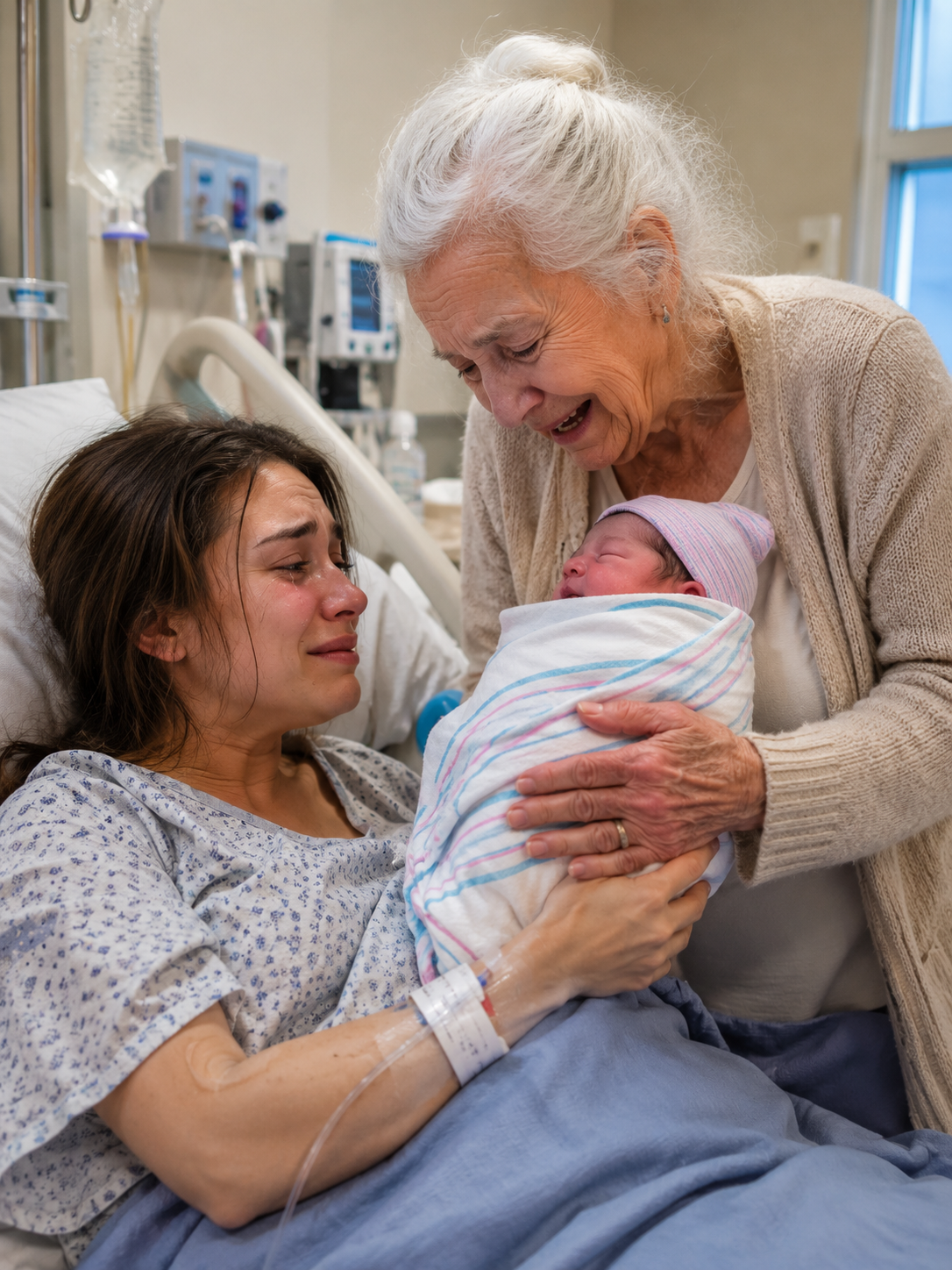
She held that tiny little girl against her chest like she was holding the entire future in her arms.
“Oh, sweetheart,” she whispered through tears. “You are beautiful.”
Exhaustion pulled at every inch of my body, but I remember laughing weakly at one point because Rose kept proudly showing the baby to every nurse who walked past.
“You did amazing,” she told me later, brushing damp hair from my forehead. “I’m so proud of you.”
Then her eyes shifted toward the empty chair beside my hospital bed.
The chair where Jack should have been sitting.
Her expression hardened instantly.
“I cannot believe he left you like this,” she said, voice trembling with fury.
I stared at the ceiling.
“I’m too tired to even be angry.”
“That’s alright,” Rose replied coldly. “I have enough anger for both of us.”
Jack never came to the hospital.
Not the first day.
Not the second.
Not when we were discharged.
Every call went unanswered.
Every message ignored.
I stopped checking my phone eventually because each silence hurt worse than the last.
Rose brought us home herself.
She cooked meals.
Washed bottles.
Folded baby clothes.
Cleaned the house.
She woke up at night to help me when I was too exhausted to stand.
Sometimes I’d hear her muttering under her breath while washing dishes.
Usually about Jack.
None of it flattering.
Then four days after he vanished, the front door finally opened.
I was sitting on the couch feeding the baby when I heard him walk in.
Jack smelled like alcohol, cigarette smoke, and stale hotel air.
He tossed his keys on the counter casually, like he’d just come home from work.
“Hey,” he said. “Where’s my little girl? I got delayed.”
I stared at him.
I actually think my body went numb.
Because there he was.
My husband.
The father of my child.
Smiling casually after disappearing during the most terrifying moment of my life.
Before I could even speak, Rose appeared.
Her cane struck the hardwood floor once.
Sharp.
Deliberate.
“No,” she said.
Jack blinked.
“What?”
“No,” Rose repeated. “You do not walk into this house pretending nothing happened.”
He laughed nervously.
“Grandma, come on—”
“Your daughter was born four days ago while you were out drinking with your friends,” she snapped. “Your wife went through labor abandoned and alone. And now you are going to stand there and listen.”
For the first time since I’d known him, Jack actually looked afraid of her.
Rose pulled an envelope from the table and handed it to him.
“Open it.”
His face slowly drained of color as he looked through the papers inside.
There was a detailed chore schedule.
Parenting responsibilities.
Financial expectations.
And legal documents.
“I changed my will,” Rose said calmly.
The room went silent.
“This house no longer goes to you. It goes to your wife and your daughter.”
Jack looked like he’d been slapped.
“You will sleep in the spare room,” she continued. “You will help care for this baby. You will contribute to this household like an adult. And if you refuse, you may leave immediately.”
“Grandma—”
“No,” she cut in sharply. “You do not get to call yourself a husband or father after what you did. Those titles are earned.”
Jack slept in the spare room that night.
At 2 a.m., when the baby started crying, Rose marched directly to his door, knocked once, and handed him a bottle.
“She already has a mother,” Rose said. “What she needs right now is a father.”
At first, he was awful.
Completely awful.
He held the baby like she might explode.
Forgot diapers.
Mixed bottles wrong.
Panicked every time she cried.
Sometimes I caught him staring at her with pure terror on his face, like he finally understood the weight of what he’d nearly thrown away.
Weeks later, he finally admitted the truth.
After his phone died during the trip, he borrowed someone else’s charger and saw dozens of missed calls from me.
He knew exactly what was happening.
And he panicked.
He said he suddenly felt overwhelmed by becoming a father, terrified he would fail, terrified he wasn’t ready.
So instead of coming home…
He ran.
Not physically at first.
Emotionally.
Cowardly.
Completely.
“I didn’t know what to do,” he confessed quietly one night.
I looked at him for a long time before answering.
“You should’ve come home anyway.”
He nodded.
“I know.”
And slowly—very slowly—he started trying to become someone better.
Not through dramatic speeches.
Not through grand romantic gestures.
But through exhausting, ordinary consistency.
He got up during night feedings.
Changed diapers.
Learned how to soothe colic.
Cleaned without being asked.
Worked extra hours.
Cooked meals when I was too tired to stand.
Some nights I’d wake up and find him asleep in the rocking chair with the baby against his chest.
I didn’t forgive him quickly.
I couldn’t.
Trust doesn’t return because someone says sorry.
It returns because day after day, they choose not to fail you again.
Weeks passed.
Then months.
One quiet afternoon, I walked into the nursery and found Jack rocking our daughter gently while whispering promises against her tiny forehead.
“I’m gonna do better than I did before,” he whispered brokenly. “I swear you’ll never wonder if I love you.”
He didn’t know I was standing there.
Neither did Rose.
She appeared beside me silently in the hallway, watching him through the cracked doorway.
For a long moment, neither of us spoke.
Then she nodded once.
“Good,” she murmured softly. “He’s finally learning.”
Life didn’t suddenly become perfect after that.
There were still arguments.
Still scars.
Still moments when I remembered that empty hospital chair and had to fight resentment all over again.
But slowly, our home stopped feeling fragile.
One afternoon, months later, Rose called us both into the living room.
She handed me a small velvet box.
Inside was a delicate gold bracelet.
Four words were engraved across the inside:
Loved from the start.
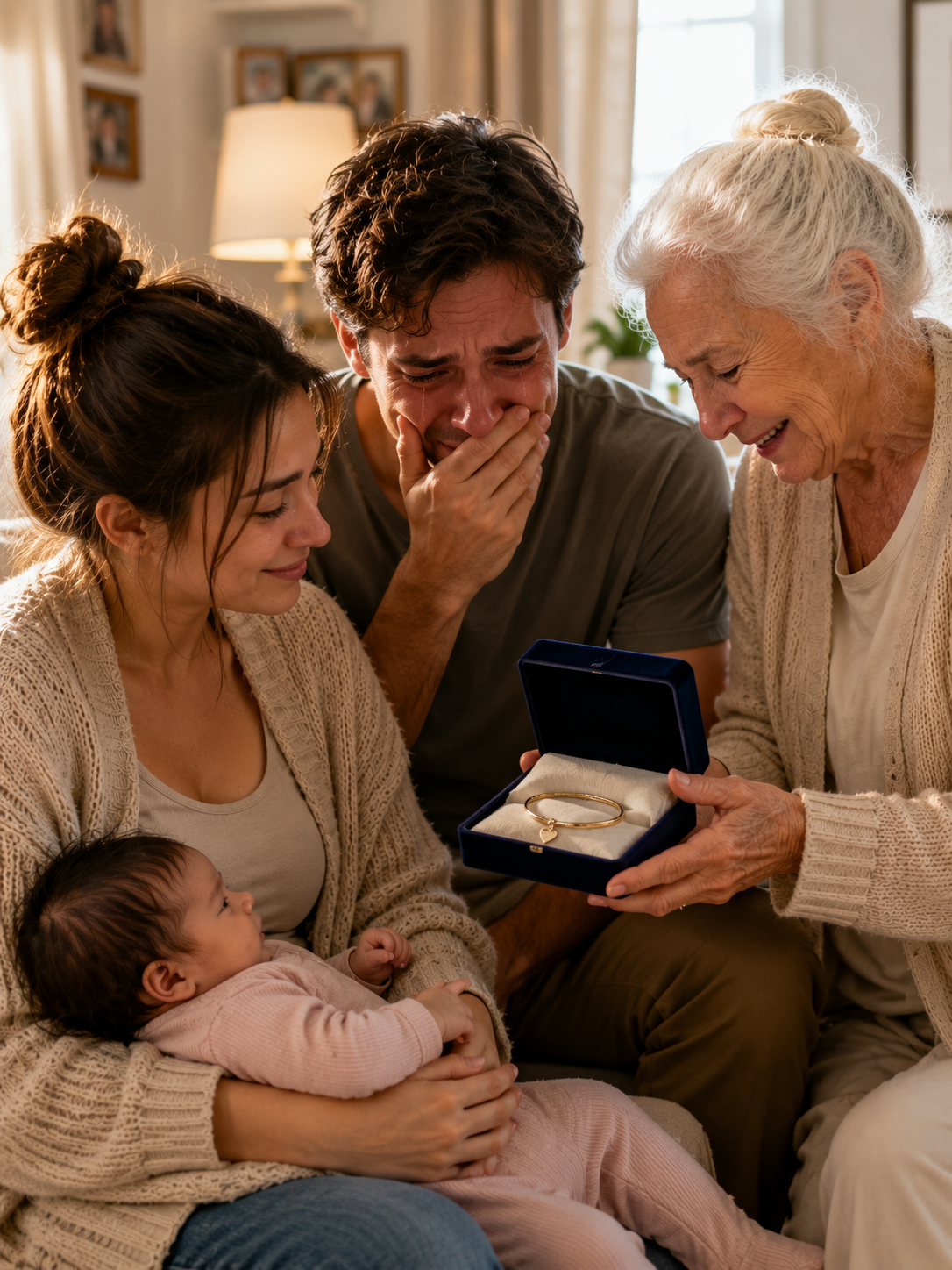
Jack read the inscription and immediately covered his mouth with his hand.
His eyes filled with tears.
“I should have been there,” he whispered.
I looked at him steadily.
“Yes,” I said. “You should have.”
This time he didn’t defend himself.
Didn’t make excuses.
Didn’t try to soften the truth.
He simply nodded.
Then our daughter wrapped her tiny fingers around his thumb.
And he broke down crying.
Not loud.
Not dramatic.
Just quiet, devastated tears from a man finally understanding the full weight of what he almost lost forever.
In that moment, something became painfully clear to me.
For months, I had believed this story was about whether Jack would become a good father.
But it wasn’t.
The real heart of the story was Rose.
The ninety-year-old woman who arrived first.
The woman who stood beside me while everything fell apart.
The woman who protected me when I had nobody else.
The woman who forced her grandson to face the consequences of failing the people who needed him most.
If my daughter someday asks who was there the night she was born, I’ll tell her the truth.
Her father came later.
But her great-grandmother?
She never left my side at all.
Note: This story is a work of fiction inspired by real events. Names, characters, and details have been altered. Any resemblance is coincidental. The author and publisher disclaim accuracy, liability, and responsibility for interpretations or reliance. All images are for illustration purposes only.
