
Stories
I Raised My Granddaughter After a Tragic Crash—20 Years Later, She Handed Me a Note That Made Me Pale
May
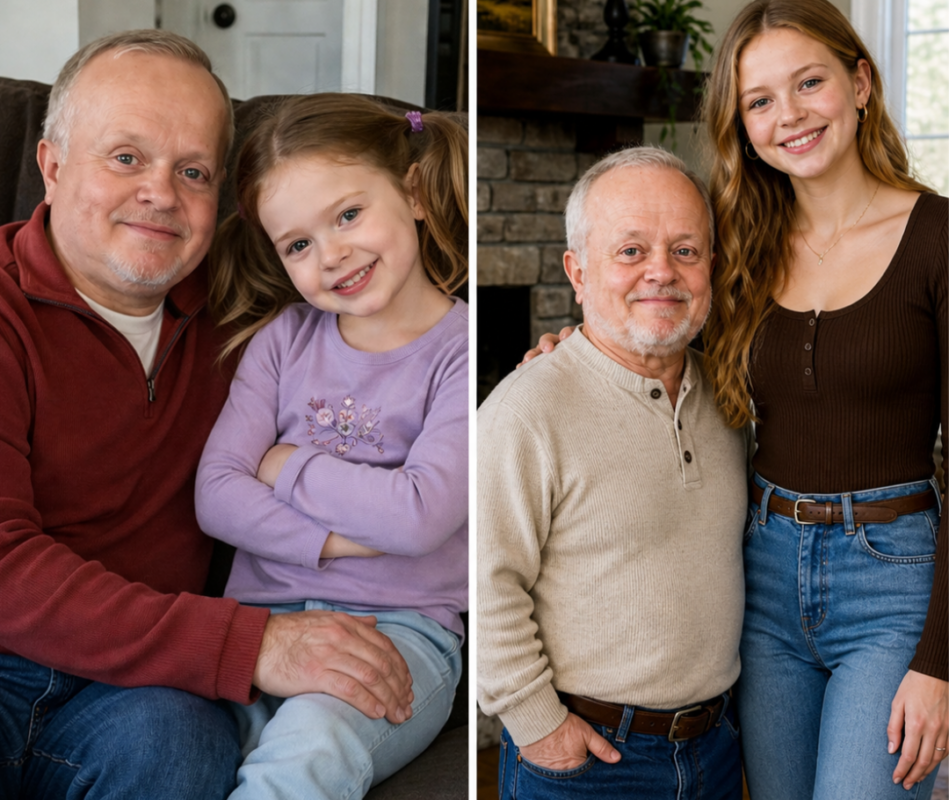
I’m 70 years old, and for twenty years, I believed I had survived the worst night of my life.
That night, snow fell so hard it erased the road.
My son Daniel, his wife Laura, and their two children had spent the afternoon at my house for an early Christmas dinner. Laura had brought her famous apple pie. Daniel had fixed the loose handle on my back door without me asking. Their little boy, Noah, had left toy trucks scattered across my living room rug.
And Emily—my five-year-old granddaughter—had fallen asleep in my recliner with a red ribbon still tied around her wrist.
I begged them to stay the night.
“Dad, we’ll be fine,” Daniel said, pulling on his coat. “It’s only forty minutes.”
Those were the last words I ever heard from him.
Their car slid off a rural road and struck a stand of trees. By the time help arrived, Daniel, Laura, and Noah were gone.
Only Emily survived.
The doctors called it a miracle. The police called it a tragic accident. At the funeral, the pastor stood before three closed caskets and said God had spared one small light from the storm.
Emily came home with me weeks later, pale and quiet, with broken ribs, bruises from the seatbelt, and eyes that looked too old for a child.
They told me she remembered very little. Fragments. Confusion. A child’s mind protecting itself.
“Don’t push her,” the doctor warned. “Let her heal.”
So I did.
I became a father again at nearly fifty. I packed school lunches, learned how to braid hair badly, sat through parent-teacher meetings, and held her through every thunderstorm, every fever, every nightmare.
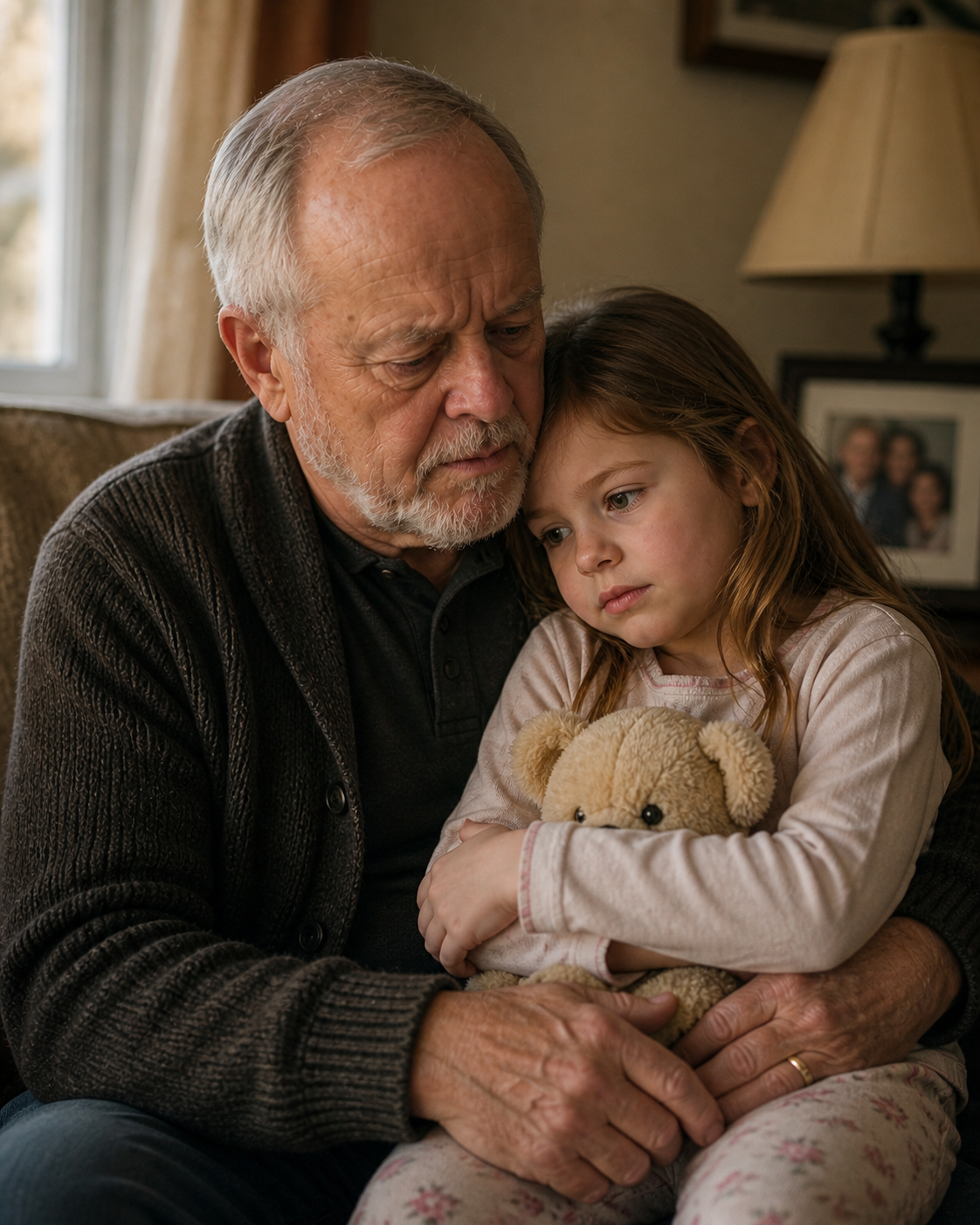
We didn’t talk much about the crash.
When she asked why her parents and brother weren’t coming home, I told her the gentlest truth I knew.
“It was an accident, sweetheart. A terrible storm. Nobody’s fault.”
She nodded, but she never cried the way I expected. Sometimes, she only stared out the window as snow fell, her little hands clenched in her lap.
Years passed.
Emily grew into the kind of woman who made people feel safe just by standing near them. She studied hard, worked harder, and after college, moved back in with me to save money while taking a job at a small legal research firm downtown.
She was twenty-five, smart, independent, and still, in my heart, the little girl who used to fall asleep on my shoulder.
Then, a few weeks before the twentieth anniversary of the crash, she changed.
She grew quiet.
At dinner, she asked questions that made my fork pause halfway to my mouth.
“Grandpa, do you remember what time they left your house that night?”
“Around seven,” I said. “Maybe a little after.”
“Did the police ever talk to you more than once?”
“No. They said the roads were bad. Your father lost control.”
She nodded, but her eyes were distant.
I told myself grief had a way of returning on anniversaries.
Then last Sunday, Emily came home early.
She didn’t take off her coat. Snow dusted her shoulders. Her face was pale, and in her trembling hand was a folded piece of paper.
“Grandpa,” she said, “can we sit down?”
My chest tightened.
She placed the paper on the kitchen table and slid it toward me.
“I need you to read this,” she whispered. “And I have to confess something. It wasn’t an accident.”
My hands shook as I unfolded the note.
At the top was a child’s uneven handwriting.
“If I forget, remember: the car stopped first.”
I looked up at Emily.
“What is this?”
Her eyes filled with tears.
“I wrote it,” she said. “Not long after the crash. A therapist had me draw and write what I remembered, but I hid that page. I didn’t understand it then.”
I read the next lines slowly.
“Daddy was scared. Mommy said don’t open the window. A man knocked. Daddy drove fast. Lights behind us.”
The room seemed to tilt.
Emily sat across from me, gripping her sleeves.
“I found it in an old box from my childhood,” she said. “At first, I thought it was just a nightmare. But at work, I’ve been helping organize old county records. I found something strange.”
She opened a folder and pulled out copied documents.
“There had been several robberies on rural roads that winter,” she said. “Someone would pretend to need help, then rob drivers who stopped. The reports were buried because the suspect disappeared.”
I could barely breathe.
“The night my parents died,” she continued, “they didn’t simply slide off the road. They stopped because someone was in the road. Dad got scared and drove away. Another vehicle followed them.”
My hands went cold.
“For twenty years,” I whispered, “I told you nobody was to blame.”
Emily reached across the table.
“You told me what you knew.”
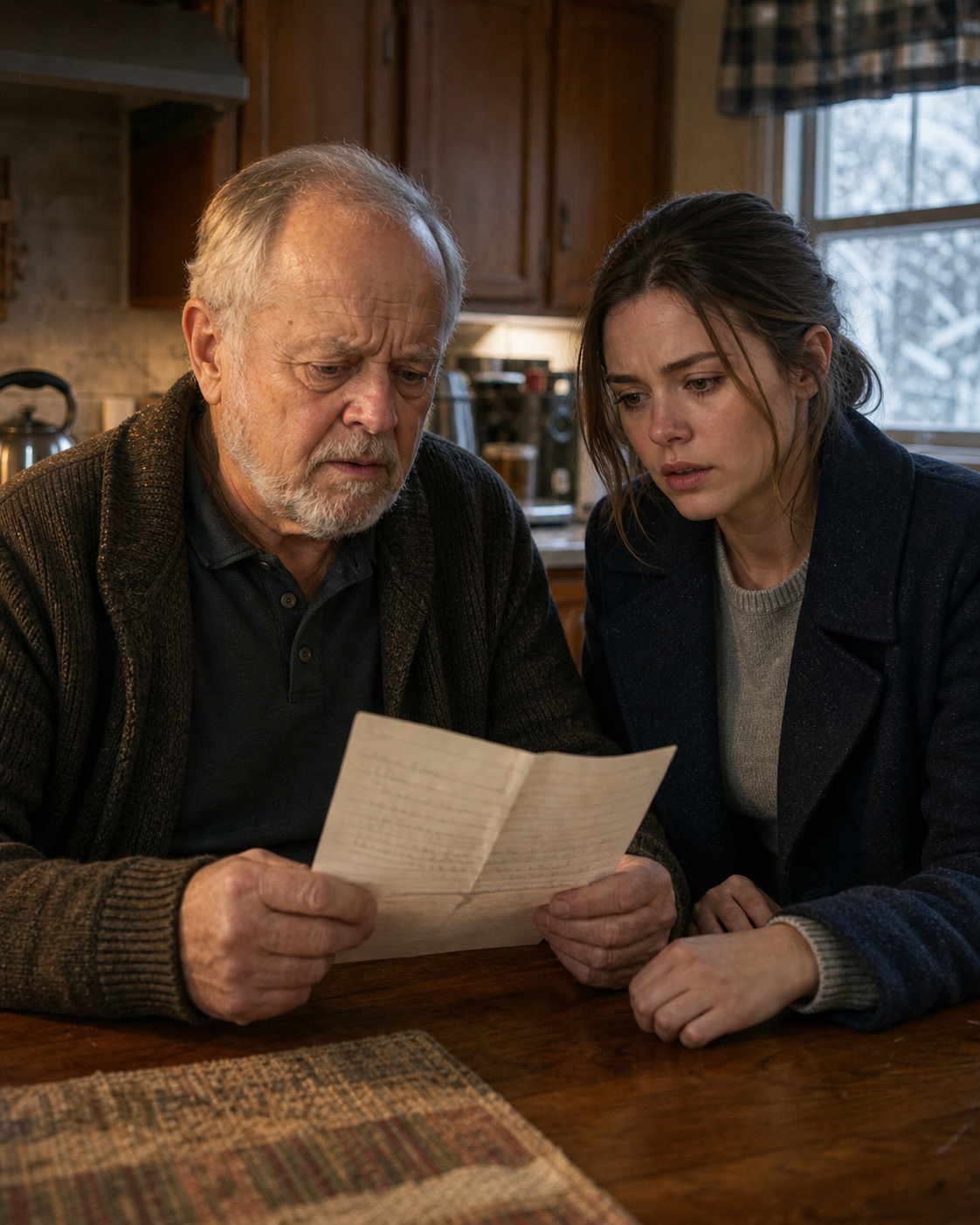
I stared at the note until the words blurred.
“Why didn’t the police find this?”
“They didn’t know what to look for. I was five. I had a head injury. And the storm wiped away most of the evidence.”
I felt anger rise in me—old, helpless anger. But beneath it was something worse: guilt.
“I should’ve made them stay,” I said.
Emily stood and came around the table. She wrapped her arms around my shoulders the way I had once wrapped mine around hers.
“No, Grandpa,” she said firmly. “You saved me after. For twenty years, you saved me every day.”
The next week, Emily and I took everything to the county sheriff’s office.
I expected polite sympathy and nothing more. But the detective who met us, a woman named Harris, listened carefully. She was young enough that the crash was history to her, but her eyes sharpened when Emily showed her the note.
“This matches an old pattern,” Detective Harris said. “There may be more here than anyone realized.”
The investigation reopened quietly.
Old reports were pulled. A retired officer was interviewed. A damaged tow company log surfaced, showing that another vehicle had been reported abandoned two miles from the crash site the next morning.
Then came the real shock.
The suspect had not vanished.
He had died years earlier.
But before his death, he had written letters to his sister from prison on another charge. In one letter, he mentioned “the family in the snow” and said he had never meant for them to crash. He admitted he had frightened a man into speeding away, then followed too close with his headlights high.
He never named them.
But the date, the road, and the details matched.
When Detective Harris told us, I didn’t feel the satisfaction I expected.
There was no courtroom drama. No dramatic arrest. No chance to demand why.
Just the truth, arriving twenty years late, carrying no power to bring back my son, my daughter-in-law, or little Noah.
Emily cried first.
Not loud. Not like in movies. She simply folded forward, and I held her in that small interview room while Detective Harris stepped outside.
“I remembered the lights,” Emily sobbed. “All these years, I thought I was making it up.”
“You weren’t,” I said, though my own voice broke. “You were a brave little girl who survived something terrible.”
A month later, the county amended the report.
The crash was no longer listed as a simple weather-related accident. It was connected to a criminal act that had caused Daniel to lose control of the car.
For most people, that would have been just paperwork.
For us, it changed the ground beneath our grief.
On the anniversary, Emily and I drove to the cemetery together. Snow fell softly, nothing like the storm that took them.
She placed three white roses on the graves.
“I know now,” she whispered. “And I’m sorry I couldn’t remember sooner.”
I placed my hand on her shoulder.
“Your parents wouldn’t want sorrow from you,” I said. “They’d want your life to be full.”
Emily looked at me through tears.
“And yours too, Grandpa.”
For the first time in twenty years, I let myself cry without hiding it from her.
I cried for Daniel, who had tried to save his family. For Laura, who must have held the children close in those final moments. For Noah, forever seven years old. And for Emily, who had carried a truth inside her too heavy for any child to name.
But when we left the cemetery, something had shifted.
The truth had not destroyed us.
It had freed us.
That evening, Emily hung a small framed copy of her childhood note beside our Christmas tree—not as a wound, but as proof.
Proof that memory can sleep and still wake.
Proof that love can survive what truth uncovers.
And proof that sometimes, even after twenty years, the past returns not to break a family again, but to finally let it heal.
Note: This story is a work of fiction inspired by real events. Names, characters, and details have been altered. Any resemblance is coincidental. The author and publisher disclaim accuracy, liability, and responsibility for interpretations or reliance. All images are for illustration purposes only.
