
Stories
I Came Home From My Husband’s Funeral… And Found His Family Emptying My House Like I Was Already Gone
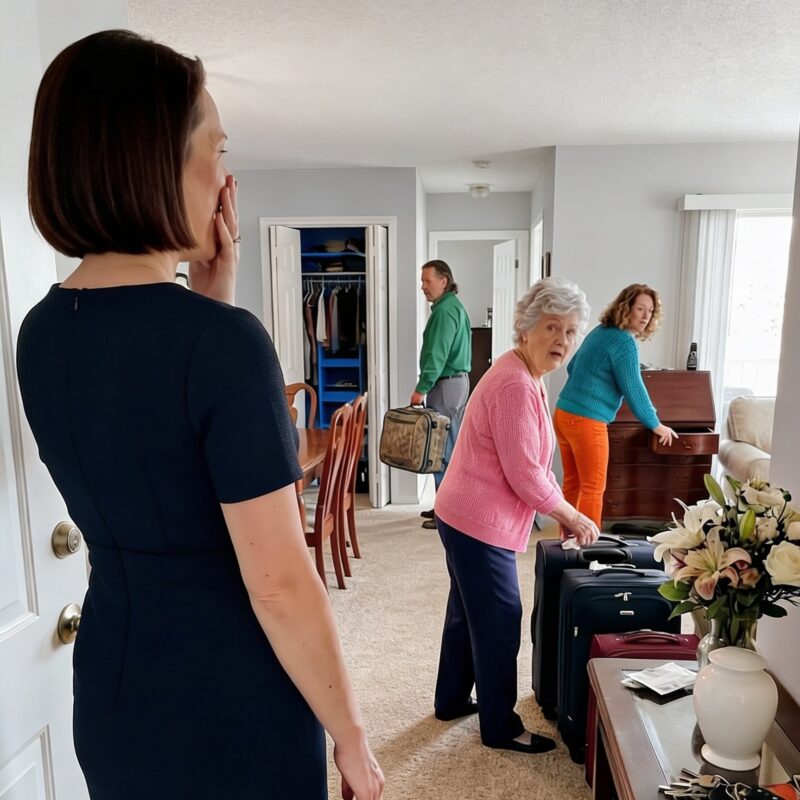
Apr
After my husband’s funeral, I came home still wrapped in black, the fabric clinging to my skin with the day’s lingering heat and the faint scent of lilies.
I pushed open the door expecting silence—the hollow, heavy quiet that follows loss. The kind that lets grief finally settle.
Instead, I stepped into chaos.
My mother-in-law stood in the middle of the living room, directing eight relatives as they packed Bradley’s belongings into suitcases like they were checking out of a hotel.
For a second, I thought I had the wrong apartment.
Closet doors hung open.
Hangers scraped wood.
A carry-on sat on the couch where Bradley used to read.
Near the entryway, untouched yet utterly disrespected, was his urn—placed beside wilting funeral flowers.
That was the moment something inside me shifted.
Not sadness.
Clarity.
Some people don’t mourn.
They move straight to taking.
Marjorie turned when she heard me. No shock. No shame. Just that familiar lift of her chin, like she still believed she was the only authority in the room.
“You’re back,” she said.
I stayed in the doorway, heels dangling from one hand, my body hollow from grief and exhaustion.
“What are you doing in my home?”
She ignored the question, tapping the dining table once.
“This house is ours now. Everything of Bradley’s, too. You need to leave.”
I took it all in slowly.
Fiona digging through drawers.
Declan zipping Bradley’s bag.
A cousin stacking framed photos like leftover decorations.
No one stopped.
No one looked away.
It was as if I had already been buried with him.
“Who let you in?” I asked.
Marjorie held up a brass key.
“I’m his mother. I’ve always had one.”
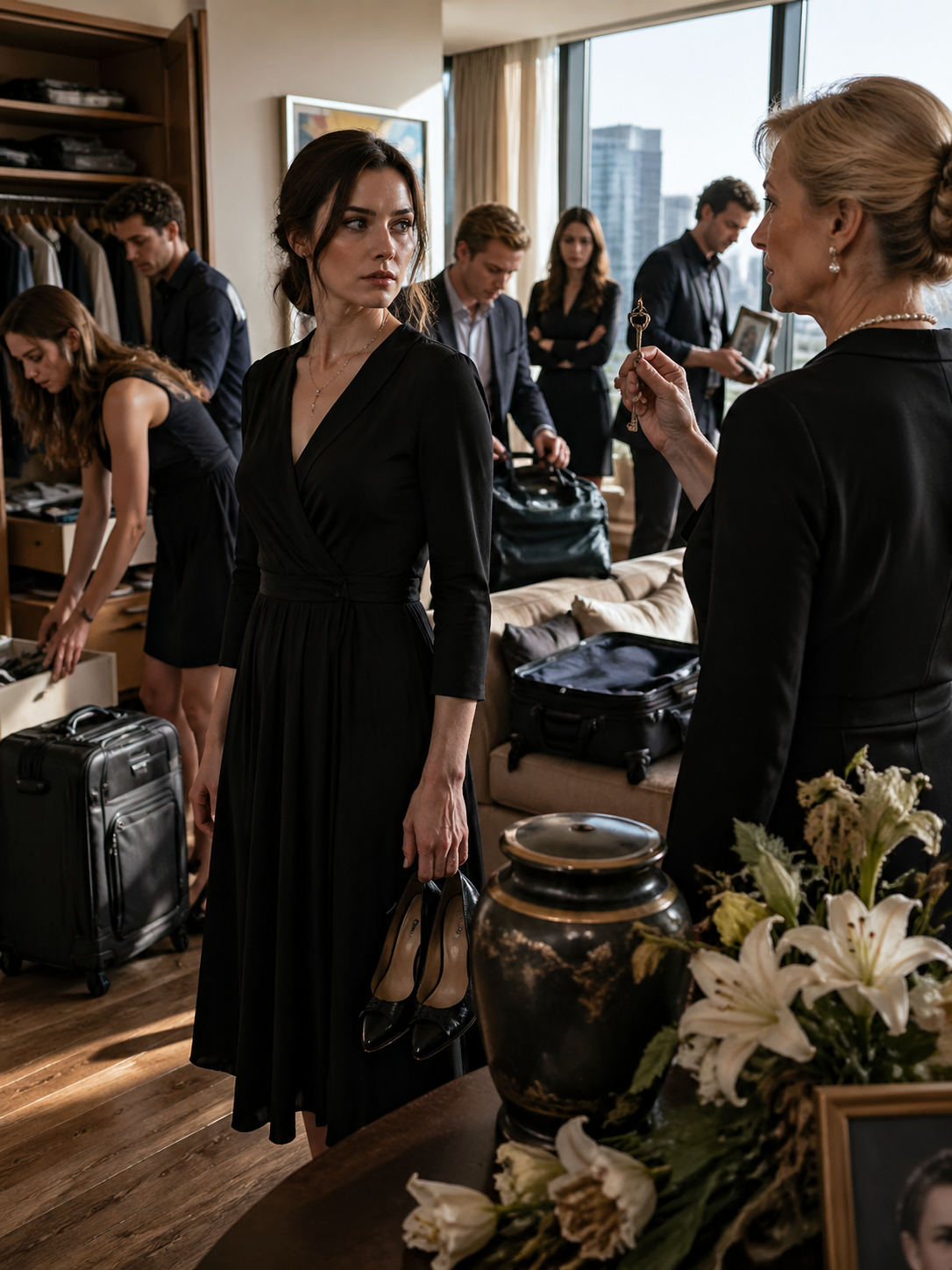
That hit harder than anything else.
Bradley had asked for it back months ago. He suspected she kept a copy—but chose peace over confrontation.
Now she was using it as proof of ownership.
Fiona yanked open Bradley’s desk drawer.
“Don’t touch that,” I said.
She turned, smiling with quiet cruelty.
“And who are you now?”
“A widow,” she said. “That’s all.”
Some words wound.
Others clarify.
That one clarified everything.
I laughed.
Not softly. Not uncertainly.
It was the kind of laugh that comes when you realize the people in front of you have walked straight into something they never saw coming.
Every head turned.
“Have you lost your mind?” Marjorie snapped.
“No,” I said, meeting her gaze. “You’ve just made the same mistake you’ve made his entire life.”
They went still.
“You thought quiet meant weak. Private meant broke. Invisible meant empty.”
Declan straightened. “There’s no will. We checked.”
“Of course you did,” I said. “And of course you didn’t find one.”
What they didn’t know—
Six days earlier, under hospital lights, Bradley had predicted this almost exactly.
If they come before the flowers die, he had whispered, laugh first. Elena will handle the rest.
At the time, I thought the medication was making him dramatic.
Bradley wasn’t dramatic.
But he had been right about one thing:
“They won’t come as family,” he said. “They’ll come as collectors.”
My phone buzzed.
Elena: We’re downstairs.
I looked at the suitcases.
“You might want to put those down,” I said.
Marjorie laughed sharply. “Or what?”
There was a knock.
I opened the door.
Elena Cruz stood there in a navy suit, rain damp on her shoulders. Beside her, the building manager held a clipboard. A deputy stood just behind them, calm and already unimpressed.
Elena stepped inside, eyes sweeping the room—the suitcases, the open closets, the list on the table.
“I’m counsel for the late Bradley Hale,” she said evenly, “and for the St. Augustine Harbor Trust. This residence is under legal protection. We’ve received a report of unauthorized entry and attempted removal of property.”
The air shifted.
“This is family property,” Marjorie snapped.
“No, ma’am,” the manager said, checking his clipboard. “This unit belongs to Harbor Residential Holdings, retitled into the trust six days ago. Occupancy rights belong solely to Mrs. Avery Hale.”
Marjorie froze. “That’s impossible.”
Elena held up the documents.
“It’s recorded.”
Fiona tried again. “There’s no will.”
“Exactly,” Elena replied. “That was intentional.”
Silence fell.
Because in one sentence, Bradley had defeated them—with structure.
Declan made one last attempt. Fiona muttered. A cousin quietly began unpacking what he had taken.
Then Elena opened another section of the folder.
“You should also know,” she said, “Bradley anticipated this.”
She placed three surveillance stills on the table.
Declan in the study.
Fiona holding documents.
Marjorie using her key.
No one spoke.
“He installed cameras after a prior incident,” Elena added.
Marjorie’s voice cracked. “He wouldn’t do this to family.”
“He did,” Elena said. “Because of what family did to him.”
Then she handed me an envelope.
My name on it.
I opened it.
Avery,
If you’re reading this with my mother in the room, I was right.
Laugh first.
I did.
Again.
More quietly this time.
The rest was simple.
He loved me.
He was sorry.
And he had made sure I wouldn’t have to negotiate with people who saw grief as opportunity.
Elena closed the folder.
“Each of you receives one dollar,” she said, “and a no-contest clause. Any interference triggers release of evidence related to prior fraud.”
Fiona sank into a chair.
Declan swore under his breath.
Marjorie went still.
“One dollar?” she whispered.
“Yes.”
The deputy instructed them to take only personal belongings.
Everything else went back.
Shirts returned.
Watches placed back.
Drawers restored.
No one touched the urn.
An hour later, they were gone.
At the door, Marjorie paused.
“You think this makes you safe?” she asked.
I met her eyes.
“No. Bradley made me safe. This just makes you visible.”
She left.
The apartment finally fell quiet.
Not peaceful.
But honest.
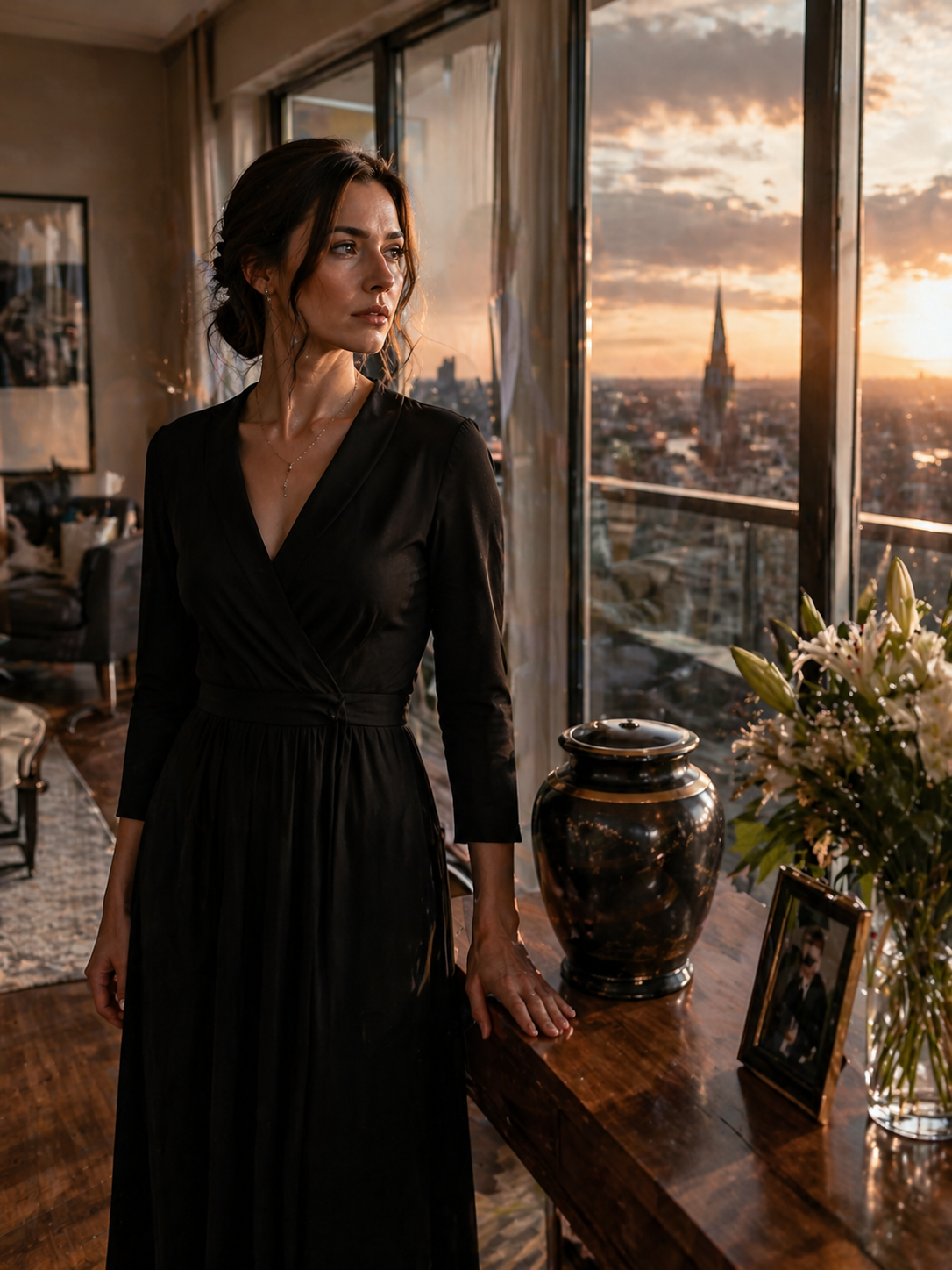
I stood there, looking at everything they had almost taken.
The half-open closet.
The scattered papers.
The flowers beginning to wilt.
Elena sat with me and handed over a flash drive.
“He recorded something for you,” she said.
I played it.
Bradley appeared on the screen—pale, tired, still himself.
“Avery,” he said softly. “If my family is there while you’re watching this… I hope you laughed.”
I did.
And something inside me finally broke open.
He spoke about love. About boundaries. About choosing peace over obligation.
The legal fight never came.
Within weeks, everything was settled.
The condo remained mine.
The accounts transferred cleanly.
His donations continued exactly as he had planned.
I learned more about him in those weeks than in ten years together.
Not because he hid anything—
But because I never measured him by what he owned.
A month later, I walked alone down St. George Street at sunset.
The city softened as the crowds faded.
I stopped where we once had coffee, arguing whether private people are born that way or made.
“Made,” he had said. “Usually by surviving the wrong kind of attention.”
He had been right.
When I returned home, the condo was quiet.
My quiet.
I placed fresh flowers beside his urn. Opened the windows. Let the warm air drift through the rooms.
Nothing had been taken.
Nothing had been lost—
Except the illusion that blood guarantees decency.
I stood there for a long moment, then turned on the lights.
And softly, into the space he protected until the very end, I whispered:
“They never knew who you really were.
But I did.”
Note: This story is a work of fiction inspired by real events. Names, characters, and details have been altered. Any resemblance is coincidental. The author and publisher disclaim accuracy, liability, and responsibility for interpretations or reliance. All images are for illustration purposes only.
