
Stories
My Husband Said He Cheated After 38 Years—But At His Funeral, I Learned the Truth That Shattered Me
Mar
Five years after my husband confessed to an affair and ended our 38-year marriage, I stood at his funeral—still carrying the anger, still holding onto the hurt. But when a stranger approached me with a letter he had left behind, everything I believed about love, loyalty, and goodbye began to shift.
I noticed her during the second hymn.
She sat alone in the back pew—not crying, not praying—just watching. She wore gray instead of black, her expression calm but unreadable. I didn’t recognize her.
And that mattered.
I knew everyone else there. Richard and I had built a life together. Our children sat beside me in the front row. Gina squeezed my hand when the pastor spoke his name. Alex stared straight ahead, his jaw set just like his father’s used to be.
But that woman didn’t belong.
At least, not to me.
When the service ended and people began to leave, I found myself walking toward her before I could stop myself.
Gina noticed.
“Mom—where are you going?”
“Bathroom,” I said evenly.
“I’ll come with you.”
As we passed the last pew, the woman stood.
“Julia?” she called out—too loudly.
Heads turned. Conversations paused mid-sentence.
Gina let go of my hand. “How does she know your name?”
The woman flinched, lowering her voice.
“Please… I’m sorry. It’s… hospice.”
That single word changed everything.
“Mom? Are you all right?” Gina asked, leaning against me.
“I’m fine, honey.”
And I was—at least in the way that mattered. I didn’t feel broken anymore. Just empty. Five years of silence had already done the grieving.
That’s what betrayal does. It doesn’t end with divorce papers. It lingers, settles, and eventually hardens into something quiet and permanent.
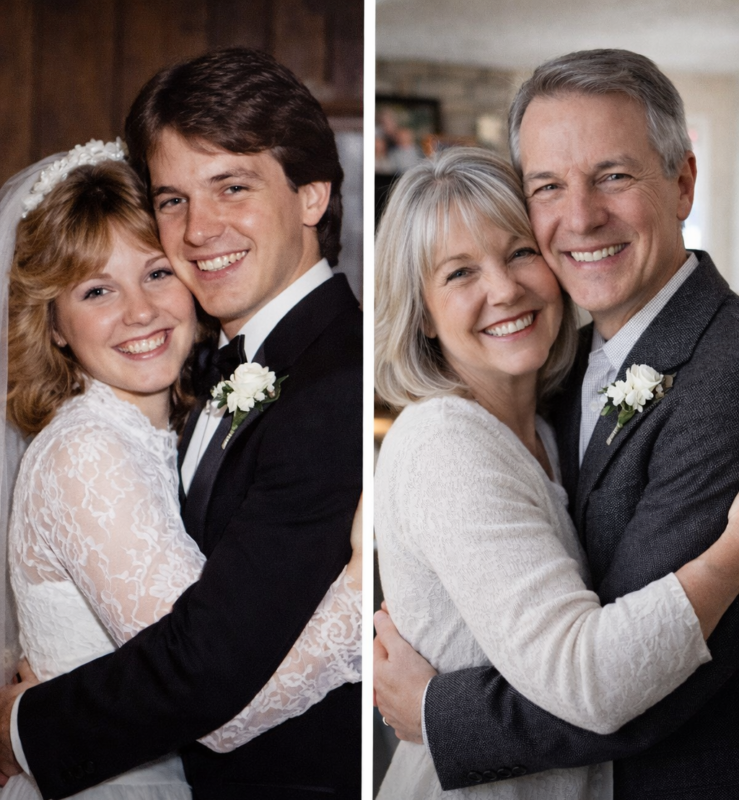
Richard and I met when we were twenty. I wore a green sweater, and he said it matched my eyes. I rolled mine so hard I almost missed the bus.
We married at twenty-two. Raised two children. Built a home filled with mismatched chairs and a faucet we never quite fixed.
He made pancakes on Sundays. I alphabetized the spice rack—even though he never knew where anything was.
We were happy.
Or at least, I thought we were.
For 38 years, I believed that.
Until something changed.
Richard grew distant. He carried a heaviness I couldn’t reach. Sometimes I’d wake up to find him asleep in his office, the door locked. He said it was work stress.
He stopped asking about my day. Some nights, I’d hear him coughing and sit outside the door, my hand pressed against it.
“Richard?” I’d whisper.
But he never opened it.
I thought he was depressed. I begged him to talk.
Then one evening, after dinner, he sat at our kitchen table—the one where we celebrated birthdays and laughed over burnt meals—and said it.
“Julia, I cheated on you.”
“What?” I stared at him.
“I cheated. I’ve been seeing someone else. I’m sorry.”
He didn’t cry. Didn’t even meet my eyes.
“What’s her name?”
“I don’t want to talk about it.”
“No,” I snapped. “You don’t get to destroy 38 years and act like you lost your keys.”
His hands trembled, but he stayed silent.
A week later, I filed for divorce.
He didn’t fight it. No arguments, no apologies. Just… distance.
Gina later told me he stayed in touch with them—the kids, the grandkids. I said I was fine with it.
I wasn’t.
Five years passed.
Quiet years.
I rebuilt my life slowly—lunches with friends, holidays with my children, rearranging rooms so they felt less like him.
Then Gina called.
“Mom… it was a heart attack. They said it was quick.”
I didn’t cry. I just sat there, listening.
“They’re having a service. I thought you should know.”
“Where?”
“The old church. Saturday morning. Alex and I will be there.”
I said yes without thinking.
Maybe I needed closure. Or maybe some part of me hadn’t let go.
The church hadn’t changed.
Same stained glass. Same creaking pews.
Gina sat near the front with her family. Alex stood in the aisle talking to someone. I stayed back.
And then I saw her again.
The woman in gray.
Still alone. Still watching.
After the final prayer, I approached her.
“I don’t believe we’ve met.”
“No. We haven’t.”
“You knew my… husband?”
“Yes. I’m Charlotte.”
“From where?”
“I was with him at the end, Julia. Hospice. And you need to know what your husband did for you.”
My stomach turned.
“He told me he was cheating on me.”
“I know.”
“You knew?” My voice shook.
“He asked us not to tell you,” she said gently. “He said you would stay… and he couldn’t let that happen.”
“And that was wrong?”
Her grip tightened on her purse.
“He didn’t just ask. He put it in writing.”
She handed me a folded page. At the top: “DO NOT CONTACT JULIA UNDER ANY CIRCUMSTANCES.”
My name looked unfamiliar beside his signature.
The date was five years ago.
I didn’t open the letter at the church.
At home, I changed, made tea, and sat on the back porch—the one we never fixed.
The garden was still there. The hydrangeas had come back.
I held the letter for a long time before opening it.
His handwriting hadn’t changed.
“Julia,
I didn’t touch anyone else, my love. I promise. There was no affair.
I got the diagnosis and knew what it would do to you.
You would’ve stayed. Taken care of me. Watched me fade. And it would have taken you with me.
You gave me your whole life. I couldn’t ask for more.
I needed you to live. I needed you to hate me just long enough to walk away.
I’m sorry.
If you’re reading this, it means I got my wish.
You’re still here.
You lived.
I loved you until the end.
—Richard”
I sat there, the words blurring.
I didn’t cry at first. I just breathed.
The porch light flickered on, as if the house didn’t know what to do either.
The next morning, I called Gina and Alex.
They arrived with worried faces and coffee cups.
“Everything okay, Mom?” Alex asked.
I placed the letter on the table.
“Read it.”
They did.
Gina covered her mouth. Alex clenched his jaw.
“He let us think he was a monster,” Alex said.
“He was dying,” I replied quietly. “And he made sure I never saw it.”
“He thought he was protecting you,” Gina whispered.
“Maybe,” I said. “But he took away my choice. And left me with the pain.”
Silence followed.
Then I added softly, “But maybe… it worked.”
A week later, Alex came by again, alone, holding another envelope.
“Dad updated his will,” he said.
Inside was a deed.
To our lake cabin.
“He put it in your name,” Alex said.
Attached was a yellow sticky note.
“Keep the porch light on, my love.
In case the kids come back.
And in case you want to watch the water again.
I’ll be there.
Just not where you can see.”
I read it again and again.
Outside, the wind picked up. A leaf clung to the window, as if refusing to let go.
“He left,” I whispered, “so I could keep the light on… mine.”
“You did, Mom,” Alex said, his voice breaking.
And for the first time in five years…
I believed it.
And the warmth of that truth nearly broke me.
Note: This story is a work of fiction inspired by real events. Names, characters, and details have been altered. Any resemblance is coincidental. The author and publisher disclaim accuracy, liability, and responsibility for interpretations or reliance. All images are for illustration purposes only.
