
Stories
My Future Daughter-in-Law Mocked My $45K Salary—But My Son’s Response Left the Entire Room Speechless

Mar
I raised my son on a teacher’s salary, and for a long time, I believed the hardest part was already behind me. But one rehearsal dinner revealed just how little some people truly understand about sacrifice.
I never imagined I’d become the kind of woman people whisper about at a country club.
I’m 55 years old. I’ve spent most of my adult life teaching middle school—English, mostly. Sometimes social studies when the district needed it. I earn about $45,000 a year.
And I raised my son on my own.
His father left when Mark was eight. There was no dramatic confession, no explosive ending. Just a slow, quiet drift into a different life—one where we no longer belonged. After that, it was just me.
Me, attending parent-teacher conferences as both the teacher and the parent. Me, furnishing our home with secondhand pieces. Me, grading papers late into the night while Mark slept on the couch beside me, saying the sound of my red pen made him feel safe.
Every difficult year was worth it for Mark.
Now he’s 28, working in investment banking. Long hours, sharp suits, numbers I don’t pretend to understand. He’s brilliant. Driven. Polished, but never artificial. When he landed his first major job, he took me out to dinner and said, “You did this.”
I told him, “No. You did.”
He shook his head. “No, Mom. I just walked through the door. You built the house.”
Then he met Chloe.
“Oh, you still teach middle school? That must be… rewarding.”
“Mark says you love your little house. That’s so nice.”
“We should find something simple for you to wear to the engagement party. You probably don’t want to feel overdressed.”
I told myself I was imagining things. That maybe rich girls just spoke differently. That what mattered was my son’s happiness.
But the cracks were there.
A few months before the wedding, Chloe was discussing budgets with her mother in front of me, laughing about the cost of flowers.
With a casual wave of her hand, she said, “Honestly, the rehearsal dinner alone costs more than some people live on for a year.”
Then she glanced at me. Just for a moment—but long enough.
Mark heard it.
“Chloe,” he said, flatly.
She gave that airy laugh of hers. “What? I meant people in general.”
Later, in the parking lot, I told him, “You don’t need to fight my battles.”
His jaw tightened. “Maybe I should start.”
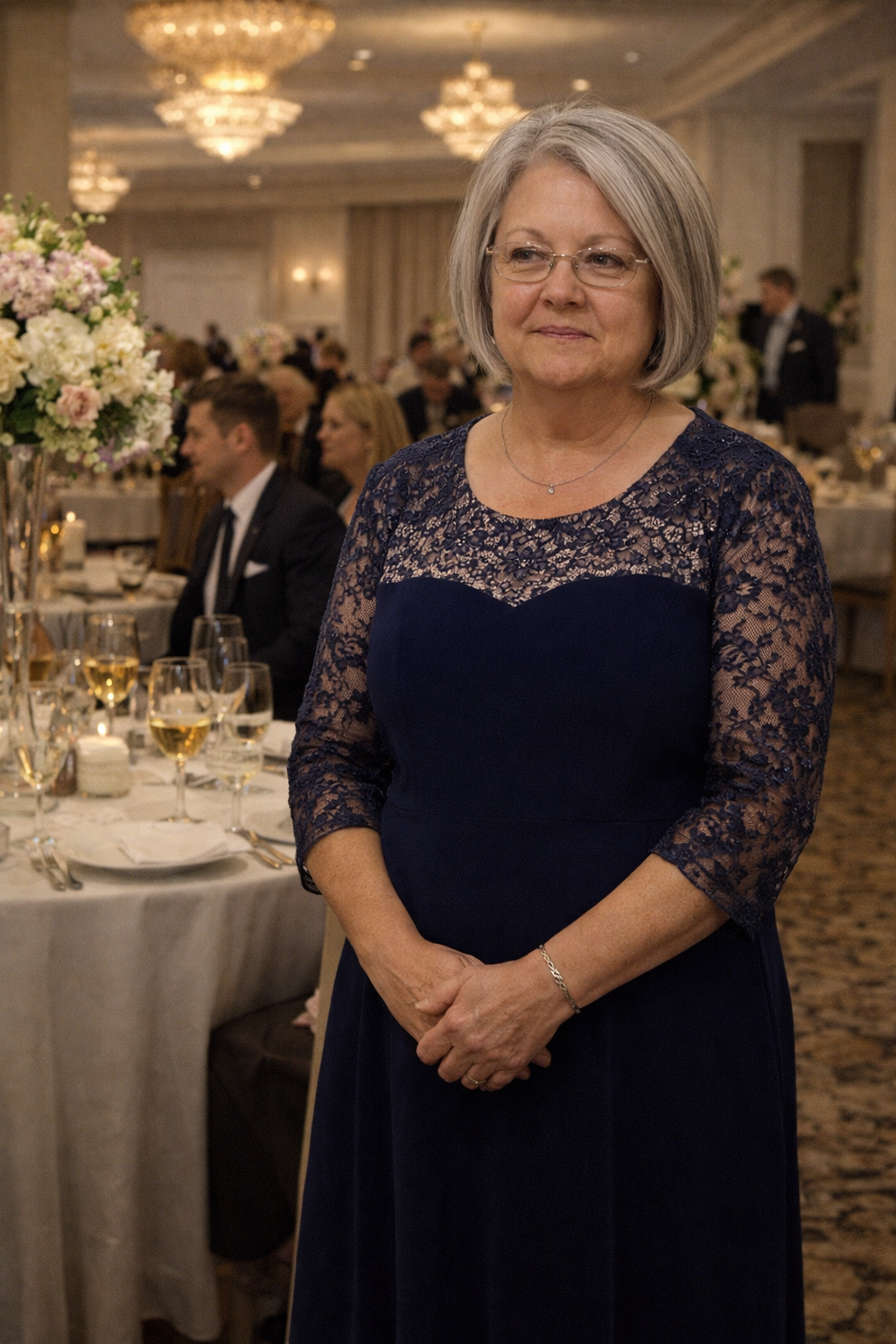
Then came the rehearsal dinner.
It was held at a country club so grand it felt almost unreal—like something staged. Chandeliers, marble floors, towering floral arrangements that probably cost more than my mortgage.
I stood in the bathroom beforehand, staring at my reflection, smoothing my dress as if that alone could make me belong.
“You can do one night,” I told myself.
At first, everything seemed fine. People laughed. Chloe teased Mark for being serious, joked about his work hours. Then her tone shifted.
She began talking about how “different” their families were.
“My parents always worried I was too spoiled,” she said with a laugh. “Then I met Mark, and I realized some people really do know how to live on almost nothing.”
A few guests shifted uncomfortably in their seats.
But Chloe kept going.
“I mean, when we first talked wedding numbers, I almost died when I found out his mom has been teaching middle school for so long. On about 45 grand a year?” She laughed into the microphone. “My seasonal wardrobe costs more than that.”
This time, the laughter was thin. Uneasy.
Her mother murmured softly, “Chloe.”
But Chloe had had enough to drink not to hear the warning.
She turned and looked directly at me.
“It’s honestly kind of adorable,” she said, “how some people still live like that and act like it’s noble.”
Mark stood up.
He didn’t look angry. That would have been easier.
He looked finished.
Chloe let out a nervous laugh. “Babe, relax. I’m joking.”
He said nothing.
He leaned toward her and whispered something I couldn’t hear.
But whatever he said changed her expression instantly.
“Mark,” she whispered. “Don’t.”
He picked up the microphone and faced the room.
“I’ve listened long enough tonight,” he said. “And I need to say something clearly.”
The room fell silent.
Then he turned to me.
“My mother spent her whole life giving. She gave her time, her energy, her weekends, her peace, and every extra dollar she had so I could stand in rooms like this one.”
I couldn’t breathe.
“She never needed a family name or a club membership to matter. She has more class in one morning before work than this room has shown her all night.”
Chloe tried to interrupt. “Mark, stop making this—”
He ignored her. His gaze moved across her parents, then the rest of the room.
“Wealth is not character. And contempt is not sophistication. If anyone here confused those things, I hope tonight clears it up.”
The silence deepened—heavy, absolute.
He placed the microphone back on its stand.
“I was ready to spend my life with someone,” he continued, “but I will not build a future with a person who enjoys humiliating the woman who built mine.”
Chloe’s face crumpled. “Mark—”
“No,” he said, quietly but firmly. “This is the first honest moment of the night. Let it stay honest.”
Then he walked over to me and held out his hand.
“Mom, you do not stay another second in a room where anyone thinks you are less than extraordinary.”
My eyes burned. My throat tightened. But I took his hand.
And we walked out together.
Outside, the air felt cold—and real.
For a moment, neither of us spoke.
Then Mark exhaled sharply. “I should have stopped this sooner. And I should have understood you sooner too.”
“You loved her,” I said gently.
He shook his head. “That’s not enough.”
A valet brought the car around. Just as we were about to get in, the doors behind us opened, and Chloe’s father stepped out alone.
He looked older than he had an hour before.
He stopped a few feet away. “I owe you both an apology.”
Mark said nothing.
The man turned to me. “What happened in there was shameful.”
“Yes,” I replied.
He nodded. “Her mother and I spent too many years cleaning up her worst moments instead of making her face them. That’s on us.”
Mark finally spoke. “This isn’t about one speech.”
“I know,” he said quietly.
Then he turned and went back inside.
On the drive home, silence filled the car. I expected anger. Maybe tears. But Mark just gripped the steering wheel and stared ahead.
Finally, he spoke.
“Why didn’t you ever tell me how hard it was?”
“Tell you what?”
“When I was little.” His voice caught. “She mocked a number tonight. Forty-five thousand. Like it was pathetic. But do you know what that number was to me? It was every field trip you managed to pay for. Every winter coat. Every lunch. Every book fair where you somehow said yes.”
I turned to the window because tears blurred my vision too much.
He continued, his voice breaking. “I see it now. The old car. You pretending you weren’t tired. Saying you liked staying home when we just couldn’t afford anything else. And I should have seen Chloe more clearly too. I let too much slide.”
Later, sitting at my kitchen table—the same one where he used to practice spelling—he said, “It wasn’t just last night.”
I placed a cup of coffee in front of him. “I know.”
He looked up sharply. “You knew?”
“Not everything. But enough.”
And then it all came out.
Chloe asking if I really needed to attend certain events. Chloe suggesting I’d be “more comfortable” at casual family gatherings instead of donor dinners. Chloe asking him if he planned to keep “financially carrying” me as I got older.
I stared at him. “She said that?”
“Yes.”
“What did you say?”
“That my mother carried me long before I ever had a paycheck.”
I reached across the table and squeezed his hand.
“Loving the wrong person doesn’t make you weak. Staying after you know the truth—that would.”
That afternoon, Chloe asked him to meet her at her parents’ house.
When he returned that evening, he looked like someone who had finally reached the bottom of something.
“She wasn’t sorry,” he said.
“What was she?”
He let out a humorless laugh. “Annoyed.”
He told me she started calm and polished. Said the dinner got out of hand. Blamed stress and champagne.
Then she made the mistake that ended everything.
“She said, ‘I only said out loud what everyone in that room was already thinking.’”
I closed my eyes.
He continued, “Then she said if I ended things over one bad moment, I was choosing smallness over my future.”
“And what did you say?”
He looked at me. “I said I wasn’t choosing between two women. I was choosing between decency and rot.”
I’ll admit it—I felt proud.
At first, she laughed, thinking he was bluffing. But when she realized he wasn’t, she became angry. Said he was too attached to me. Accused me of poisoning him against her. Her mother started talking about deposits and guest lists. Her father asked if things could be fixed.
Mark said no.
Then Chloe, cornered and furious, said the final thing:
“None of this would have happened if your mother knew how to laugh at herself for one night.”
Mark removed the ring and placed it on the table.
“My mother survived things you wouldn’t last a week in,” he said, “and she did it without becoming cruel.”
Then he walked out.
The wedding was canceled.
Of course, people talked. Let them.
A few days later, two handwritten notes arrived. One from an older woman on Chloe’s side read, “I am ashamed I said nothing in the moment.” Another, from one of Mark’s coworkers, said, “Your son reminded a room full of adults what courage looks like.”
I kept that one.
The following Monday, I returned to school.
Because that’s what teachers do.
The world can fall apart on Saturday, and by Monday morning, you’re still taking attendance and telling Trevor to stop humming during a quiz.
Near the end of the day, I found a note on my desk from a student.
“Thanks for always showing up even when you’re tired.”
I sat down and cried quietly where no one could see me.
That Friday, Mark picked me up and took me to the small Italian restaurant we used to save for special occasions. Same red-checkered tablecloths. Same inexpensive candle. Same chocolate cake we used to share because it was all we could afford.
Halfway through dinner, he said, “I spent years trying to become successful enough that nobody could ever look down on us again.”
I set down my fork. “And what did you learn?”
He smiled—a small, real smile.
“That the only people who do that were never above us to begin with.”
When he dropped me off, he hugged me a little longer than usual.
After he left, I sat at my kitchen table, grading papers under my old lamp, surrounded by my modest home and my quiet, stubborn hope.
And I thought about everything Chloe had never understood.
Some people inherit comfort.
Some people inherit courage.
I didn’t raise a wealthy man.
I raised a good one.
And when the room laughed, he stood up.
Source: amomama.com
Note: This story is a work of fiction inspired by real events. Names, characters, and details have been altered. Any resemblance is coincidental. The author and publisher disclaim accuracy, liability, and responsibility for interpretations or reliance. All images are for illustration purposes only.
