
Stories
My Husband “Accidentally” Ruined My Only Nice Dress So I’d Miss His Company Gala—But When I Walked In 30 Minutes Later, He Went Completely White

May
Three months after giving birth, I stood in front of my closet feeling like I was staring at fragments of a stranger’s life.
The dresses I used to wear effortlessly no longer fit the same way. Zippers refused to close. Fabric stretched awkwardly across my body. Nothing looked like it belonged to me anymore.
But it wasn’t only my body that had changed.
It was me.
My days had become a blur of oversized pajamas, messy hair, laundry piles, and feeding schedules. Before motherhood, I had deadlines, meetings, plans, and ambition. Now everything revolved around survival and exhaustion.
Nathan had encouraged that shift more than anyone.
When I mentioned continuing a few freelance clients during pregnancy, he would sigh impatiently and say, “Eva, why make life harder than it has to be?”
Little by little, I stopped pushing back.
And eventually, I stopped recognizing how much of myself I had quietly given away.
So when Nathan’s company announced a formal event where spouses were invited, something inside me refused to stay buried.
I called my mother to babysit.
Then I bought a dress.
It was simple—champagne-colored silk with clean lines—but when I put it on, something unexpected happened.

For the first time in months, I saw myself again.
I looked in the mirror and whispered softly, “There you are.”
That evening, I showed Nathan.
He barely looked up from his phone.
“It’s fine,” he muttered.
I blinked. “Fine?”
“It’s just a work party, Eva. You don’t need to turn it into something dramatic.”
Later that night, I walked past his office and heard him laughing during a phone call.
“Yeah, my wife might show up,” he said casually. “She’s still recovering, though. Don’t judge me based on how she looks.”
I froze.
Some heartbreaks don’t arrive with shouting or tears.
Some arrive quietly… and settle deep.
The next morning, I asked him directly, “Are you embarrassed by me?”
Nathan barely slowed while grabbing his things.
“Eva, please don’t start this.”
Then he walked out the door as though he hadn’t just crushed the little confidence I had fought to rebuild.
I stood there holding the garment bag, feeling foolish for ever believing the evening meant something.
The night of the event, I still got ready carefully.
I curled my hair, applied makeup, and slipped into the dress slowly, trying to hold onto the confidence I’d felt earlier.
Nathan walked into the bedroom carrying a plate of pepperoni pizza.
Immediately, something felt strange.
We were leaving in ten minutes, and Nathan never ate greasy food while dressed for formal events.
“You almost ready?” he asked casually.
“Just finishing up.”
He stepped closer, glanced at my dress… then suddenly turned too fast.
The plate tipped.
Grease and tomato sauce splattered across the front of my silk dress.
Bright orange oil spread instantly over the fabric.
I looked at the stain.
Then at him.
And what I saw on his face wasn’t guilt.
It was relief.
“That’s unfortunate,” he said calmly.

I stared at him in disbelief. “Unfortunate?”
“You should probably stay home and rest,” he replied gently.
That softness made it even crueler.
For a second, I couldn’t speak.
Then I nodded.
“Yeah,” I said quietly. “You’re right.”
Nathan grabbed his keys and left without another word.
The second the front door closed, tears finally came.
But while I stood there crying, I heard his voice in my head again:
“Don’t judge me based on how she looks.”
And suddenly, the sadness hardened into something else.
Resolve.
A few weeks earlier, I had secretly started consulting again during late nights while rocking the baby to sleep.
Small assignments at first. Quiet projects Nathan knew nothing about because I was tired of asking permission to use my own mind.
One opportunity led to another.
Eventually, I realized the company hiring me was Nathan’s company.
And the executive I had been working closely with?
Mr. Robertson.
Nathan’s CEO.
The same man Nathan practically worshipped.
I wiped my face, grabbed my phone, and called him.
“Mr. Robertson… I need a favor.”
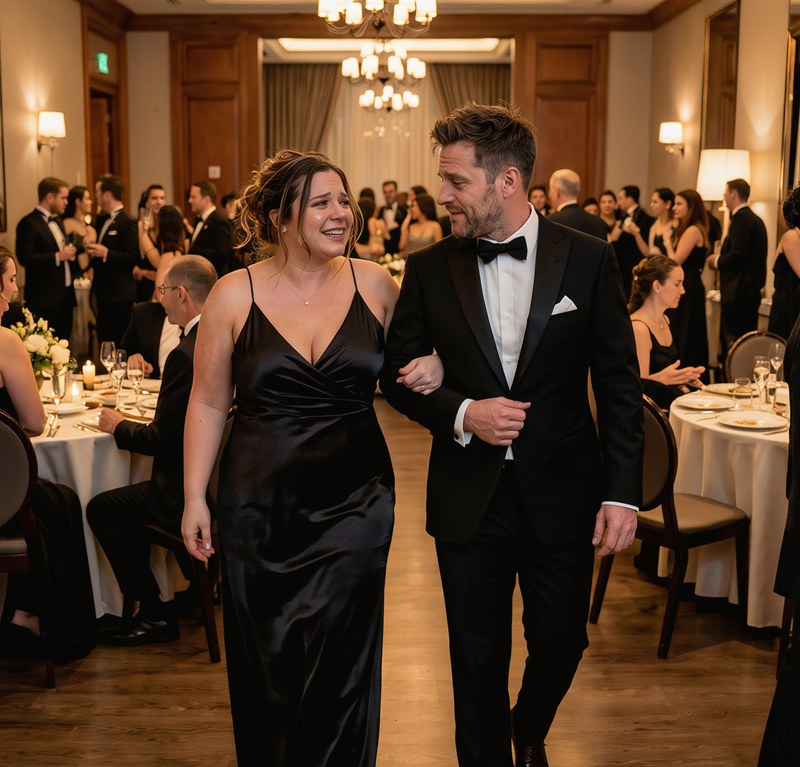
Thirty minutes later, I stepped out of a car in front of the hotel wearing another dress I’d bought years ago.
Mr. Robertson offered me his arm like a gentleman.
When I explained what Nathan had done, his expression darkened immediately.
“Are you ready?” he asked quietly before we entered.
This time, I lifted my chin.
“Yes.”
The ballroom quieted almost instantly when people noticed Mr. Robertson entering.
Then they noticed me beside him.
Confusion spread across the room.
Across the floor, Nathan was laughing with a woman in a red dress. He looked relaxed—more relaxed than he had looked with me in months.
Then he saw us.
The color vanished from his face immediately.
He hurried toward us.
“Eva? Mr. Robertson? What’s going on?”
Nobody nearby even pretended not to listen.
The woman in red disappeared into the crowd.
Nathan looked completely disoriented.
“Good evening, Nathan,” Mr. Robertson said calmly.

Nathan barely acknowledged him. “Eva, explain this.”
I met his stare evenly.
“I don’t owe you calm just because you’re panicking.”
“What is this supposed to be?” he snapped.
“It’s called work.”
Nathan laughed sharply. “Work? You don’t work.”
Several nearby employees exchanged uncomfortable glances.
“Yes, actually,” I replied. “I’ve been consulting again.”
“For who?”
“For me,” Mr. Robertson answered before I could.
Nathan looked stunned.
“When you asked me to quit after I got pregnant, I did,” I told him. “But recently I started taking remote consulting assignments again. I didn’t even realize it involved your company at first.”
“You hid this from me,” he hissed.
“You made honesty feel unsafe.”
Nathan stepped closer. “That’s a huge thing to keep from your husband.”
“Lower your voice,” Mr. Robertson interrupted coldly.
Nathan instantly fell silent.
And in that moment, I realized how much of his confidence depended on choosing people he thought wouldn’t challenge him.
Mr. Robertson looked directly at him.
“A man who deliberately ruins his wife’s dress because he doesn’t want colleagues seeing her demonstrates extremely poor judgment.”
Nathan’s eyes widened in panic.
“Sir, I—”
“Explain why you carried pizza into a bedroom while dressed for a formal event,” Mr. Robertson continued.
Nathan had no answer.
For the first time all evening, I saw genuine fear in his eyes.
“Eva,” he whispered desperately, “can we talk privately?”
I smiled faintly.
“So I’ll be easier to control?”
“Please,” he said. “Not here.”
I shook my head.
“We aren’t creating this situation tonight, Nathan. You created it yesterday when you mocked me on the phone. You created it tonight when you ruined my dress.”
His expression tightened.
“I hope this won’t affect my position here.”
Mr. Robertson didn’t rescue him.
“Performance evaluations reflect character as well as results.”
“And my role in those evaluations,” I added calmly, “was earned entirely on my own.”
Nathan stared at me as if the ground beneath him had disappeared.
“I said something stupid,” he muttered. “Let’s just go home.”
“I’ll go home later,” I replied.
He reached toward my arm but stopped himself halfway.
“I never meant to hurt you.”
I looked directly at him.
“Nathan… you aimed carefully.”
For the rest of the evening, he hovered around me nervously.
He offered me drinks.
Food.
A dance.
I declined every time.
Finally, he whispered bitterly, “You’re enjoying humiliating me.”
I looked at him steadily.
“No. I would’ve enjoyed simply being your wife tonight.”
That answer hurt him more than anger ever could.
Near the end of the event, Mr. Robertson was invited to give closing remarks.
Instead, he handed me the microphone.
For once, I didn’t shrink myself to protect someone else’s comfort.
“Good evening,” I began. “I’ve recently been consulting on leadership and workplace performance. The evaluations released Monday will reflect more than numbers. They’ll reflect integrity, professionalism, and how people treat others when they believe nobody important is watching.”
The room became completely silent.
“Character always reveals itself eventually.”
Only then did I glance toward Nathan.
Afterward, I handed the microphone back and walked toward the exit.
Nathan followed me into the lobby.
“Please don’t leave like this,” he begged.
I turned toward him calmly.
“You already left me behind once tonight.”
Nathan came home later that evening and found me in the kitchen removing my makeup.
For a long moment, neither of us spoke.
Finally, he sighed heavily.
“I messed up.”
“Yes,” I answered.
“I was trying to protect you.”
I laughed softly in disbelief.
“Protect me from what? Being seen?”
“You’re still getting back to yourself…”
I looked directly at him.
“Back to myself? Or back to the version that made you look better?”
“That’s not fair.”
“No,” I replied. “Fair would’ve been letting me decide for myself whether I wanted to go.”
“I said I’m sorry.”
“Sorry doesn’t erase what you revealed about how you see me.”
He rubbed his face tiredly.
“What do you want from me?”
I answered honestly.
“I think I want a version of you I haven’t met yet.”
But the real consequences arrived Monday.
Nathan came home tense and pale.
“You gave me a terrible review.”
“I gave you an honest one.”
“My promotion is gone.”
“That decision wasn’t mine alone.”
“The others got poor reviews too,” he muttered. “Now they’re blaming me.”
I looked down at our son playing beside me.
“Because your behavior forced people to notice things they ignored before.”
Nathan sat heavily in a chair, exhausted.
“What am I supposed to do now?”
I bounced the baby gently in my arms before answering.
“Become someone your son can be proud to learn from.”
Since then, Nathan has been trying.
He helps without expecting praise.
He wakes up during feedings.
He watches his words more carefully.
I notice the effort.
But effort and trust are not the same thing.
Nathan still waits for me to become the quiet version of myself again.
I won’t.
I speak honestly now.
I wear what makes me feel beautiful.
Last week, I bought another dress—a navy one—and hung it where I could see it every morning.
Because the worst part was never the ruined silk.
It was realizing my husband had reduced me to something temporary. Something embarrassing. Something to hide until I became acceptable again.
Yesterday, Nathan asked softly, “Do you think you’ll ever forgive me?”
I looked at him.
Then at our son.
Then back at the man who was only beginning to understand the damage he caused.
“Maybe someday,” I said quietly. “But the woman you tried to hide is the one making that decision now.”
Note: This story is a work of fiction inspired by real events. Names, characters, and details have been altered. Any resemblance is coincidental. The author and publisher disclaim accuracy, liability, and responsibility for interpretations or reliance. All images are for illustration purposes only.
