
Stories
I Came Home Early And Found My Pregnant Wife Shaking In Bed — Then One Terrible Thought Nearly Ruined Our Marriage
May
The night I came home early from my business trip and found my pregnant wife trembling alone in the dark, one horrible thought poisoned my mind before I even asked if she was okay — and that single moment nearly destroyed everything we had built together.
PART 1 — THE NIGHT I ALMOST LOST HER
I still remember the sound my suitcase made when it slipped from my hand and hit the hardwood floor.
A dull thud.
Heavy.
Final.
The apartment was almost completely dark except for the weak yellow hallway light spilling into our bedroom, and for a second my brain refused to understand what I was looking at.
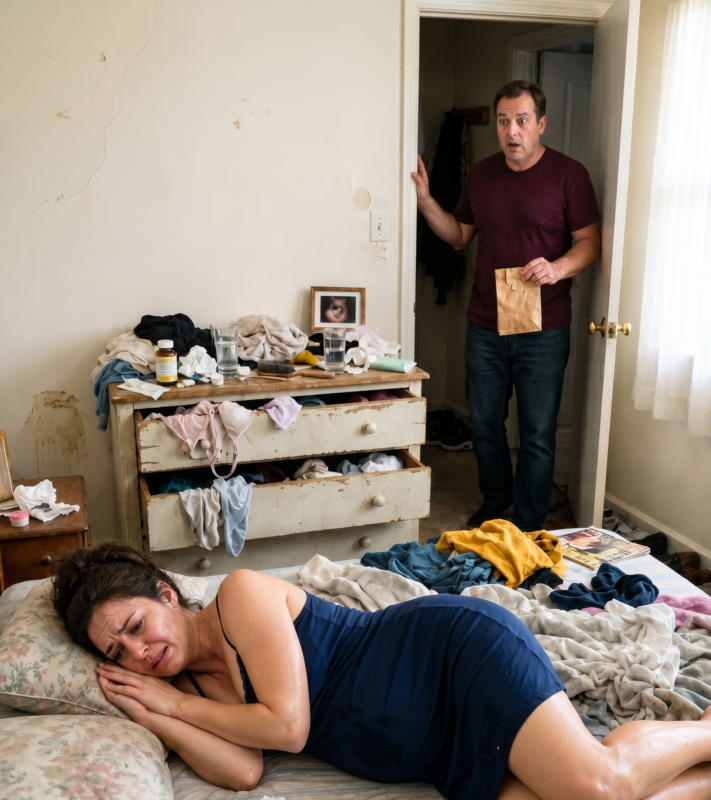
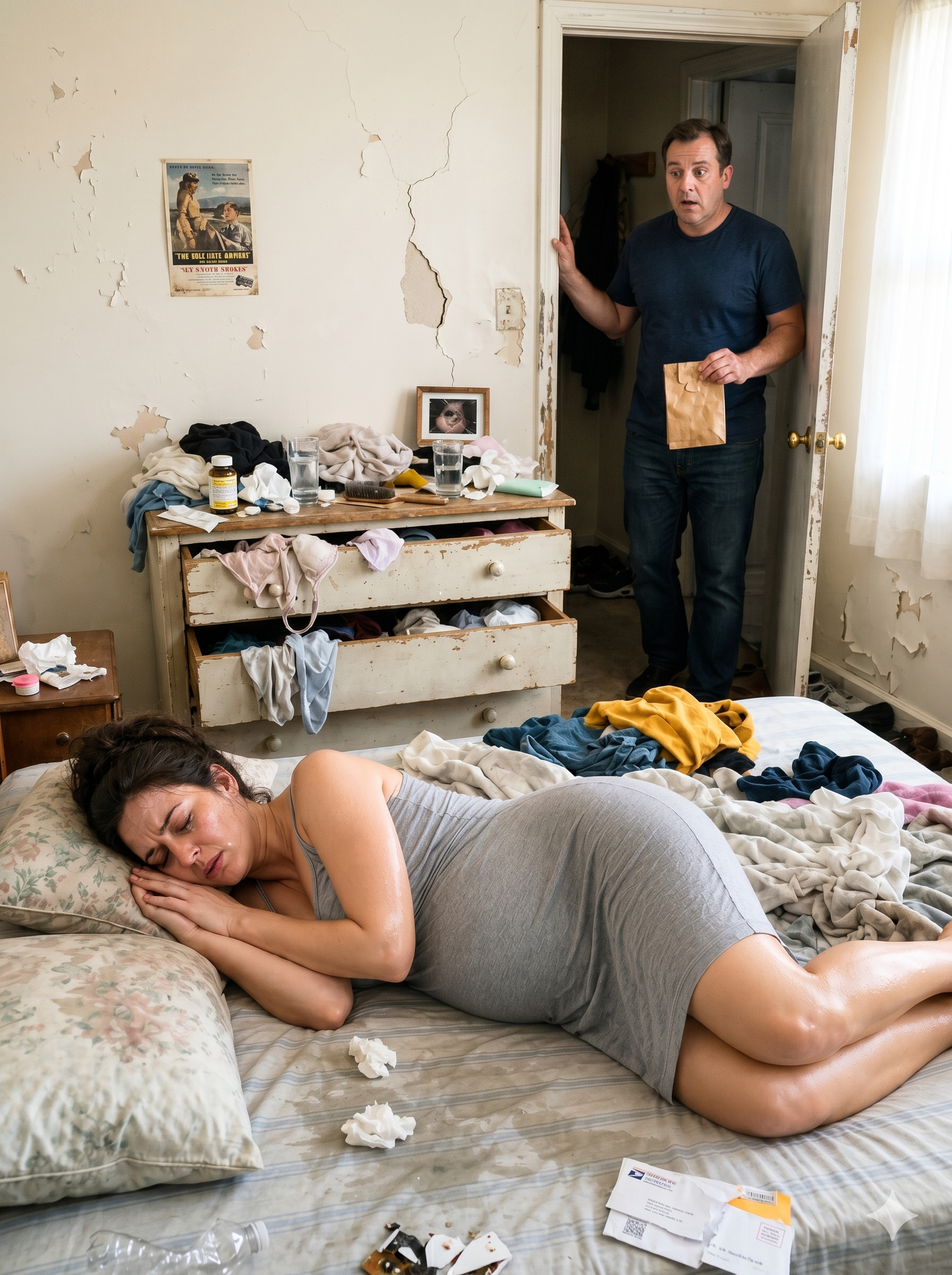
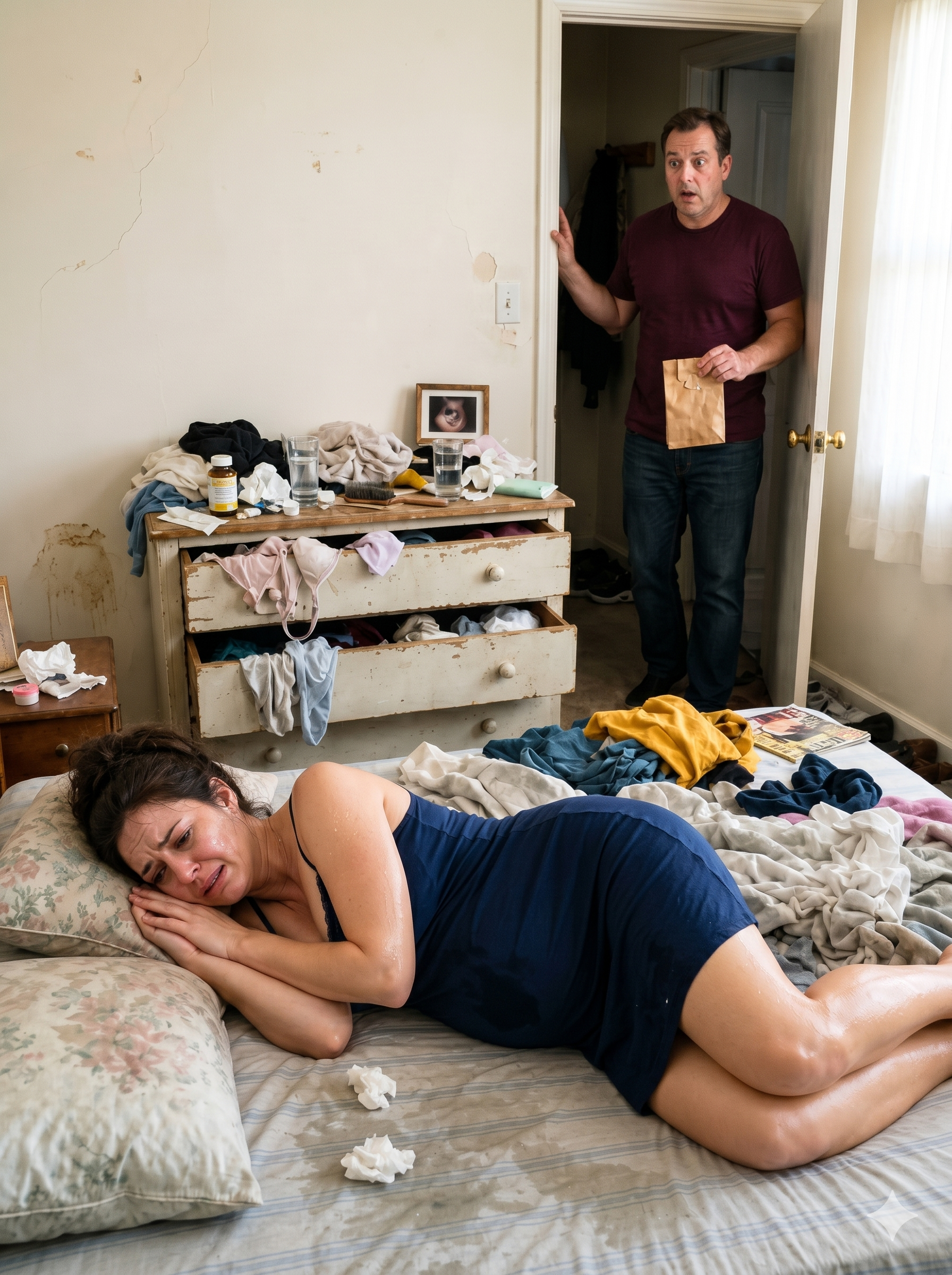
Claire lay curled on the bed, shaking.
One hand gripped her stomach so tightly her knuckles looked white beneath the dim light. Her pale pink nightgown was twisted backward, wrinkled badly around her body, and the sheets underneath her were soaked with large dark stains that immediately sent my thoughts somewhere ugly.
Somewhere shameful.
I froze in the doorway.
Not because I didn’t love my wife.
But because some terrible part of me reacted before love did.
The room tilted slowly around me. My chest tightened. My heartbeat pounded violently in my ears while a hundred disgusting suspicions exploded through my mind all at once.
Claire looked exhausted. Pale. Almost gray beneath the shadows.
An overturned glass of water sat beside the bed.
One stain suddenly made sense.
The fear in her eyes did not.
“Ethan…” she whispered weakly.
Not angry.
Not defensive.
Like she was begging me not to panic.
That was the moment reality finally crashed through the poison in my head.
I rushed toward her so fast I nearly tripped over my suitcase, dropping to my knees beside the bed while guilt tore through me hard enough to make me feel sick.
Her skin felt cold when I grabbed her wrist.
Too cold.
“How long has this been happening?” I asked, my voice rough and shaking.
Claire blinked slowly, trying to focus through the pain.
“Since around ten… maybe earlier,” she whispered. “At first I thought it was cramps. Then it kept getting worse.”
She swallowed hard before continuing.
“I tried calling you.”
My eyes immediately moved toward her phone lying face down on the nightstand.
Something inside me collapsed.
I grabbed it with trembling fingers and turned it over.
The screen lit instantly.
Twenty missed calls.
Every single one from Claire.
Two emergency calls had connected briefly before disconnecting.
My chest tightened so hard I could barely breathe.
“I couldn’t really talk,” she murmured after noticing my expression. “I panicked. Then I thought maybe I was overreacting.”
That sentence hurt more than it should have.
Because while my pregnant wife was terrified of seeming dramatic, I had spent the first few seconds imagining betrayal instead of danger.
I helped her sit up carefully, but the second she moved, pain twisted across her face sharply enough to make her gasp and grab my arm.
“We’re going to the hospital,” I said immediately.
She nodded weakly.
“My medical file… top drawer.”
I opened the drawer too fast, sending papers flying everywhere.
Receipts.
Prenatal paperwork.
Appointment reminders.
Old movie ticket stubs.
Then finally I found the blue folder Claire organized so obsessively months ago.
I remembered laughing at her back then while she sat at the kitchen table labeling everything with ridiculous seriousness, writing our baby’s name across documents like she was already building a life around someone we hadn’t even met yet.
Now my hands barely worked.
When I looked back at her, Claire was watching me quietly with an expression that made my stomach twist.
Not anger.
Not suspicion.
Something heavier.
Like she already knew exactly what I had thought when I walked through the door.
“Did you think I was with someone?” she asked softly.
The question landed gently.
That somehow made it worse.
I opened my mouth, but shame closed my throat before words could come out.
Outside, somewhere far below our apartment building, a motorcycle passed through the empty Chicago street with a low metallic growl.
Claire turned slightly toward the sound, then looked back at me again.
“I saw your face,” she whispered. “Before you touched me.”
God.
I couldn’t even look at her anymore.
The backward nightgown.
The wet sheets.
The unanswered calls.
All the ugly little comments my mother had planted inside my head over the past few months had surfaced instantly the second things looked strange.
Are you sure the timing isn’t weird?
Pregnancy changes women.
A paternity test protects everybody.
I had always dismissed those comments lightly instead of confronting her directly because fighting with my mother felt exhausting.
Now that weakness sat between my wife and me like a living thing.
“I don’t know what I was thinking,” I said weakly.
But we both knew that wasn’t true.
I knew exactly what I had been thinking.
Claire closed her eyes as another wave of pain crossed through her body. I grabbed her coat from the chair and helped her into it carefully.
Then she noticed my eyes flick again toward the backward seams of her nightgown.
“I changed after showering,” she explained quietly. “I got dizzy. I didn’t even realize it was backward.”
The explanation was painfully simple.
No affair.
No hidden man.
Just a frightened pregnant woman trying to dress herself while in pain and alone.
I knelt to tie her shoes because she couldn’t bend properly anymore, and silence filled the room heavily around us.
Not empty silence.
Punishing silence.
The elevator ride downstairs felt endless.
Claire leaned against the wall clutching the blue folder tightly against her chest while harsh fluorescent lights drained the remaining color from her face.
I stood beside her without touching her.
Because suddenly I didn’t know whether my touch still comforted her.
Fifth floor.
Fourth.
Third.
Every pause felt deserved.
Outside, freezing November air hit us instantly. Claire inhaled sharply through clenched teeth while I guided her carefully toward the car.
When I opened the passenger door, she stopped suddenly.
For one terrifying second, I thought she might collapse.
Instead, she looked at me quietly and asked:
“Were you scared for me first… or angry first?”
The question was almost gentle.
That gentleness destroyed me.
Because she could have screamed.
She could have accused me.
Instead, she gave me the chance to tell the truth.
And I knew she already knew it.
“I got angry first,” I admitted quietly.
Claire’s eyes fluttered slightly.
She nodded once.
Just once.
Like some painful fear inside her had finally been confirmed.
Then she climbed into the car without another word.
I drove too fast through downtown Chicago while red lights and traffic felt designed specifically to torture me.
Claire sat rigid beside me, both hands wrapped protectively around her stomach while she breathed carefully through each wave of pain.
Then my phone buzzed inside my pocket.
I ignored it.
A few seconds later, it buzzed again.
Then again.
At the next red light, I finally pulled it out expecting work messages.
Instead, I saw my mother’s name.
Three texts.
Are you home yet?
Call me before you talk to Claire.
Please, Ethan. There are things you need to know.
My stomach dropped.
Claire turned slowly toward me.
“Who is it?”
“My mother.”
Something changed in her expression immediately.
Not surprise.
Recognition.
Like a missing puzzle piece had finally clicked into place.
“She called me tonight,” Claire said quietly.
My grip tightened around the steering wheel.
“When?”
“Around nine. Before the pain got bad.”
A sick feeling spread through me instantly.
“What did she say?”
Claire stared ahead toward the glowing hospital sign in the distance.
“She told me I shouldn’t trap you with a baby if we weren’t completely stable yet.”
For a second I genuinely stopped breathing.
Because I recognized my mother’s tone immediately.
The fake concern.
The carefully disguised cruelty.
The manipulation wrapped inside “advice.”
And suddenly I realized something horrifying.
My mother hadn’t just poisoned me.
She had been poisoning my wife too.
Claire’s phone vibrated weakly near her seat. At the next stoplight, I picked it up.
More missed calls from my mother.
And one answered call.
Six minutes long.
Six minutes before Claire’s panic became unbearable.
By the time we reached the emergency entrance, nurses were already rushing a wheelchair toward us.
Questions came rapidly afterward.
“How many weeks?”
“Any bleeding?”
“Any falls?”
“Previous complications?”
Claire answered as best she could while I stood there uselessly holding the blue folder like evidence of my failure.
Then one nurse asked quietly:
“Are you the father?”
Claire hesitated.
Only for a second.
But it cut through me like glass.
Not because she doubted the baby.
Because my doubt had become visible enough for her to feel it.
They wheeled her behind a curtain while I followed until a nurse stopped me gently.
“Give us a minute.”
Machines hummed softly inside the examination room while doctors prepared the ultrasound equipment.
Claire stared silently at the ceiling.
Then my phone buzzed again.
The sound felt enormous.
Claire heard it.
The nurse heard it.
Even the doctor glanced toward my pocket.
I looked down at my mother’s name glowing on the screen again and finally understood something I should’ve realized years ago.
I had spent my entire marriage trying not to choose between my wife and my mother.
I called it “keeping peace.”
But silence is not neutrality when someone you love is being hurt.
It’s permission.
The phone kept vibrating.
Claire watched me quietly beneath the harsh hospital lights.
And finally, for the first time in years, I did something I should have done long ago.
I rejected the call.
Then I turned my phone completely off.
PART 2 — THE HEARTBEAT
Claire closed her eyes after I powered the phone down, but it wasn’t relief I saw on her face.
It was exhaustion.
The kind people carry after surviving fear alone for too long.
Cold ultrasound gel spread across her stomach while the doctor adjusted the monitor beside the bed.
The room became painfully quiet.
Just the soft mechanical hum of the machine.
The distant squeak of wheels in the hallway.
The sound of Claire breathing unevenly beside me.
I stood near the bed clutching the blue folder against my chest like it could somehow make me useful.
The doctor moved the probe carefully across Claire’s abdomen, his expression unreadable in that professional way doctors learn to hide concern.
I stared at the monitor without understanding anything.
Gray shadows.
Blurry movement.
Shapes I couldn’t interpret.
Claire wasn’t watching the screen.
She was watching the doctor’s face.
That terrified me more than anything else.
Another sharp pain crossed through her body, and instinctively I reached for her hand.
For half a second—
she didn’t take it.
That tiny hesitation nearly broke me.
Then another contraction hit, and finally her fingers wrapped tightly around mine.
I held on like someone drowning.
The doctor adjusted the image again.
Silence stretched longer.
Too long.
Then suddenly—
a faint flicker appeared on the monitor.
Small.
Rapid.
Fragile.
“There’s cardiac activity,” the doctor said carefully.
The breath left my body all at once.
Claire made a broken sound beside me that almost became crying before she swallowed it back down.
My knees weakened so suddenly I had to brace myself against the bed.
The baby was alive.
For one suspended moment, nothing else in the world mattered except that tiny heartbeat flashing on the screen.
The doctor continued explaining complications in calm clinical language.
Threatened miscarriage.
Observation period.
Stress-related complications.
Strict bed rest.
No guarantees.
Only hope.
Claire stared at the monitor without blinking, like looking away might make the heartbeat disappear.
I stared at her instead.
At the damp strands of hair stuck against her forehead.
At the backward nightgown beneath her open coat.
At the woman I almost failed during the exact moment she needed me most.
Hours later, nurses moved Claire into a small observation room overlooking the hospital parking lot.
Dawn slowly crept across the sky outside, turning everything pale gray.
A nurse suggested I sit down before I passed out.
I ignored her.
Claire lay beneath thin blankets with one hand resting protectively over her stomach.
My powered-off phone sat inside my pocket like a stone I couldn’t escape carrying.
Eventually she opened her eyes.
Morning light softened her face slightly, making her look younger somehow.
And sadder.
“I need you to tell me something,” she whispered.
I moved closer immediately.
“Anything.”
She studied me silently for several seconds.
“If your mother asks for proof that the baby is yours… would you ask me for it?”
The question didn’t surprise me.
Because deep down, I already knew the truth.
Some weak frightened part of me had imagined tests before tonight.
Not because Claire had ever given me a reason to doubt her.
But because my mother’s poison had lived inside my head long enough to leave stains.
Outside the room, someone laughed softly near the nurses’ station.
The ordinary sound somehow made the moment even crueler.
I thought about my mother waiting for obedience disguised as concern.
Then I thought about Claire lying alone in our apartment calling me twenty times while pain folded her in half.
And finally I thought about that tiny heartbeat blinking on the screen moments earlier.
“No,” I said quietly.
This time my voice didn’t shake.
Claire kept watching me carefully.
So I repeated it.
“No. And I should’ve said no a long time ago.”
Her eyes filled slowly.
Not with relief.
With something more complicated.
Because late honesty still arrives carrying damage.
“I believed something terrible tonight,” I admitted softly. “I’m not going to pretend I didn’t.”
Claire turned toward the window.
“And I let my mother stay in our marriage because confronting her felt harder than protecting you.”
Silence filled the room afterward.
Painful.
But honest.
“I don’t know what this makes us now,” Claire whispered finally.
Neither did I.
Not healed.
Not destroyed.
Just wounded.
And trying to figure out whether anything could still survive.
Then Claire spoke again without looking at me.
“When we leave here… I don’t want to keep feeling like your mother lives between us.”
There it was.
The real wound.
Not the comments.
Not the accusations.
The space I allowed them to occupy inside our marriage.
I looked at the phone for a long moment.
Then I turned it back on.
Messages flooded the screen instantly.
A mother has the right to protect her son.
Don’t let emotions trap you.
You deserve certainty.
I read every message completely.
Because looking away now would just be another form of cowardice.
Then I pressed call.
My mother answered immediately.
“Ethan, finally,” she said quickly. “Listen to me before Claire starts filling your head with—”
“No,” I interrupted quietly. “You’re going to listen to me.”
Silence.
Real silence.
The kind I had avoided creating my entire adult life.
“Claire is in the hospital,” I said. “The baby almost didn’t make it tonight.”
Her tone softened instantly into practiced concern.
“Oh honey, I was only trying to help you think clearly—”
“Stop.”
The word came out sharper than I intended.
But not sharper than it needed to be.
“You told my pregnant wife she might be trapping me,” I continued. “You planted doubts that never should’ve existed.”
“I was protecting you.”
“No,” I said quietly. “You were poisoning my marriage because you couldn’t accept boundaries.”
The silence afterward felt enormous.
Then finally she asked coldly:
“So you’re choosing her over your own mother?”
For years, that question terrified me.
Tonight, suddenly, it sounded simple.
“I’m choosing my family,” I answered.
Behind me, Claire opened her eyes slowly.
And for the first time that entire night—
she looked at me without fear.
PART 3 — THE COST OF CHOOSING
My mother stayed silent for several long seconds after I told her I was choosing my family.
Then she laughed softly.
Not kindly.
The same disappointed laugh she always used whenever she believed I was being manipulated.
“So this is what she wanted,” she said coldly. “To isolate you from your own family.”
I closed my eyes briefly.
Even now, after hearing Claire and the baby were in danger, she still made herself the victim.
“She never asked me to cut you off,” I said carefully. “She asked me to protect her.”
“And you think I’m dangerous?”
The question sounded offended.
Not reflective.
I looked toward Claire lying beneath pale hospital blankets with one trembling hand resting over her stomach.
I thought about her calling me twenty times while my mother’s suspicions echoed louder in my head than her fear.
“Yes,” I answered honestly. “I think what you’ve been doing to us is dangerous.”
My mother inhaled sharply.
“You’re emotional right now.”
“No,” I said quietly. “I’ve been emotionally weak for years. This is the first honest thing I’ve done.”
Then came the guilt.
Predictable.
Heavy.
After everything I sacrificed raising you alone…
For most of my life, those words worked instantly.
My father died when I was fourteen, and after that my mother wrapped grief around both of us so tightly that disagreeing with her always felt cruel.
At first it looked like closeness.
Then loyalty.
Eventually it became obligation.
And somewhere inside that obligation, I forgot the difference between compassion and surrender.
But standing beside my exhausted wife in that hospital room, the pattern suddenly looked clear instead of complicated.
“I love you,” I said carefully. “But loving you doesn’t mean allowing you to wound my marriage.”
She laughed bitterly.
“You think this woman won’t leave you eventually? You think children keep people together forever?”
Claire shifted slightly in the bed behind me, tension moving visibly through her body the moment my mother’s voice sharpened.
“That’s enough,” I said.
“What?”
“You don’t get to talk about my wife like that anymore.”
“And if I refuse?”
For years, I always retreated when conversations reached this point.
But not tonight.
I looked at my wedding ring.
Then at Claire.
Then at the blue folder containing ultrasound photos and proof of how fragile life really was.
“If you refuse,” I said quietly, “then you won’t be part of our lives until you can respect boundaries.”
Silence.
Complete silence.
Because for the first time in her life—
my mother realized I meant it.
“You’d keep my grandchild from me?”
“No,” I answered softly. “Your behavior would.”
The conversation ended badly after that.
Not explosive.
Worse.
Cold.
She accused Claire of manipulating me.
Accused hospitals of exaggerating complications.
Accused me of becoming weak and ungrateful.
Eventually I stopped defending myself and simply repeated:
“This conversation is over.”
When I finally hung up, my hands shook so badly I had to place the phone carefully on the windowsill.
Claire watched me quietly.
I moved back toward the bed slowly.
“How bad was it?” she asked softly.
I sat beside her.
“Bad enough.”
She searched my face carefully, like she still expected me to retreat from everything I’d just said.
Then she asked the only question that really mattered.
“Did you mean it?”
“Yes.”
No hesitation this time.
No balancing act.
Claire looked toward the window where weak sunlight had fully replaced the darkness outside.
“She’s going to hate me now,” she whispered.
I shook my head slowly.
“No,” I said. “She’s going to hate losing control.”
That distinction mattered.
Because love without boundaries eventually stops protecting people and starts consuming them.
Later that afternoon, an older nurse paused near the doorway while Claire slept.
“First baby?” she asked softly.
I nodded.
She smiled gently.
“Men usually look terrified the first time.”
“I almost lost them tonight.”
The nurse glanced toward Claire.
“You showed up,” she said simply.
I almost corrected her.
Almost explained how emotionally absent I had been even after arriving physically.
But then I looked at Claire sleeping with one hand protectively covering her stomach.
Maybe showing up late was still better than never showing up honestly at all.
By evening, the doctor finally cleared Claire to go home under strict conditions.
Bed rest.
Minimal stress.
Follow-up monitoring within forty-eight hours.
As I helped her into the wheelchair near the hospital exit, she looked smaller somehow.
Fragile in ways no pregnancy book could ever prepare someone to witness.
Outside, Chicago glowed gold beneath the setting sun while cold wind swept through the streets.
Before helping her into the car, I stopped.
“Claire.”
She looked up at me carefully.
“I know saying sorry isn’t enough.”
“No,” she said quietly. “It isn’t.”
I nodded slowly.
“But I’m still sorry.”
For a moment neither of us moved.
Then Claire reached for my hand.
Not forgiveness.
Not completely.
But not rejection either.
Something quieter.
Something fragile enough to survive only if handled honestly from now on.
As we drove home through the glowing evening traffic, my phone remained silent in the center console.
No calls from my mother.
No messages.
That silence hurt more than I expected.
But beside me, Claire rested one hand over her stomach while the other remained loosely intertwined with mine across the space between us.
And for the first time in years—
I finally understood which silence mattered more.
Note: This story is a work of fiction inspired by real events. Names, characters, and details have been altered. Any resemblance is coincidental. The author and publisher disclaim accuracy, liability, and responsibility for interpretations or reliance. All images are for illustration purposes only.
