
Stories
“She Made It All Up” — My Mother Humiliated Me in Court Until One Piece of Evidence Changed Everything
May
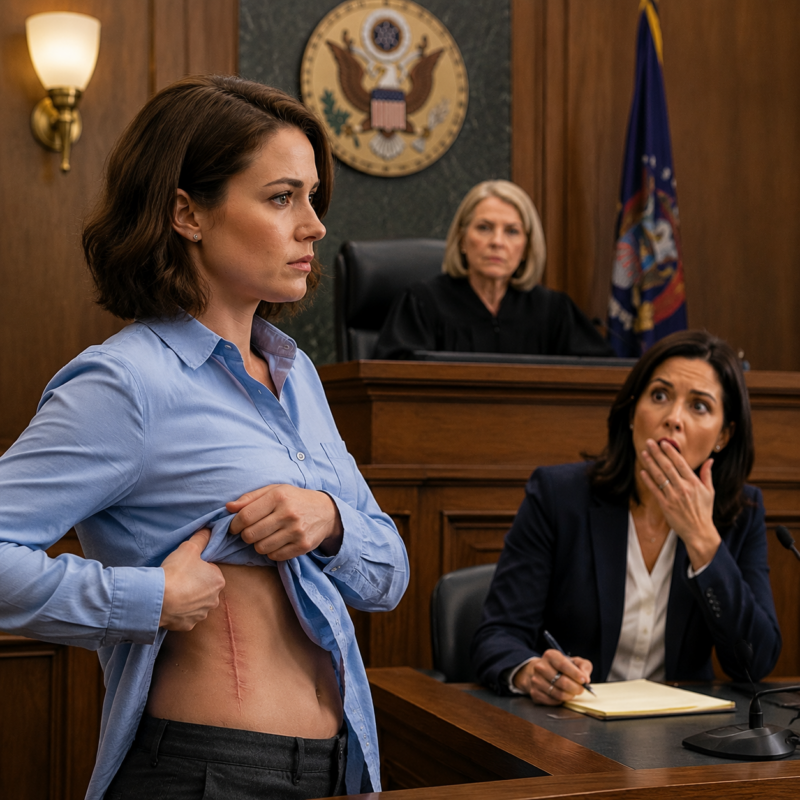
Madison Parker never expected the greatest battle of her life to take place inside a courtroom filled with strangers while her own mother stared at her like she was the enemy.
“My daughter is a liar,” Diane Parker said coldly under oath. “She never served in the military. She invented the entire story for attention, sympathy, and money.”
The words spread through the courtroom like poison.
Local reporters leaned forward. Curious townspeople whispered to each other. Several members of the Parker family sat proudly behind Diane, convinced they were about to witness Madison finally exposed.
But Madison didn’t react.
She didn’t cry.
She didn’t argue.
She simply sat there in silence, her eyes fixed on the judge while years of betrayal pressed heavily against her chest.
Because the truth was something she had carried far longer than any of them could understand.
And before that day ended, everyone in the room would realize just how far her own family had gone to destroy her.
Madison’s life had changed the moment she enlisted in the U.S. Army at eighteen.
She grew up in a small Missouri town where appearances mattered more than honesty. The Parker family had spent generations building a polished reputation in the community. They attended every charity event, every church fundraiser, every town celebration. To outsiders, they looked perfect.
Behind closed doors, things were very different.
Her mother, Diane, controlled everything.
The way the family dressed.
The way they spoke.
The image they projected.
And when Madison announced she wanted to join the Army, Diane reacted as though her daughter had personally humiliated her.
“You’re throwing your life away,” Diane snapped the night Madison signed the enlistment papers. “Do you know how people will talk about this family?”
Madison remembered standing in the kitchen gripping the edge of the counter while her father quietly watched from the doorway, too exhausted to intervene.
“It’s my life,” Madison replied softly.
“No,” Diane said sharply. “Everything you do reflects on this family.”
But Madison had already made her decision.
For the first time in her life, she wanted something bigger than the suffocating world she grew up in. She wanted purpose. Discipline. Meaning. She wanted to prove to herself that she was stronger than the fear that had controlled her for years.
So she left.
And from the moment she boarded the bus to basic training, something inside the Parker household fractured permanently.
At first, Diane tried to treat Madison’s military service like a temporary phase.
Whenever Madison came home on leave, the criticism started almost immediately.
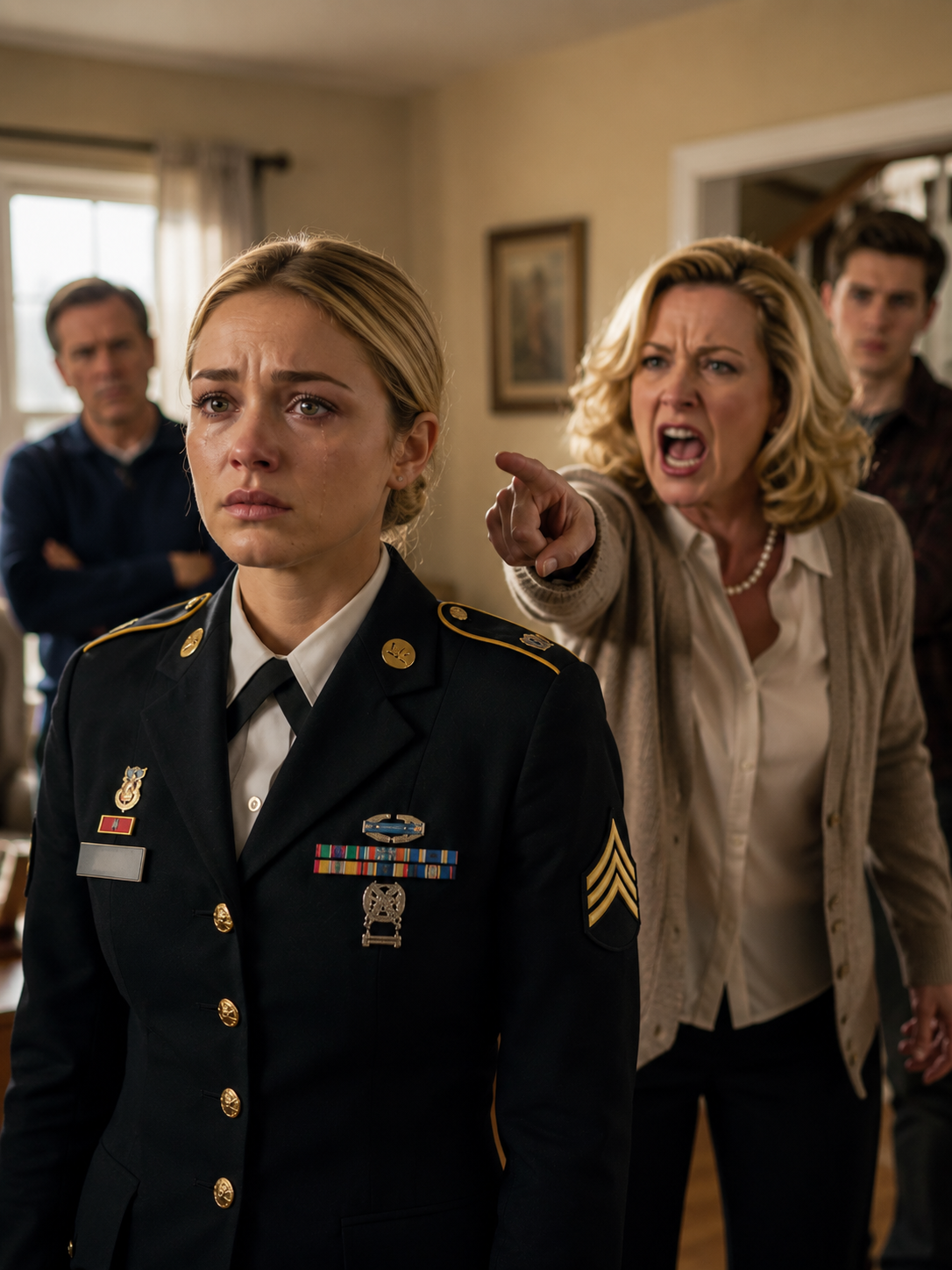
“Oh look,” Diane would say with a fake smile, eyeing the uniform. “What branch are you pretending to belong to this time?”
Sometimes relatives laughed nervously.
Sometimes Derek, Madison’s older brother, joined in.
“Careful,” he joked once during Thanksgiving dinner. “Madison might arrest us all with her imaginary military authority.”
Madison usually stayed quiet.
The Army had changed her. It taught her discipline, restraint, and endurance. She learned quickly that reacting emotionally only gave cruel people more power.
So instead of arguing, she focused on surviving deployments that most people in her hometown could never imagine.
She spent years moving between military bases and combat zones.
She learned how to function on almost no sleep.
She learned the sound of distant explosions.
She learned how quickly fear could turn into instinct.
And somewhere during those years overseas, Madison stopped expecting love from her family altogether.
Then Afghanistan happened.
Even years later, fragments of that night still haunted her.
The sound of gunfire.
Dust thick in the air.
Someone screaming over the radio.
The burning pain that tore across her shoulder when the bullet grazed her during a firefight.
She remembered collapsing behind cover while another soldier dragged her to safety.
She remembered the blood soaking through her uniform.
And she remembered staring at the sky afterward, wondering if she would ever make it home alive.
The scar remained long after the deployment ended.

But when Madison returned home months later, Diane barely looked at it.
Instead, her mother rolled her eyes and said, “Honestly, Madison, you make everything sound so dramatic.”
That was the moment something inside her finally broke.
Not because of the insult itself.
But because she realized her own mother would rather believe her daughter was a liar than accept that she had actually suffered.
After Madison’s father died, the situation became even worse.
He had always been the only person capable of softening Diane’s cruelty. Without him, there was nothing left to stop it.
Diane became openly hostile.
She started telling relatives that Madison exaggerated stories about her deployments.
Then she started suggesting something darker.
“She was barely even gone,” Diane whispered during family gatherings. “People just assume she served because she wears the uniform.”
The rumors spread slowly at first.
Then faster.
Some people in town began looking at Madison differently.
Others quietly questioned whether her military stories were real.
Madison heard all of it.
And still, she stayed silent.
Until her grandfather died.
Unlike Diane, Madison’s grandfather had always respected her service. He understood sacrifice in a way the rest of the family never did. Before his death, he quietly arranged his estate so Madison would inherit his home and a modest investment account directly.
Diane received nothing she could control.
And that changed everything.
The moment the will was read, Madison saw the rage in her mother’s eyes.
Derek looked furious too.
“What did you tell him?” Derek demanded afterward. “How did you manipulate Grandpa into this?”
Madison stared at him in disbelief.
“I didn’t manipulate anyone.”
But Diane had already decided what mattered most.
Control.
If she couldn’t dominate Madison emotionally anymore, she would try financially.
Within weeks, Madison was served with legal papers.
The accusations were unbelievable.
Diane and Derek formally claimed Madison had fabricated her military service to gain sympathy, social recognition, and influence over the family inheritance.
According to them, Madison had built her entire identity on a lie.
When the lawsuit became public, the town exploded with gossip.
Some people defended Madison.
Others weren’t so sure.
The Parker family name carried influence, and Diane knew exactly how to weaponize public opinion.
By the morning of the hearing, the courthouse was overflowing.
Reporters crowded near the entrance.
Neighbors whispered in the hallways.
Even distant relatives showed up, eager to witness the humiliation they believed was coming.
Madison walked through them alone.
Thirty-four years old.
Straight posture.
Calm face.
But underneath the surface, years of pain churned violently inside her.
Because this wasn’t just a lawsuit.
It was her own family trying to erase her life.
Inside the courtroom, Diane looked completely confident.
She wore an elegant cream-colored suit and pearl earrings, every detail carefully chosen to project respectability. Derek sat beside her with the smug expression of someone convinced victory was guaranteed.
When Diane took the witness stand, her performance was flawless.
“She invented everything,” Diane said firmly. “My daughter lied about serving in the military for years. She wanted attention. She wanted admiration. She embarrassed this family with these stories.”
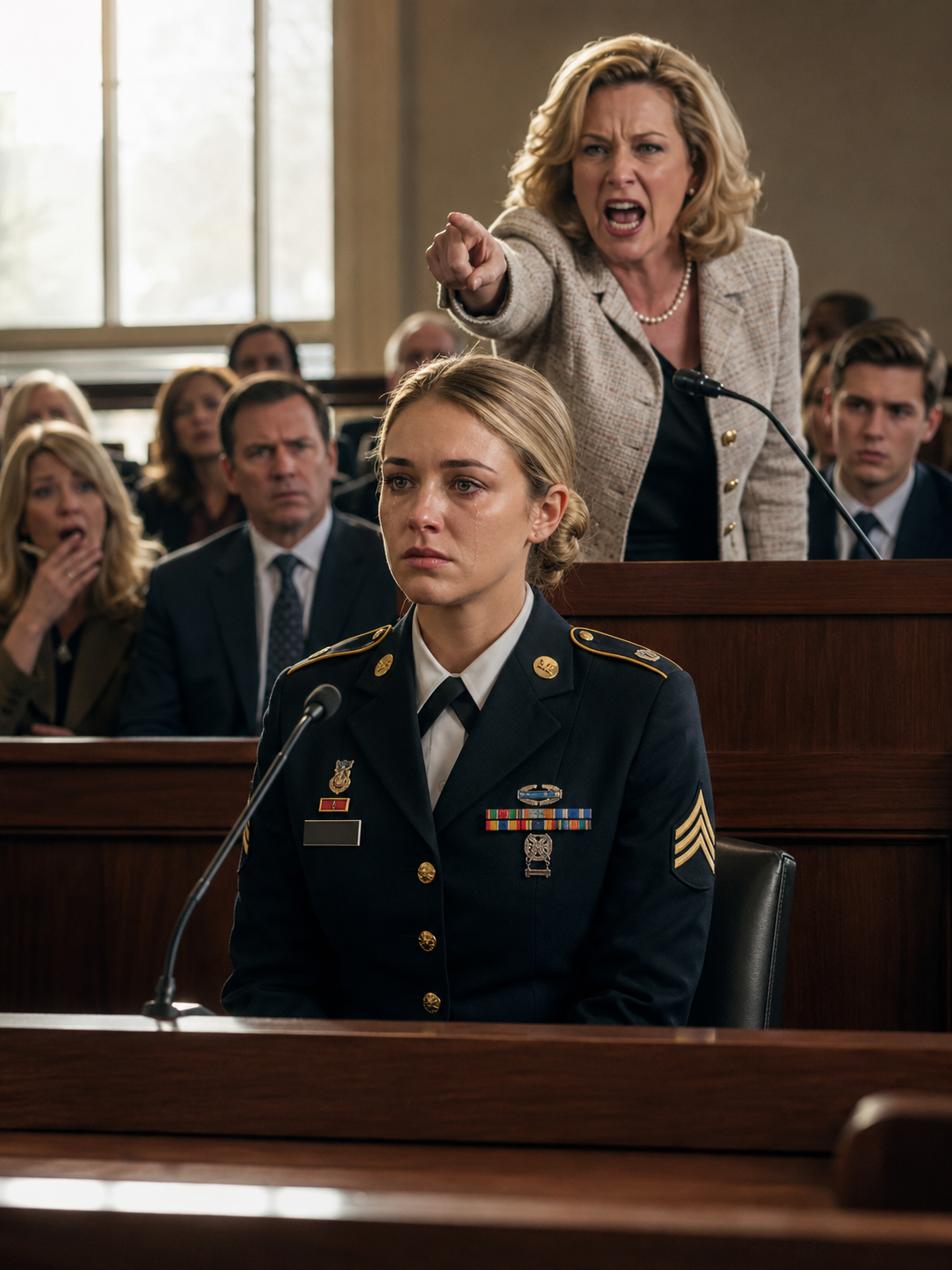
Several people in the courtroom exchanged shocked glances.
Diane continued without hesitation.
“Neighbors can testify she was home more often than she claims. She manipulated people into believing she was some kind of war hero.”
Madison felt every word like another knife twisting deeper.
Not because strangers believed it.
But because her own mother sounded so convincing.
Judge Allison Grant listened carefully, her expression unreadable.
When Diane finally stepped down, Derek added his own testimony.
“She’s been lying for years,” he said. “Honestly, we’re trying to protect the family name.”
Protect the family name.
Madison nearly laughed at the cruelty of it.
After everything she had survived overseas… after nearly dying for her country… her family was sitting in court pretending she was the disgrace.
Finally, Judge Grant turned toward her.
The courtroom became completely silent.
“Ms. Parker,” the judge said carefully, “do you have evidence confirming your military service?”
Madison slowly stood.
“Yes, Your Honor,” she answered quietly.
Then she paused.
“And more than that.”
For the first time all morning, people leaned forward in anticipation.
Madison reached for the sleeve of her blouse.
Slowly, deliberately, she pulled the fabric back.
Gasps rippled through the courtroom.
The scar stretched across her shoulder in a long jagged line, ugly and unmistakable.
It was not theatrical.
It was real.
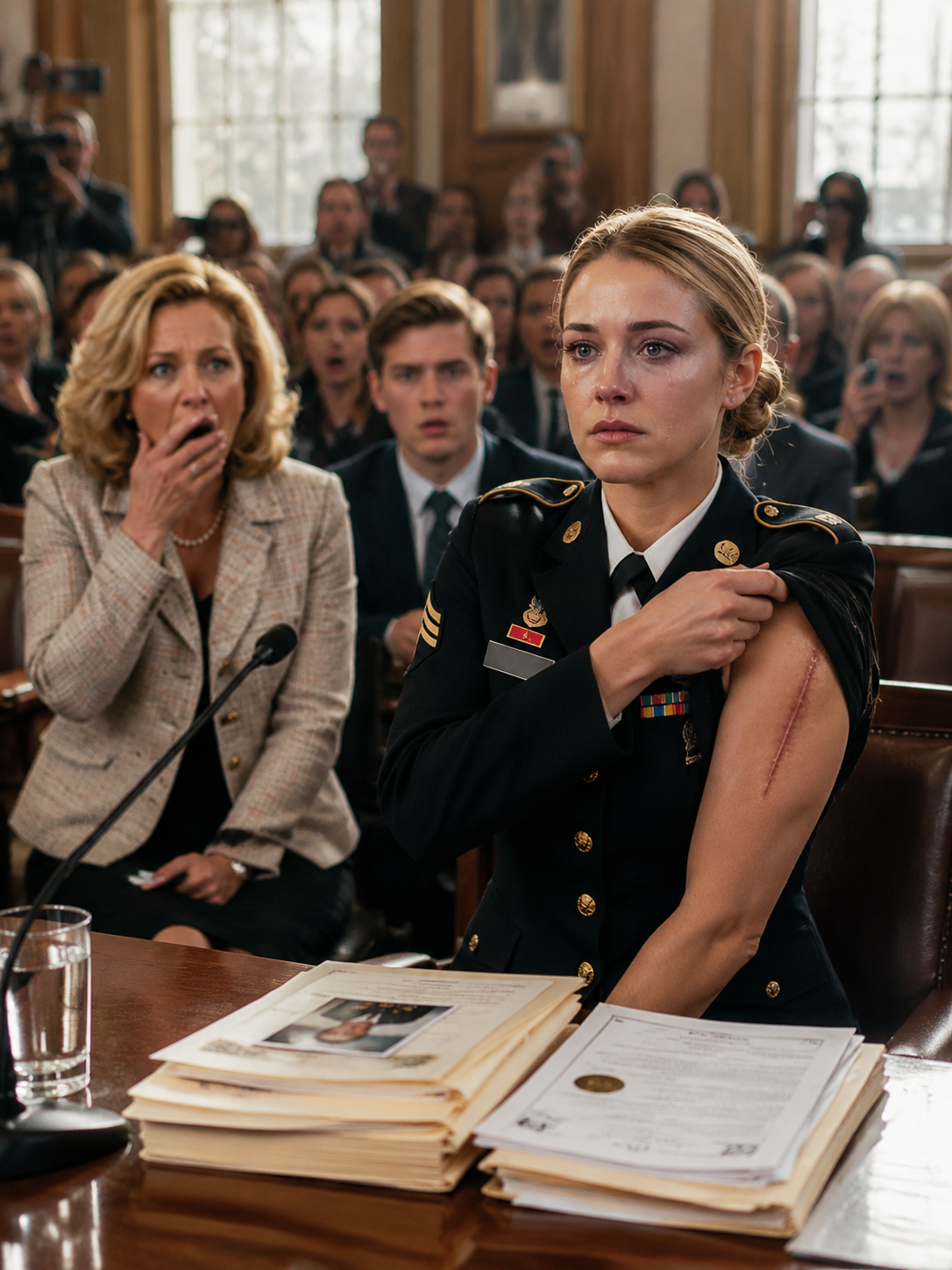
The kind of wound no one could fake.
Madison’s voice remained steady.
“A bullet grazed my shoulder during a firefight in Afghanistan,” she said. “I’ve lived with this scar for years.”
The silence that followed felt suffocating.
Diane’s face drained of color.
Derek’s smug grin disappeared instantly.
One of the relatives in the back lowered her eyes in visible shame.
Madison continued.
“I didn’t talk about it because I didn’t owe anyone proof of my pain.”
Every word landed harder than the last.
For the first time, people in the courtroom stopped seeing a family dispute.
They saw betrayal.
Real betrayal.
Judge Grant cleared her throat carefully.
“Do you have official records as well?”
“Yes, Your Honor.”
Madison handed over her DD214 discharge papers along with military service records confirming eight years of honorable service, overseas deployments, and combat-related injuries.
The judge reviewed them silently.
Then she looked directly at Diane and Derek.
“This documentation is conclusive.”
The courtroom held its breath.
“The lawsuit is dismissed effective immediately.”
Just like that, everything Diane had built collapsed.
Years of lies.
Rumors.
Manipulation.
Destroyed in seconds by the truth.
Diane sat frozen in her chair.
Derek looked stunned, unable to even meet Madison’s eyes anymore.
And Madison?
She didn’t smile.
She didn’t celebrate.
Because victory felt strangely quiet after carrying pain for so long.
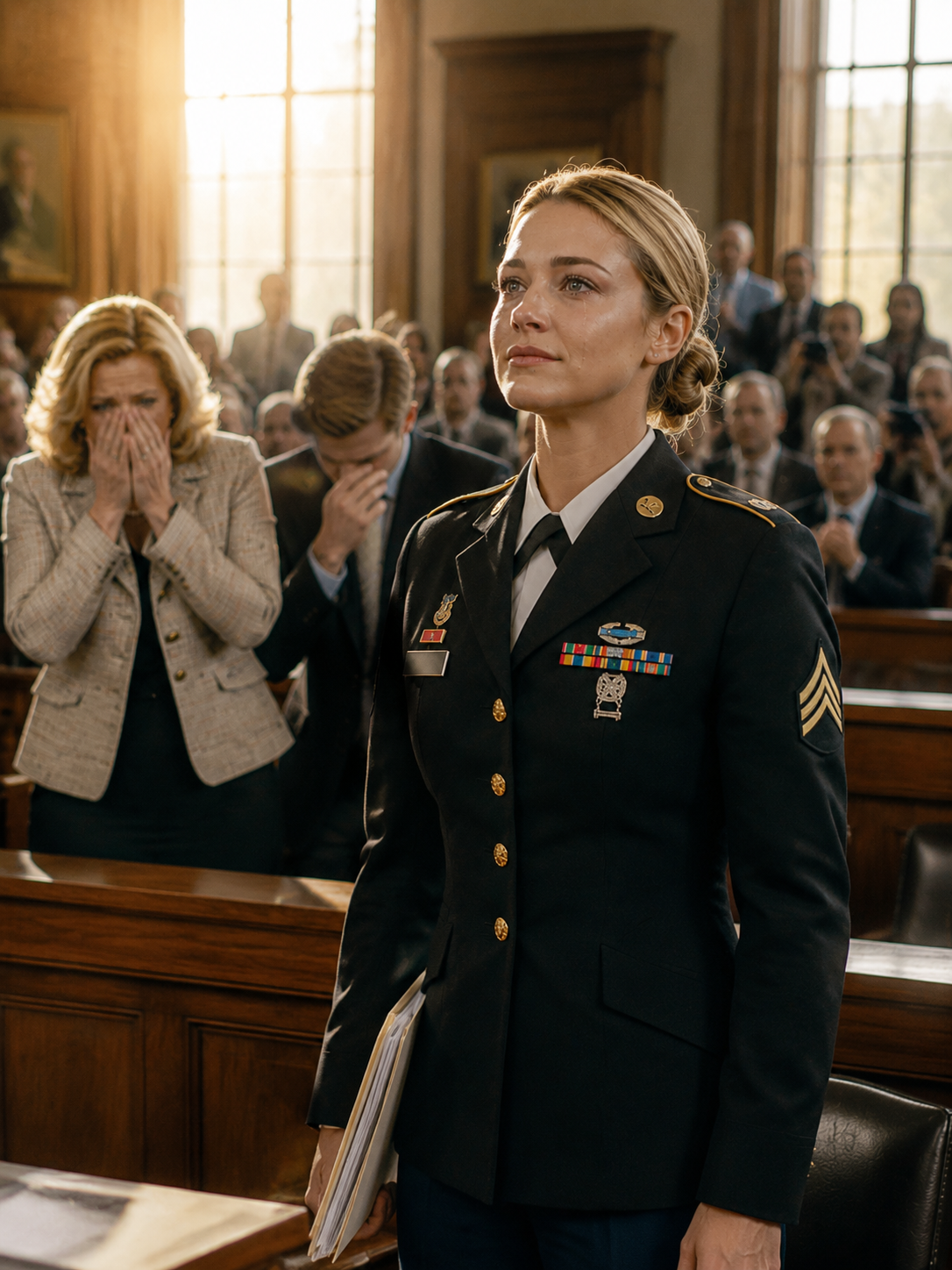
As people slowly began leaving the courtroom, whispers filled the air again—but this time the whispers were different.
Some looked at Madison with sympathy.
Others looked horrified by what her family had done.
A local reporter tried approaching her near the exit, but Madison kept walking.
She was done explaining herself to people who only cared once the truth became dramatic enough to entertain them.
Outside the courthouse, the cold Missouri wind brushed against her face as she stood alone on the steps.
For a moment, she closed her eyes.
And finally, after years of carrying the weight of silence, she allowed herself to breathe.
Not because the scars were gone.
They weren’t.
The physical scar across her shoulder would always remain.
So would the emotional wounds left behind by her mother and brother.
But the lies no longer owned her.
In the months that followed, Diane and Derek disappeared from Madison’s life almost entirely. Whether it was shame, pride, or fear of public judgment, neither of them ever truly tried to repair the damage they caused.
And Madison stopped waiting for them to.
Instead, she focused on rebuilding a life that belonged to her—not to the Parker family reputation.
Sometimes people in town still stared.
Sometimes they whispered.
But now, when Madison looked in the mirror, she no longer saw someone forced to defend her existence.
She saw a survivor.
A soldier.
A woman who endured combat overseas and betrayal at home—and survived both.
Because courage doesn’t always look the way people expect.
Sometimes courage isn’t found on a battlefield surrounded by gunfire.
Sometimes it’s found in a silent courtroom, where a daughter stands completely alone while her own family tries to erase the truth.
And refuses to let them win.
Note: This story is a work of fiction inspired by real events. Names, characters, and details have been altered. Any resemblance is coincidental. The author and publisher disclaim accuracy, liability, and responsibility for interpretations or reliance. All images are for illustration purposes only.
