
Stories
My Husband Handed Me Divorce Papers in My Hospital Bed… But My Final Gift Left Him Shattered

May
I woke up in a hospital bed three days after a car crash, expecting my husband to ask if I was alive, in pain, or afraid. Instead, Gerald placed divorce papers in my hand and told me he needed a wife, not a burden. Three weeks later, I gave him a parting gift that shook him to his core.
I still hear his voice sometimes: “I’ve filed for divorce.” That was the first thing he said when I opened my eyes.
I had been conscious for barely two minutes. My throat was dry, my legs were in traction, and my head was wrapped in bandages. Gerald stood at the foot of my bed with a lawyer beside him, pressed a pen into my hand, and delivered the words as casually as if he were announcing a change in dinner plans.
I whispered, “You’re not serious.”
He shrugged. “I am. I need a wife, Lisa. Not a burden.” Then he leaned closer and added, “The house is staying with me. It always suited me more, anyway.”
All of it had started because of a pizza.
That night, I had made lasagna from scratch—sauce simmered slowly, cheese layered carefully. Gerald took one bite, dropped his fork, and grimaced. “That again?”
“You said you liked it last week,” I replied.
“I want pizza, Lisa,” he snapped. “Don’t ruin my night.”
I suggested we go to a restaurant together. He was already reaching for his game controller. “I’m not going out. You can pick it up.”
It was 10 p.m. My instinct was to keep the peace, so I grabbed my keys. Gerald never looked up when I left. The last thing I remember was blinding headlights and the sound of metal crumpling.
Now, I don’t just grieve the crash—I grieve the version of myself who thought a husband’s childish demands were worth driving across town in the dark.
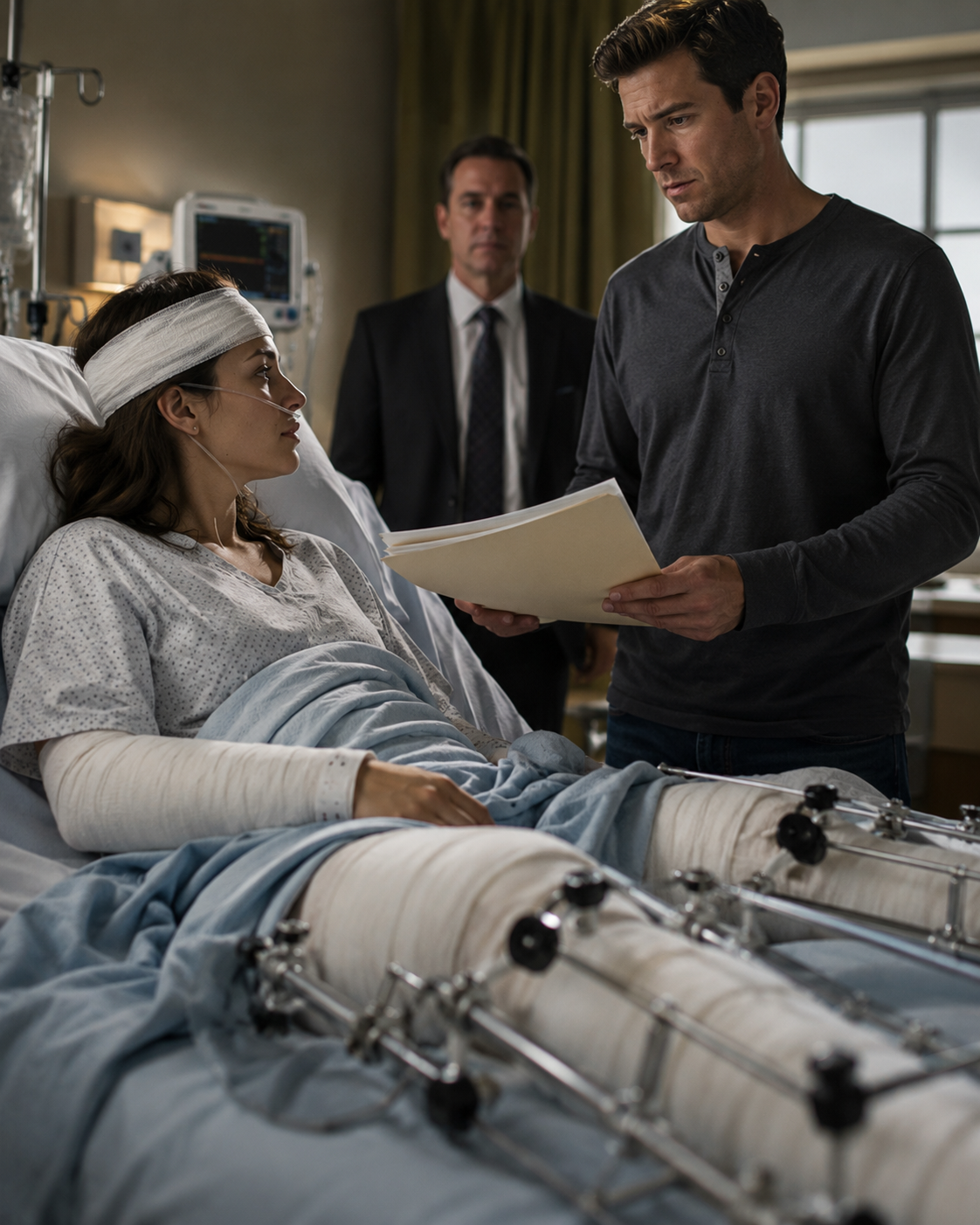
Three days later, I woke up expecting fear on Gerald’s face. Instead, I found convenience. He handed me divorce papers, told me not to make things difficult, and left with the lawyer.
Later, I learned something worse. While I was still unconscious, Gerald had already moved his assistant, Tiffany, into our bedroom—the same bed I had changed with my own hands just a week earlier.
I didn’t scream. I didn’t beg. I signed the divorce papers. That was the part Gerald never expected. He thought pain would make me cling, betrayal would make me plead. He was wrong.
I spent three weeks in that hospital bed thinking clearly about who he was, what I had paid for, and what he believed he was walking away with. By the time I was discharged, my body was weak, but my mind was steady. Sometimes survival begins with saying, “Fine, take everything,” while quietly ensuring the other person has no idea what that sentence will cost them.
When I returned home in a cab, Gerald was in my kitchen, Tiffany tucked against his side. He was flipping chicken in the skillet I had bought and seasoned over years of cooking. The man who once acted burdened by reheating soup was now cooking for another woman.
“Looks that way,” I said when he greeted me with a flat, “You’re back.”
He stepped aside coldly. “Pack what you need. I’d prefer this not drag out.”
I packed one small overnight bag. Twenty minutes later, I came downstairs and said, “You can have the house.” His face lit up. Tiffany looked around, already imagining new curtains.
“I even left you a small parting gift upstairs,” I added.
“What kind of gift?” Gerald asked.
“Something you’ve been waiting for. The documents you’ll need.”
He and Tiffany rushed upstairs, nearly tripping over each other. By the time I reached the bedroom doorway, Gerald had already torn open the package. Their smiles vanished. Gerald’s hands shook. “No.”
“Surprise,” I said.
And I wasn’t alone. Behind me stood Marlene, his mother. She had returned from overseas quietly and waited outside until I texted her to come in. The moment she stepped into the room, fear crossed Gerald’s face.
“M-Mom?”
Marlene’s voice was firm. “Are you surprised to see me?”
Inside the package was a full accounting of every dollar I had poured into that house—mortgage payments, repairs, appliances, renovations—all documented with receipts and transfers. Buried in the middle was a medical report.
Gerald slapped the stack onto the bed. “This is insane. You can’t do this.”
“You didn’t want a burden,” I said. “So I took one thing off your shoulders.”
Tiffany stared at the report, confusion turning to shock. “What is this?”
I answered: “For years, my husband blamed me for the fact that we never had children. He refused to get tested. He was happy letting me carry that sadness. But I got tested on my own. I’m perfectly fine… which means only one thing. Gerald is the reason.”
Gerald went pale. Tiffany’s confidence crumbled. “You lied to me?” she demanded.
He tried to recover. “That report doesn’t prove anything.”
“It proves enough,” I said.
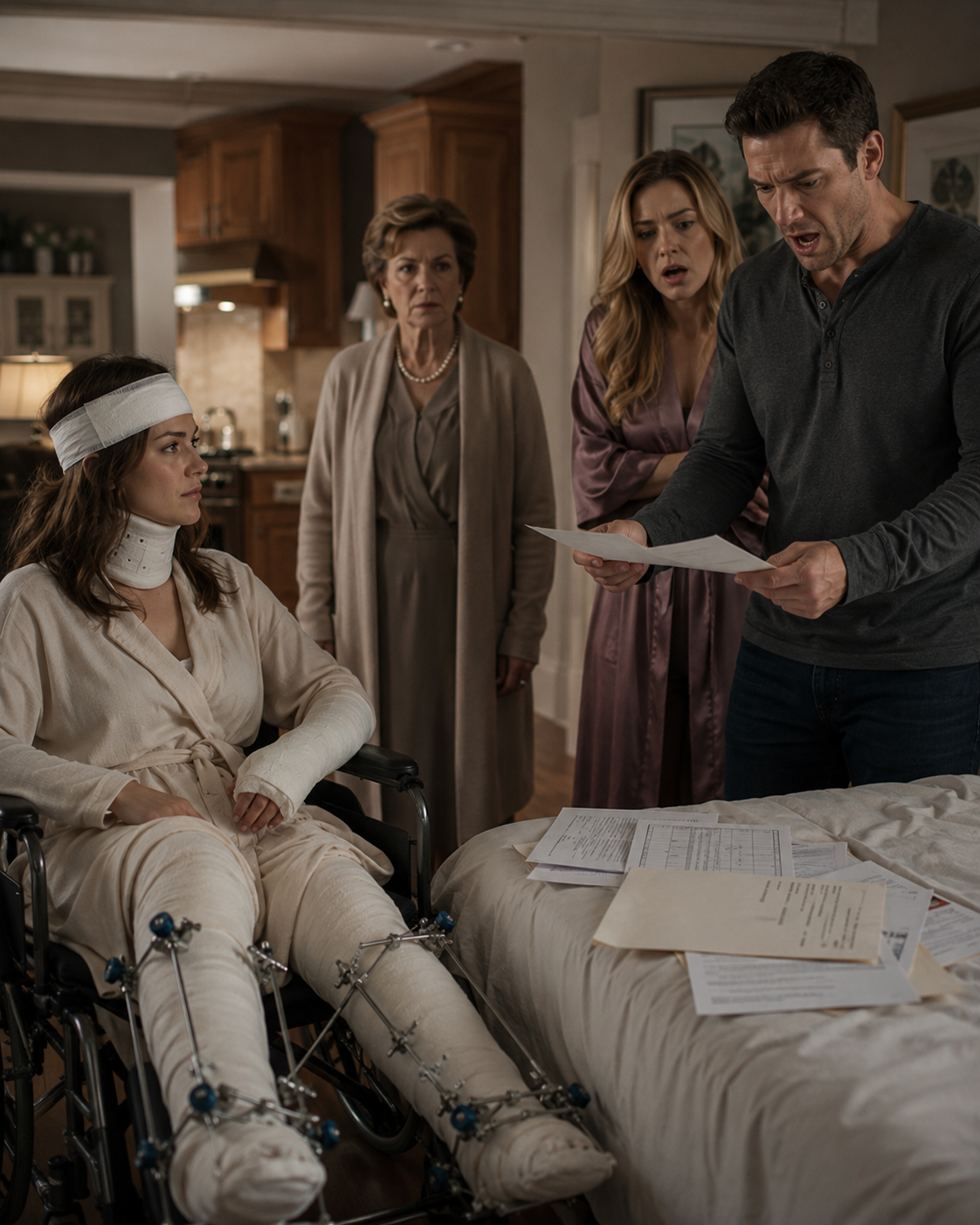
“You told me she was the reason,” Tiffany snapped. “You said she couldn’t give you the life you wanted.” She pulled away from his touch like it burned. “You lied to your wife; you lied to me.”
Marlene’s voice cut through: “Your father would be ashamed of the man you’ve become.”
Gerald laughed bitterly. “So everyone gangs up on me now?”
“No,” I said. “We just stopped covering for you.”
Tiffany grabbed her bag and left. Gerald called her name once, but she didn’t stop. That was the moment his fantasy cracked—not when I spoke, not when his mother judged him, but when the woman he had chosen over me saw nothing worth staying for.
Then I gave him the final blow. “I’ve already asked investigators to look at the car.”
His head snapped up. “What?”
“For a while, I wondered whether the brakes had failed on their own.”
Gerald went pale. “Are you saying I had something to do with the crash?”
“I’m saying I’m done guessing.”
I believed him when he said he hadn’t touched my car. That was the hardest part—not because I thought he was innocent, but because the crash was most likely exactly what it appeared to be: a terrible coincidence. And that made everything afterward worse, not better.
“You didn’t have to do anything to the car, Gerald,” I said. “You just left me when I needed you most.”
That landed harder than anything else. Marlene lowered her eyes. “I don’t know how you became this man.” Gerald had no answer.
I left the house an hour later with my bag, my purse, my paperwork, and whatever dignity I had left. Marlene accompanied me to my old apartment, insisting, “A woman should not be alone the first night after walking out of a fire.”
Investigators later confirmed the crash was not caused by tampering. Just a terrible accident—and a husband whose worst act came afterward. Somehow, that truth hurt even more. Gerald hadn’t needed a dramatic move to destroy the marriage. All he had to do was be himself at the ugliest possible moment.
He has been calling ever since, offering apologies that circle back to his own fear. He says he panicked, didn’t know what he was doing. But he knew enough to bring a lawyer to my hospital bed. He knew enough to move Tiffany in while I was unconscious. He assumed I would keep absorbing the damage quietly, the way I always had before. He was wrong.
Now I am back in my old apartment—not with the same furniture, body, or life, but with the same narrow kitchen and the same little balcony where the afternoon light still falls at an angle I love. The divorce papers are signed. The hearing is coming soon.
Marlene visits twice a week, bringing groceries I don’t ask for, sitting at my table, saying the kind of honest things only older women seem brave enough to say. She chose justice over blood, and I will respect her for that as long as I live.
Gerald keeps asking how I can be so cold. I am not cold. I am clear. He did not just leave me—he revealed himself. And only I know exactly what I survived.
Some endings break you first. Then they free you.
Note: This story is a work of fiction inspired by real events. Names, characters, and details have been altered. Any resemblance is coincidental. The author and publisher disclaim accuracy, liability, and responsibility for interpretations or reliance. All images are for illustration purposes only.
