
Stories
They Stole My Baby When I Was 17 — 21 Years Later, Fate Brought Him Back Next Door
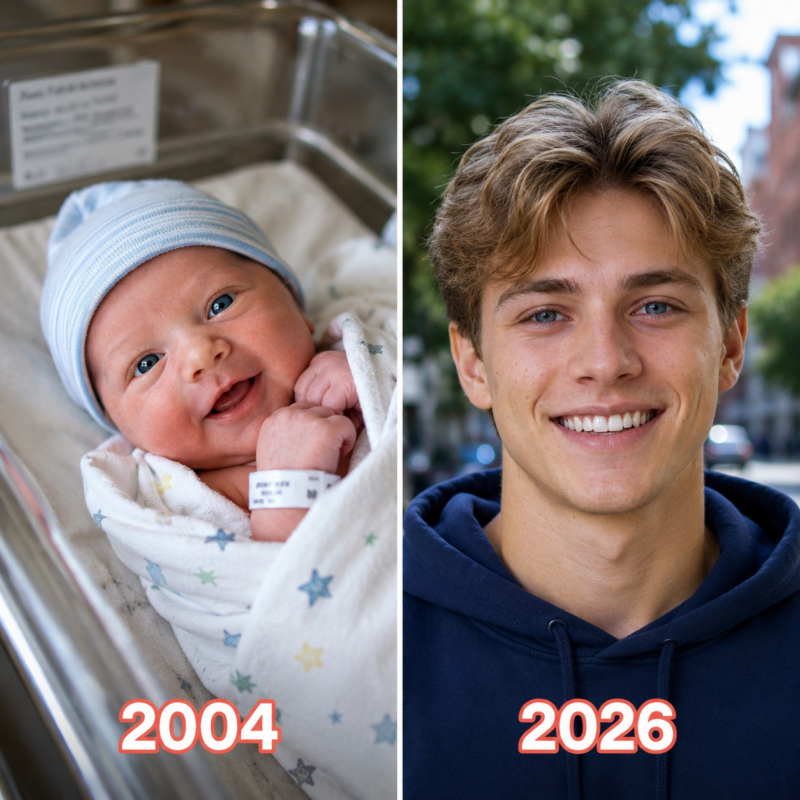
May
I Was Seventeen When They Took My Baby Away — Twenty-One Years Later, the Man Next Door Smiled at Me with My Son’s Eyes
I’m thirty-eight now.
From the outside, my life looks peaceful. I have a stable job, a quiet house on a calm suburban street, and routines so ordinary they almost feel rehearsed. My father lives in the guest room because age has finally made him fragile in ways guilt never did. Most evenings, I make dinner while he watches television too loudly and pretends not to notice how often he repeats himself.
People look at my life and see calm.
What they don’t see is the silence I learned to build around grief.
I was seventeen when I got pregnant.
My parents never screamed at me. That would have required emotion, and emotion was messy. My family didn’t do messy. They were wealthy, respected, admired in every room they entered. Reputation mattered more to them than honesty ever had.
So instead of anger, they chose control.
My mother made several quiet phone calls behind closed doors.
My father stopped looking me in the eye.
Within days, everyone around us was told I had gone away for a “health retreat.”
That was the phrase they used.
As if exhaustion were the problem.
As if shame could be treated somewhere private.
But there was no retreat.
It was a clinic in another town, hidden behind tall hedges and frosted windows. The rooms smelled like antiseptic and silence. I wasn’t allowed visitors. I wasn’t allowed my phone. Every door felt locked even when it technically wasn’t.
Whenever I asked questions, I received the same cold answers.
“This is temporary.”
“This is for the best.”
“You’ll understand later.”
No one ever explained what “best” meant.
The night I gave birth, I thought I was dying.
I remember the pain. The fluorescent lights above me. The nurses speaking softly to one another as if I wasn’t there. I remember gripping the rails of the bed so hard my fingers cramped.
And then—
I heard him cry.
Just once.
A thin, trembling sound.
Fragile.
Alive.
My entire body reacted before my mind could. I tried to sit up immediately.
“Please,” I begged. “Please let me see him.”
Nobody answered me.
A nurse avoided my eyes. Another adjusted equipment that didn’t need adjusting.
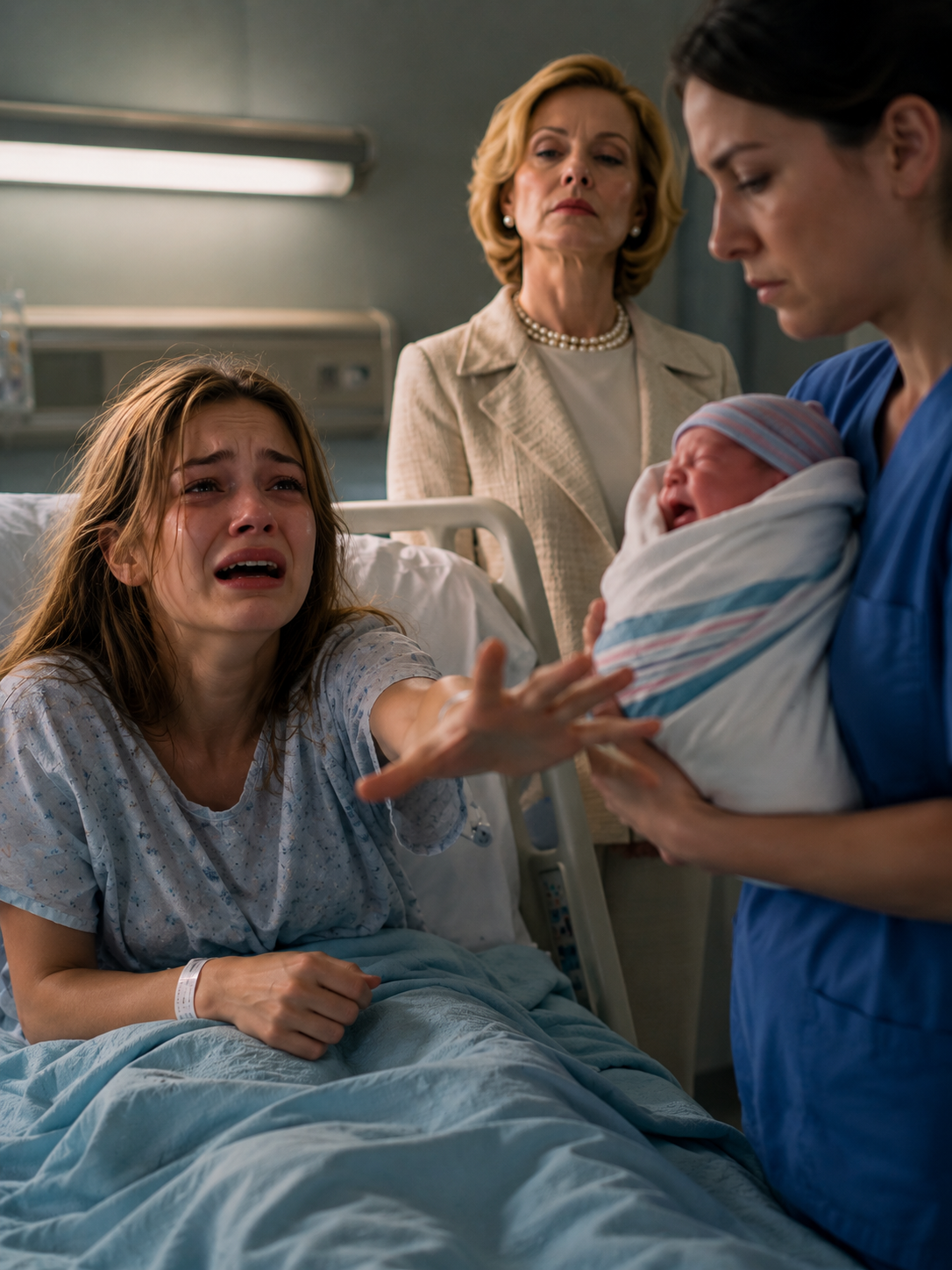
Then my mother walked into the room.
Perfect as always. Calm. Elegant. Controlled.
Not a strand of hair out of place.
She stood beside my bed and said, in the same tone someone might use to discuss the weather,
“He didn’t make it.”
That was all.
No explanation.
No details.
No proof.
I remember staring at her in disbelief.
“No,” I whispered. “I heard him cry.”
Her expression never changed.
“You need rest.”
A doctor entered. Someone injected something into my IV. The room blurred around the edges.
The last thing I remember before losing consciousness was trying to say the word “baby” again.
When I woke up, the world felt hollow.
Not sad.
Empty.
As though someone had reached inside me and removed something vital while I slept.
I asked the first question that entered my mind.
“Where is he?”
My mother sat in the corner reading a magazine. She turned a page before answering.
“You need to move forward.”
I asked if there would be a funeral.
“There’s nothing for you to do here,” she replied.
Nothing.
As if my child had vanished so completely that even mourning him was inconvenient.
That night, after she stepped out of the room to take a phone call, a nurse returned quietly. She looked nervous, glancing toward the hallway before closing the door halfway behind her.
Then she slipped me a small folded piece of paper.
“If you want to write something,” she whispered, “I’ll try to send it with him.”
I stared at her for several seconds because by then, I had nothing left inside me except pain.
But pain still leaves room for love.
With shaking hands, I wrote one sentence:
“Tell him he was loved.”
That was all I could manage.
I folded the note carefully and handed it back along with the only thing I had secretly made during the pregnancy—a small blue blanket with yellow birds stitched into the corners.
I had worked on it late at night when no one was watching.
Every stitch had been hope.
The nurse took both items and disappeared.
The next morning, they were gone.
Later, when I finally gathered enough courage to ask about the blanket, my mother said she had burned it.
“It wasn’t healthy for you to hold on to things,” she told me.
Then, before my body had even healed properly, they sent me away to college.
No grave.
No records.
No goodbye.
Nothing.
After a while, I stopped asking questions because every question only reopened the wound. I learned how to carry grief quietly. I learned how to smile at holidays and sit through conversations and pretend there wasn’t an invisible absence beside me every day of my life.
Years passed.
My mother died two years ago.
My father moved in with me last year after his health started failing. His memory slips sometimes now. He forgets appointments. Repeats stories. Leaves drawers open.
But selective memory is still memory.
And my father has always remembered exactly what benefits him.
Last week, a moving truck arrived at the house next door.
I was outside pulling weeds from the flower beds when I saw him for the first time.
A young man stepped out of the truck carrying a floor lamp over one shoulder.
And my heart nearly stopped beating.
Dark curls.
Sharp cheekbones.
My chin.
For one terrifying second, it felt like the universe had physically tilted beneath my feet.
I immediately told myself I was imagining things. Grief makes people desperate. People see ghosts in strangers every day.
Then he smiled at me.
“Hi,” he called. “I’m Miles. Looks like we’re neighbors.”
I answered him. At least I think I did.
I don’t remember the conversation because all I could focus on was the unbearable familiarity of his face.
When I finally went back inside, my hands were shaking so badly I nearly dropped my keys.
My father was in the kitchen pouring himself tea.
I tried to sound casual when I spoke.
“The new neighbor looks like me.”
At first, he didn’t react.
Then suddenly he did.
Too fast.
Too sharp.
His hand froze halfway to the cup. Color drained from his face so quickly it frightened me.
And in that instant, something deep inside me shifted.
Two days later, I learned why.
He had already gone next door while I was at work. He saw Miles’s last name on a package sitting near the door and recognized it immediately.
It belonged to the couple who had adopted my baby.
My father hadn’t forgotten anything.
He had simply buried it.
Three days after the moving truck arrived, Miles knocked on my front door holding a coffee mug.
“I made too much coffee,” he said with an awkward smile. “Want to come over?”
I should have said no.
Every instinct told me not to walk into that house.
But I followed him anyway.
The moment I stepped inside, everything changed.
Time stopped.
There, draped casually across the back of a chair—
was the blanket.
Blue wool.
Yellow birds stitched carefully into the corners.
Mine.
The same blanket my mother claimed she had burned twenty-one years earlier.
The room tilted around me.
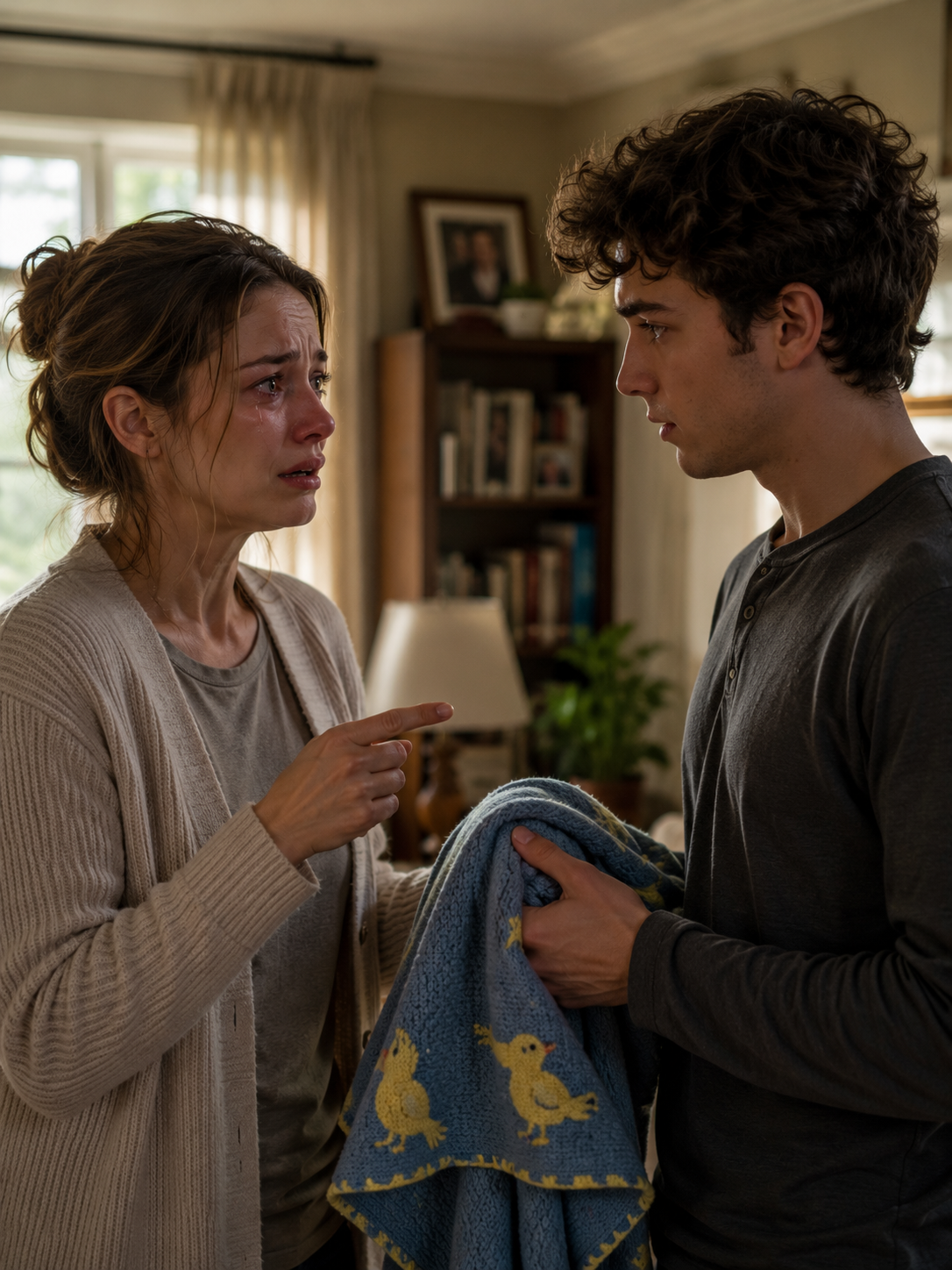
I pointed at it with trembling fingers.
“Where did you get that?”
Miles picked it up gently.
“I’ve had it my whole life,” he said. “My parents gave it to me when I was little.”
I couldn’t breathe.
Then he added softly,
“I was adopted when I was three days old. My parents told me my birth mother left me with this blanket… and a note.”
Every sound in the room disappeared.
“What note?” I whispered.
He looked directly at me.
“‘Tell him he was loved.’”
The words hit me like a physical blow.
That was the moment I knew.
Not hoped.
Not wondered.
Knew.
Behind me, I heard movement.
My father had appeared in the doorway.
“Claire,” he said urgently, “we need to go.”
But it was already too late.
The truth had finally found us.
I turned toward him slowly.
“What did you do?”
He looked older in that moment than I had ever seen him.
When I demanded answers, he finally broke.
“She arranged the adoption,” he admitted weakly.
“Who?” I asked, though I already knew.
“Your mother.”
The room fell silent.
My father’s voice shook as he continued.
“She told the clinic the baby had died. Not everyone… just enough people. There was a lawyer involved. Papers were signed. You were a minor, Claire. You never legally agreed to any of it.”
I stared at him in horror.
“You let me mourn a child who was alive?”
Tears filled his eyes.
“I didn’t know how to stop it.”
“And that excuse kept you silent for twenty-one years?”
He opened his mouth.
Nothing came out.
Miles stood frozen between us, gripping the blanket tightly.
Then, quietly, almost fearfully, he asked,
“Are you saying… you’re my mother?”
My vision blurred with tears.
“I think I am.”
He swallowed hard before asking the only question that mattered.
“Can you prove it?”
“Yes,” I said immediately. “DNA tests. Records. Anything you need. But before any of that, you need to know something first.”
My voice broke.
“I never gave you away. I was told you died.”
Miles lowered his eyes to the blanket, brushing his thumb over one of the yellow birds.
“My parents always told me my birth mother was very young,” he murmured. “That she left this for me because she loved me. There was never a name. Nothing else.”
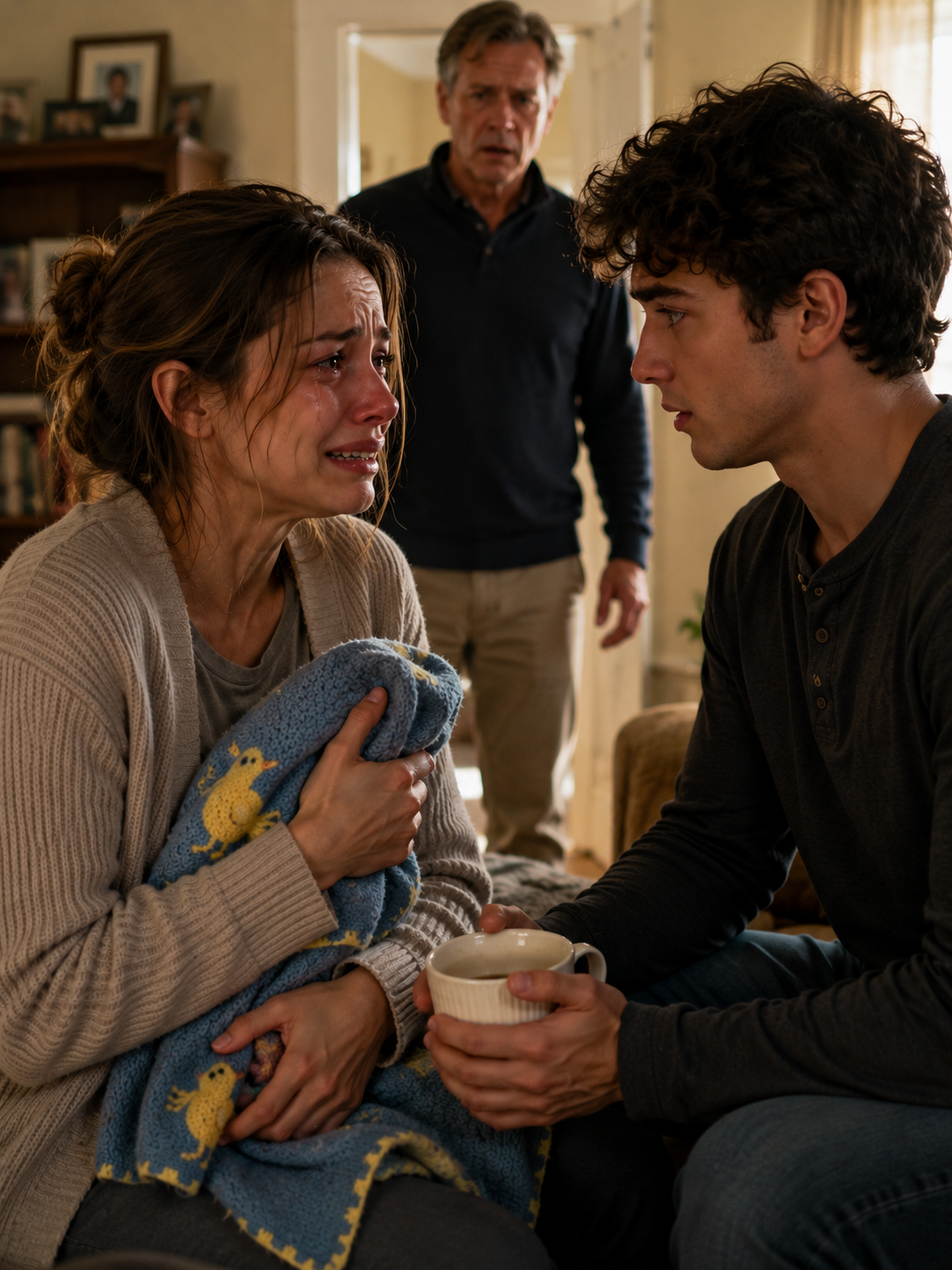
“They didn’t know the truth either,” my father said quietly. “They were lied to too.”
Miles ignored him completely.
His eyes stayed on me.
“You made this?” he asked.
“Yes,” I whispered. “Every stitch.”
For a long moment, nobody moved.
He looked torn apart inside, caught between the life he had always known and the impossible truth standing in front of him.
Then slowly… carefully… he held the blanket out toward me.
Not as proof.
Not as forgiveness.
As something shared between us.
My hands shook as I took it back.
I pressed it against my chest and buried my face in the faded blue wool.
And for the first time in twenty-one years—
I allowed myself to grieve out loud.
Not silently.
Not politely.
Not behind closed doors.
I cried for the seventeen-year-old girl who had begged to hold her baby.
For the years we lost.
For every birthday I never saw.
For every moment stolen from both of us.
Miles stayed.
We sat in his living room for hours talking through pieces of a life neither of us understood anymore.
Nothing about it was simple. Nothing about it magically healed the damage.
There were still questions.
Still anger.
Still years between us that could never be returned.
But before I finally left that night, he handed me another cup of coffee and gave me a small, uncertain smile.
“‘Mom’ might be too much right now,” he said awkwardly. “But… coffee works.”
And somehow, after twenty-one years of believing I had lost everything—
coffee was enough.
Note: This story is a work of fiction inspired by real events. Names, characters, and details have been altered. Any resemblance is coincidental. The author and publisher disclaim accuracy, liability, and responsibility for interpretations or reliance. All images are for illustration purposes only.
