
Stories
My Fiancé’s Mother Humiliated Me In A $14,000 Wedding Dress — But She Had No Idea I Was About To Destroy Her Family’s Empire
May
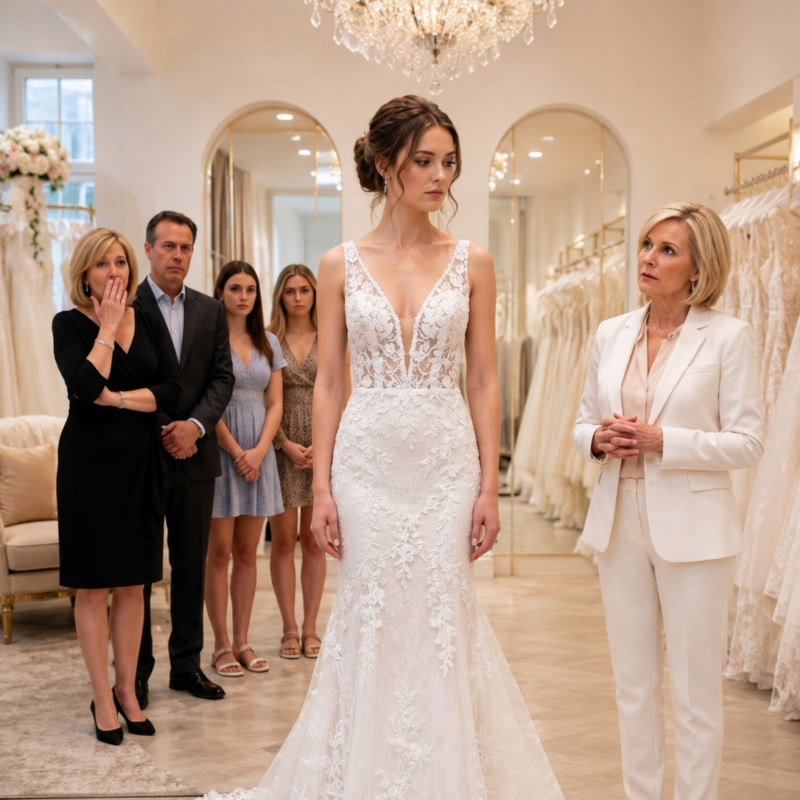
At my bridal fitting, my fiancé’s mother slowly looked me over in a fourteen-thousand-dollar gown and said, “White is for women who actually have a family waiting for them at the end of the aisle.” And while the entire salon fell silent around us, my fiancé dropped his gaze to the floor and said absolutely nothing.
The words did not come all at once. They arrived carefully, one blade at a time, each syllable sharpened before Beatrice Sterling released it into the room.
The bridal boutique on Rodeo Drive became so quiet I could hear the faint hiss of satin as a consultant shifted behind me. Somewhere near the wall of veils, a woman inhaled sharply. Another guest froze with a crystal champagne flute halfway to her lips, staring at me with open sympathy.
Even the music—some soft instrumental version of an old love song—suddenly sounded cruel.
And there I stood on a mirrored platform, wrapped in a gown that looked like it had been stitched from winter itself.
The dress was white in the purest sense of the word. Not ivory. Not cream. Not champagne. Pure white.
French lace climbed over my shoulders like frost, hand-sewn pearls floated across the bodice like drops of light, and the cathedral train spilled behind me in silk and tulle so beautiful it almost hurt to look at.
It was the kind of gown that made little girls believe weddings meant safety. Belonging. Permanence.
And for one devastating second, I was no longer thirty-two years old or the CEO of one of the most powerful firms in San Francisco.
I was eight again, standing at the window of a Newark group home while another child got chosen by a family.
I was eleven, overhearing foster parents whisper that I was polite but distant because children always know when they’re unwanted.
I was sixteen in a borrowed dress at a scholarship banquet, smiling through dessert while people politely asked which parents had come with me.
“No one,” I had answered then.
The old humiliation came rushing back so violently it stole the air from my lungs.
My eyes moved toward Miles.
He stood just outside the fitting area with one hand shoved into his pocket and the other loosely gripping a champagne glass. He had the kind of face magazines loved and the kind of voice that always sounded sincere when apologizing.
But in that moment, beneath his mother’s cruelty hanging in the air for everyone to examine, Miles lowered his eyes to the carpet as if its pattern had suddenly become fascinating.
He did not defend me.
He did not tell her to stop.
He did not even say my name.
His silence spread through me like ice water.
Beatrice gave a small, almost sorrowful smile, as though she were bravely saying what everyone else lacked the refinement to admit.
She adjusted the cuff of her silk jacket and casually acknowledged the audience around us. Women like Beatrice adored audiences. When they commanded attention, it was called elegance. When others did it, it became impropriety.
“I’m only trying to spare you embarrassment, Camille,” she said smoothly. “These things matter in our circles. White has meaning. Tradition has meaning. One should respect both.”
Tabitha, Miles’s younger sister, shifted her designer handbag higher onto her shoulder and avoided my eyes entirely. Aunt Josephine offered the tiniest approving nod, as though Beatrice had simply corrected an etiquette mistake at dinner.
Twelve strangers stood there watching me decide what kind of woman I would become.
A sales associate named Sarah looked seconds away from crying on my behalf.
Very carefully, I stepped down from the platform, because women in fourteen-thousand-dollar gowns do not stumble no matter how badly someone wants to wound them.
I looked directly at Beatrice and simply said, “Okay.”
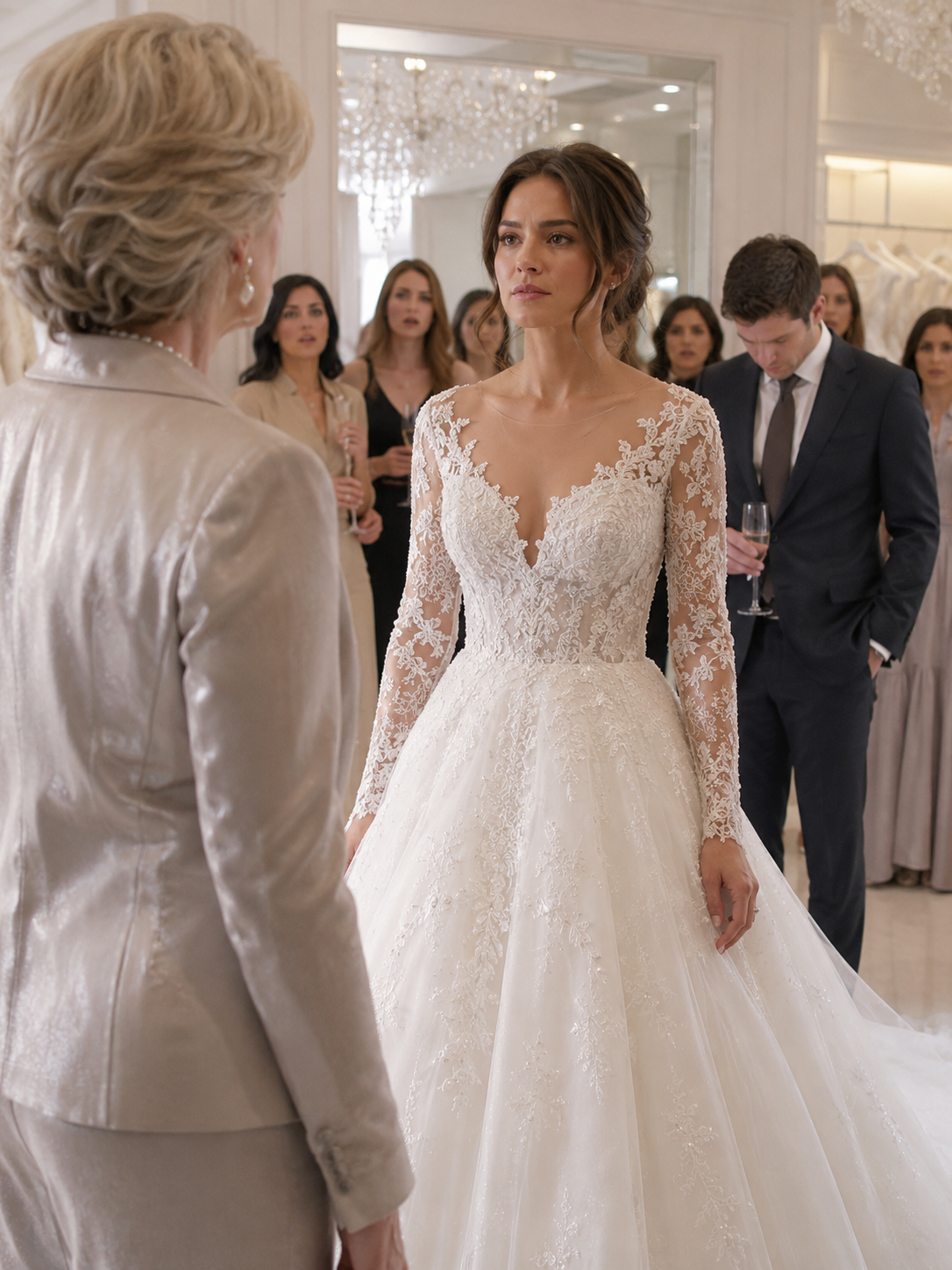
For the first time that afternoon, surprise flickered across her face.
“Beg your pardon?” she asked.
“You’re right,” I replied calmly. “I’ll change.”
I smiled the same way I smiled in negotiations when arrogant men mistook composure for weakness.
Beatrice had expected tears. Or anger. Or desperate explanations.
Instead, I turned, gathered the skirt in my hands, and walked back into the dressing room.
Inside, the air smelled faintly of expensive perfume and rising fury. Sarah followed me in with trembling hands.
“I am so sorry,” she whispered.
I met her eyes in the mirror and realized she was learning, in real time, that wealth and cruelty often arrive together.
“It’s not your fault,” I told her softly.
Then I reached up and unfastened the pearl buttons at my shoulders myself. My hands never shook once, and somehow that mattered more to me than anything.
There are moments in life when composure becomes the only victory available.
When people expect you either to collapse or explode, there is power in giving them neither.
I had learned that lesson in corporate boardrooms and in cramped kitchens where foster parents argued about bills while pretending children couldn’t hear.
Standing there in the slip beneath the gown, I stared at my reflection.
Women often have complicated feelings about wedding dresses.
Mine had always been painfully simple.
I had never dreamed about a wedding spectacle. I had dreamed about what weddings implied.
Belonging.
That dress made me look like I belonged somewhere.
And that was exactly why Beatrice hated it.
Once I changed back into my navy wool dress, I folded the gown over my arms more carefully than I had handled some men’s careers.
Sarah accepted it like something sacred.
I thanked her for her time and headed toward the exit.
“Camille, wait.”
Miles’s voice followed me halfway to the door.
I stopped but did not turn around.
He hurried closer and lowered his voice. “Don’t leave like this.”
I finally faced him. “Like what?”
He exhaled sharply. “My mother just gets intense sometimes.”
And in that moment, I truly saw him.
I saw the handsome man I had kissed over candlelit dinners. The man who had listened to his mother tell his fiancée she was unworthy of wearing white because she came from nowhere.
And afterward, he wanted me to help make the moment smaller so he could survive it comfortably.
“Enjoy the rest of your appointment,” I told him.
Then I walked out into the cold California afternoon.
I didn’t cry in the car.
I didn’t cry in the elevator.
I didn’t cry when I entered the apartment Miles believed was the nicest place I had ever lived in, unaware that I spent more each month securing the building than he paid for rent.
I slipped off my heels beside the console table and stood in silence.
The apartment occupied the top three floors of a restored historic building overlooking the bay. Floor-to-ceiling windows wrapped around white oak floors and a private library with rolling ladders.
Almost no one knew the property belonged to me.
Miles had never even been inside.
That had never been accidental.
From the beginning, I kept parts of myself locked away out of self-preservation.
I had wanted one honest thing.
I wanted a man who saw me before he saw what I represented.
Miles knew I worked in finance. He knew I was successful.
But he did not know Kensington Capital managed more than forty-seven billion dollars in assets.
He did not know the tower in the Financial District with KENSINGTON etched in steel across the entrance carried my name because I built it.
And he certainly did not know his father’s law firm had spent months negotiating the biggest merger of its existence with my company.
That night, he arrived carrying apologies disguised as excuses.
He brought flowers.
He opened a bottle of wine from my kitchen without asking, because somewhere along the way, he had confused access with intimacy.

“Camille, I’m sorry,” he said quietly.
I leaned against the counter. “Specifically?”
He flinched.
“I’m sorry for how my mother spoke to you,” he said. “And for not handling it better.”
I stared at him. “Do you know what I heard when she said those things?”
He stayed silent.
“I heard that no matter what I build, no matter how successful I become, I will always be the little girl nobody chose,” I said. “And when you stood there saying nothing, Miles, I heard you agreeing with her.”
“That’s not fair,” he snapped defensively.
I almost laughed.
“Was it fair when your mother humiliated me in front of strangers while you worried about your own discomfort?”
“You know how my family is,” he argued.
“Yes,” I said quietly. “Now I do.”
But he kept talking. His mother was stressed. Obsessed with appearances. Under pressure.
“Stop,” I said coldly. “I will not spend the rest of my life translating cruelty into stress just so powerful people can stay comfortable.”
His jaw tightened. “I came here to fix this.”
“No,” I corrected him. “You came here to make this survivable.”
Something cracked between us then, the way glass fractures before it completely shatters.
“She’ll apologize tomorrow,” he insisted. “We all just need to calm down.”
I studied him for a long moment.
Then I said, “Go home and sleep, Miles.”
It was the kindest thing I had left to offer him.
He left close to midnight.
After the apartment fell silent again, I walked into the office at the end of the hall and sat behind the long black desk where I had signed deals capable of reshaping industries.
I opened my laptop and logged into the secure server.
Then I clicked on the Sterling & Sons international expansion merger.
The transaction would inject prestige, liquidity, and survival into Henry Sterling’s aging litigation firm. Without it, they were vulnerable.
Without it, they were drowning.
I leaned back slowly.
Revenge is never clean.
Neither is power.
But what I felt that night wasn’t simple anger.
It was clarity.
Miles’s silence had revealed the future waiting for me if I married him: a lifetime of insults repackaged as misunderstandings.
Beatrice would never change.
She would simply become closer. Louder. More entitled.
And once truth exposes itself, pretending not to see it becomes self-betrayal.
At 6:47 the next morning, I emailed my head of acquisitions and instructed her to withdraw from the merger immediately with no public explanation.
By 7:30, Rose sat across from me in the forty-seventh-floor conference room.
She had been beside me since Kensington Capital was small enough to fit into one office.
“Sterling is contained,” she said, sliding a memo across the table.
Then she looked at me carefully.
“You’re canceling a highly profitable deal over something material that didn’t happen in this building.”
I held her gaze.
Understanding settled over her expression.
“Do I need details?” she asked.
“No.”
She nodded once. “Understood.”
By 9:00 a.m., financial reporters were already circling rumors they couldn’t yet confirm.
By market close, the Sterling firm’s collapse had become impossible to hide.
I was midway through a meeting when my assistant Megan stepped inside.
“There’s a Miles Sterling in reception,” she said carefully. “He says it’s urgent.”
When Miles walked into my office, he stopped so abruptly I thought he had collided with the glass wall.
His eyes moved from the skyline to me and back again, as though reality required visual confirmation.
“What is this?” he whispered.
“This,” I replied calmly, “is my office. Sit down.”
He stayed standing.
“You’re Camille Kensington?” he asked.
“I’m the woman who just withdrew from your father’s merger.”
He dragged a hand through his hair. “Why didn’t you tell me who you really were?”
“Because what I own is not the most important thing about me.”
He actually laughed once, short and broken.
“This merger is destroying my father’s firm,” he said. “Do you understand that?”
I walked toward the windows overlooking the city.
“I wanted one honest thing,” I said quietly. “A man who saw me before he saw my value.”
“You were never unwanted by me,” he insisted weakly.
“No,” I said. “I was merely tolerated until my lack of pedigree became inconvenient.”
He lowered his head. “My mother was wrong.”
“She should never have believed those things to begin with.”
His throat tightened. “Is this punishment?”
“This,” I said, turning back toward him, “is alignment with reality.”
Then I removed the engagement ring from my finger and placed it gently on the desk between us.
“The wedding is off.”
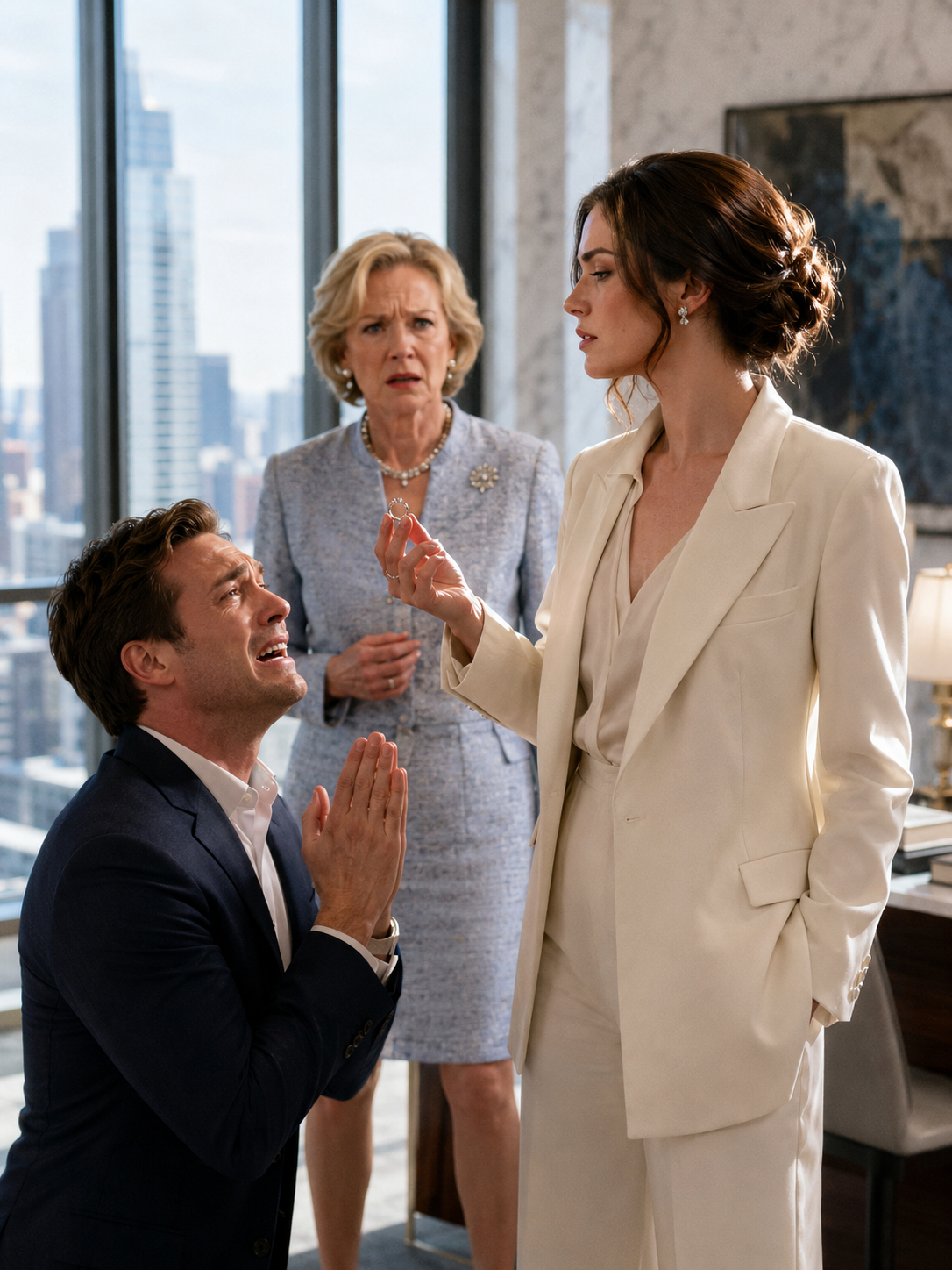
He stared at the ring like he couldn’t process what he was seeing.
“You’re ending everything because I froze in one bad moment?”
“I’m ending this because one bad moment exposed every good one as structurally unsound.”
His eyes filled.
“Tell me what to do,” he whispered desperately.
“I wanted you to defend me without needing instructions.”
Silence.
Then he asked softly, “What do you want now?”
“I want you to leave.”
He stood there another second, waiting for me to rescue him from the humiliation.
I didn’t.
Eventually, he turned and walked out.
A minute later, Megan buzzed my office.
“Beatrice Sterling is here demanding to see whoever is responsible.”
“Send her in.”
Beatrice stormed around the corner radiating fury. But the moment she saw me standing behind the desk, the color drained from her face.
“You,” she breathed.
“Inconveniently, yes.”
“You lied to us.”
“No,” I corrected calmly. “I simply omitted information.”
She stepped forward, shaking with anger. “Do you have any idea what you’ve done to my family?”
I almost admired the audacity.
“Yesterday,” I said evenly, “you told a room full of strangers I was unworthy of wearing white. Today you are here begging that same woman to save your family.”
Panic flashed openly in her eyes as she rushed into a trembling apology.
I shook my head.
“I don’t want your apology, Beatrice. I want you to remember what it feels like to be undone by the woman you mocked.”
I nodded toward security.
They moved immediately.
At the elevator doors, she turned back one last time.
“You’ll regret this.”
“Maybe,” I replied. “But I’ll regret it with excellent views.”
The doors closed.
And the day continued.
Because power rarely pauses long enough to admire itself.
There were still earnings calls to return. Meetings to attend. Markets to move.
But later that night, back home in the library, the silence finally became loud enough to hear.
I sat with a glass of wine remembering foster homes and the awful feeling of being misplaced inventory.
Then my phone buzzed.
It was Sarah from the boutique.
“You were the most beautiful bride I’ve ever seen,” she wrote. “Some people don’t deserve to witness grace.”
I stared at the message for a long time.
The following weeks were catastrophic for the Sterlings.
Clients began leaving.
Partners quietly took meetings elsewhere.
The firm entered restructuring negotiations before the month ended.
Miles called seven times.
I answered none of them.
Beatrice sent handwritten letters that I placed unopened into a drawer and never touched again.
I paid every wedding vendor in full despite the cancellation because working people should never suffer for the sins of the wealthy.
Eventually, I stopped checking whether Miles had called.
Then one Thursday in April, I found myself standing outside the same bridal boutique again.
When I walked inside, Sarah’s face lit up instantly.
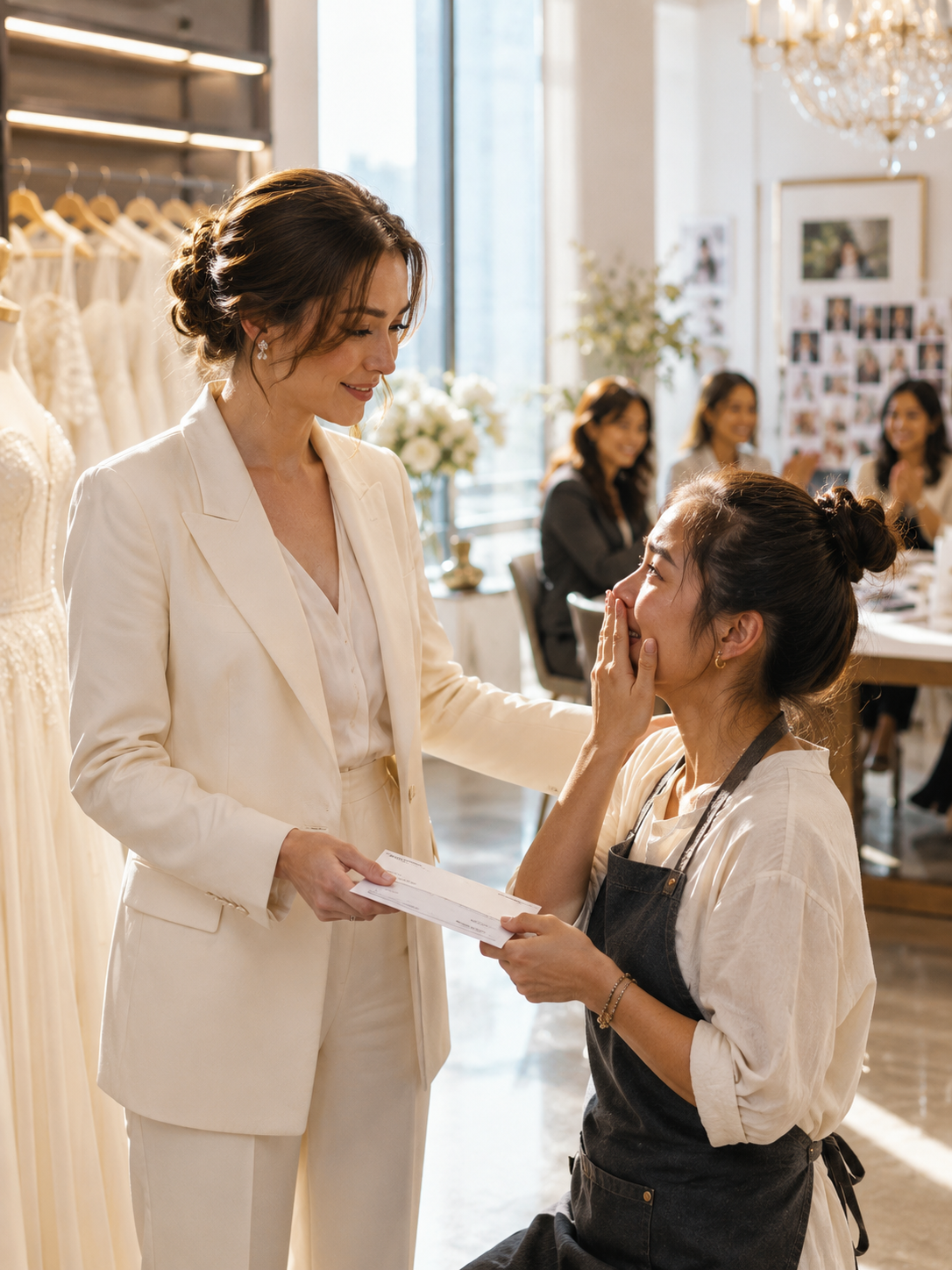
I handed her an envelope containing a check covering her design school tuition.
She had shown me kindness when it benefited her in absolutely no way.
I wanted to honor that.
Then I asked whether the fitting platform was free because I wanted to try on another dress.
This one was sleek. Architectural. Powerful.
A dress for a woman who no longer asked permission to exist.
I bought it.
Three months later, I wore it to a major gala and arrived alone, deliberately late enough for the room to notice.
An old mentor named Eleanor smiled at me across the ballroom.
“You look like a woman who finally stopped asking to be admitted,” she said.
And I realized she was right.
Not long afterward, I established a foundation for young adults aging out of foster care so they would have the infrastructure and support I never did.
At our first fundraising dinner, I looked around at a room full of people who had built lives from absolutely nothing.
That Thanksgiving, I hosted a dinner at my penthouse for anyone who had nowhere else to go.
The rooms filled with laughter, candlelight, and the smell of incredible food.
At one point, someone jokingly asked if there would be a dress code next year.
Another guest shouted from across the room, “Any color we want!”
And I laughed because that was the truth Beatrice Sterling never understood.
I still carry the little girl I used to be.
But now she lives inside a life strong enough to hold her safely.
I built my belonging myself—in silk, in steel, and in every locked door I learned to open on my own.
I am Camille Kensington.
And I have never again asked anyone whether I was allowed.
Note: This story is a work of fiction inspired by real events. Names, characters, and details have been altered. Any resemblance is coincidental. The author and publisher disclaim accuracy, liability, and responsibility for interpretations or reliance. All images are for illustration purposes only.
