
Stories
My Son Sent Me to the Wrong Wedding Address Because I Was Poor—But When I Showed Up Anyway, He Turned Pale
May
I drove three hours in my best thrift-store dress, determined to watch my son get married—only to realize he had deliberately sent me to the wrong location. Heartbroken but unwilling to give up, I still found my way to the wedding. And when I finally placed the small gift I had carried through the storm into his hands, the entire room fell silent.
The warehouse looked like a place even stray dogs had abandoned. I turned off my old Ford and stared through the windshield, almost hoping to see a single black car or a late guest in a suit appear out of nowhere.
But nothing moved.
The silence felt wrong—unnatural. At first, I thought it might be a mistake. But after a minute, that feeling shifted. It no longer felt accidental. It felt intentional.
I checked the message again. Same address. Same cheerful little pin Mark had sent the moment I told him I truly wanted to come.
I stepped out into the wind. There was no music. No valet. No flowers. Just peeling paint, a rusted gate chained shut… and a slow, painful realization settling in.
My son hadn’t forgotten to invite me properly.
He had sent me here on purpose.
Three weeks earlier, Mark had called to tell me he was marrying Chloe—the daughter of a tech billionaire. I cried tears of joy. But soon after, the hints began to slip in, disguised as concern.
“It’s going to be very formal, Mom,” he had said. “The dress code is strict. You might not feel comfortable around all those people.”
What he really meant was clear.
He thought I would look poor. Sound poor. Carry my life on me in a way his new world would notice.
And he wasn’t wrong.
I am poor.
I raised him on double shifts and clearance-rack casseroles after his father got sick and passed away. I worked at a grocery register during the day and cleaned tables at a diner at night.
But never—not once—did I imagine that the boy who watched me build his life out of nothing would grow into a man ashamed of the hands that raised him.
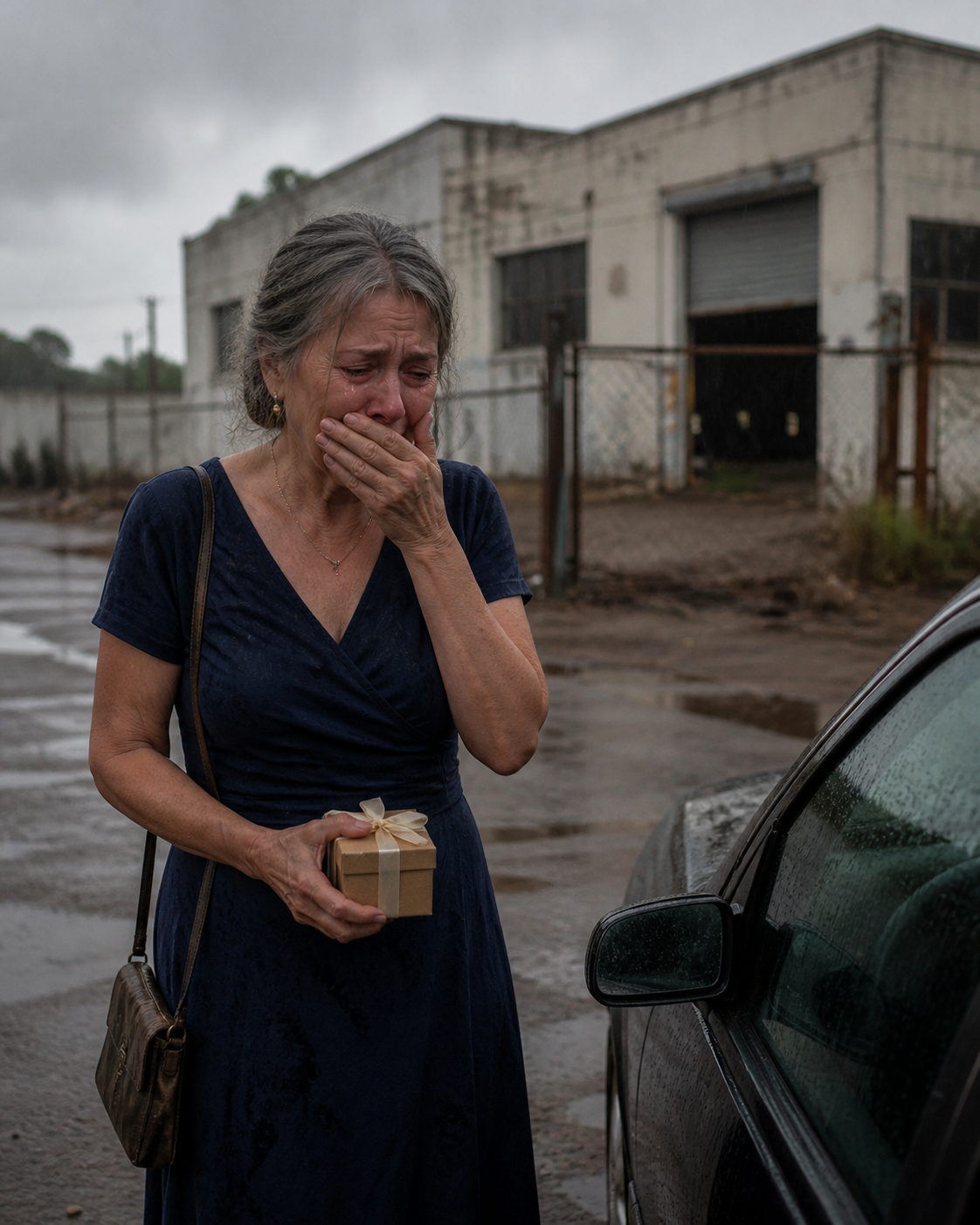
Still, I bought a dress. A simple navy one from Goodwill for twelve dollars. I hand-washed it the night before and pressed it carefully on my kitchen counter, using an old towel underneath.
Then I texted Mark for the venue.
He replied almost immediately.
Because he had already decided where he wanted me to go instead.
Standing outside that broken-down building, I cried.
But I didn’t go home.
I sat back in the car and let the tears fall—quiet, furious tears—while my mind searched for what to do next.
I thought of Mark when he was seven years old, handing me a crayon drawing. It showed a big house with blue shutters, a stick-figure woman, and a taller boy standing proudly in front.
“That’s ours, Mom,” he had said. “When I grow up, I’ll buy you a big house so you never have to work again.”
I had laughed and kissed his forehead.
Now I sat outside a crumbling warehouse, realizing that same boy had grown into someone who decided I should be kept out of sight.
I wiped my face and opened Facebook.
Mark had been careful—he hadn’t posted anything about the wedding. But Chloe was easier to find. Wealthy people don’t hide joy the way poor people hide bills.
Her caption read: “Counting down forever with my best friend, Mark. 💍🤵♂️👰💞”
Below it was a pale gold invitation graphic.
The Ritz downtown.
I stared at her photos longer than I should have and whispered, “You look beautiful,” to a girl who likely only knew me through whatever story Mark had told.
Then I turned the car around.
The rain caught up with me halfway there.
My hands tightened on the steering wheel as the wipers fought the downpour. I pictured Mark—handsome, confident, standing somewhere warm in a tuxedo.
Then, just as the city skyline came into view, the tire blew.
I stepped out into ankle-deep water and stared at it. I had afforded the dress by skipping groceries. I could stretch another week.
But I couldn’t afford a tow.
So I grabbed my purse, took off my raincoat—there was no point protecting the dress anymore—and started walking.
Four blocks doesn’t sound far.
Until you’re walking through cold rain and mud.
By the second block, my shoes were soaked. My dress clung heavily to my legs. Cars passed by, their tires whispering over wet pavement, and I caught people glancing at me—then quickly looking away.
By the time I reached the Ritz, I barely recognized my reflection in the glass.
My makeup was gone. My hair hung in damp strands across my face. The dress I had carefully ironed looked wrung out and ruined.
I stood there for a moment and thought:
Mark was right.
I didn’t belong there.
But I refused to turn back.
I pushed the doors open.
The ballroom smelled of white flowers and vanilla frosting.
And then—the music stopped.
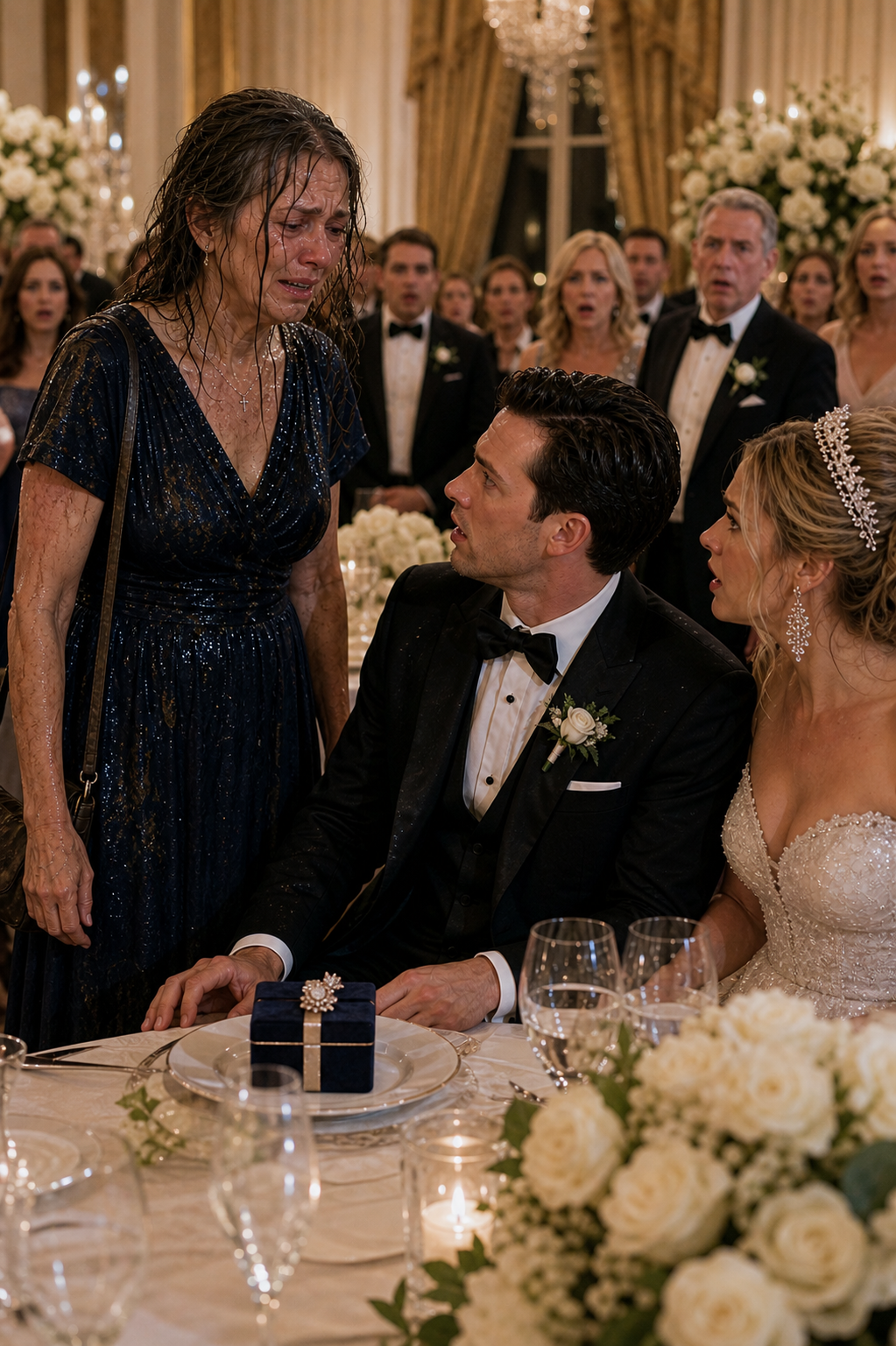
Conversations died mid-sentence. Violin notes faded into silence. Nearly two hundred elegantly dressed guests turned as one, staring at the soaked woman in a ruined dress.
“Who let her in?” someone muttered.
Another voice whispered, “homeless,” as if it might spread.
Water dripped from the hem of my dress as I scanned the room.
Then I saw him.
Mark stood near the front beside Chloe, at a table dressed in ivory linen and candlelight. He looked polished. Refined. Like someone who had built a life far away from me.
Then he saw me.
He stood so suddenly his chair scraped loudly against the marble floor.
“Mark?” Chloe said.
I kept walking.
“She stinks,” someone near the aisle whispered.
Rain and mud don’t leave a pleasant scent.
But I didn’t care.
All I could see was my son.
His face turned pale. For a moment, I thought—hoped—he might come to me, take my hand, and say, “This is my mother… she came after all.”
But he didn’t move.
He just stood there as I crossed the room.
I stopped beside his table.
Chloe looked between us. “Mark, who is she?”
He said nothing.
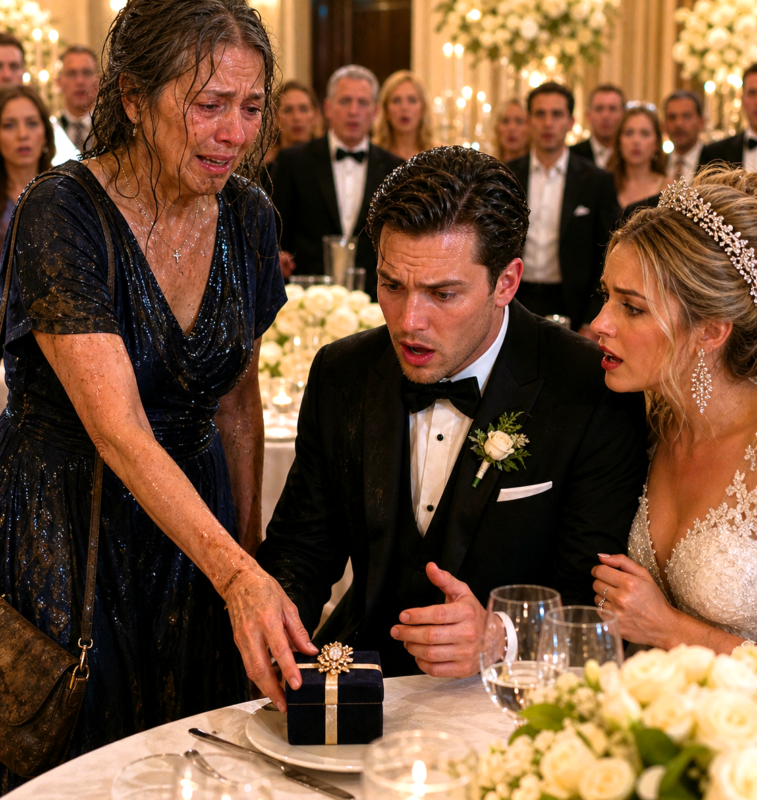
So I reached into my purse.
Inside was a small velvet box—the one thing I had protected through the drive, the storm, and the long walk.
I opened it and placed it gently on his pristine china plate.
Mark looked down.
And went completely pale.
His hands began to tremble.
“Mom… Oh my God… where did you get this?”
A wave of gasps spread through the room.
Chloe’s expression shifted—confusion, shock, then something sharper.
“That’s your… mother?”
Her parents stood up behind her.
Her mother said, “You told us she was ill. You said she was in the hospital and couldn’t come.”
The whispers changed.
I smiled—because it was the only thing holding me together.
“Congratulations,” I said softly. “You both look beautiful.”
A man stepped forward, picked up the box, frowned, and asked, “Where did you get this?”
“A jewelry store,” I replied.
“Should someone call the authorities?” he asked.
I pulled out the receipt and handed it to him.
It was damp—but still readable.
$7,840. Paid in full.
That ended the whispers instantly.
Mark lifted the ring. The diamond caught the light, sparkling under the chandeliers.
His grip tightened.
When Mark was seventeen, we had passed a jewelry store after my second job. I was exhausted. He was hungry—but pretending not to be.
Then he stopped and pointed.
“That’s the one, Mom!”
“The one for what?” I asked.
“The one I’d buy if I ever got married.”
It was simple. Timeless.
“Then some lucky girl has expensive taste,” I teased.
He grinned. “Then I’d better get rich.”
I never forgot that ring.
Every extra shift. Every saved dollar. Every sacrifice carried one goal quietly in my mind.
When the store changed ownership, I panicked.
When it went private, I memorized the number.
And when I finally had enough, I bought it.
Not for me.
For him.

Now, standing beside his bride, he whispered, “You bought this?”
“Yes.”
“For me?”
“Who else?”
His eyes filled with tears.
I placed my hand over his briefly.
“I just wanted to see you get married, dear.”
Then I turned to Chloe.
“I wish you both a beautiful life together, sweetheart.”
“I didn’t know…” she said softly.
“I believe you.”
And then I walked away.
Mark caught up with me outside.
“Mom…”
I kept walking.
“Mom, please.”
I turned.
He stood there—breathing hard, holding the ring—no longer polished, no longer distant.
Just my son.
“Come back inside,” he said. “Eat dinner. Bless us.”
“My blessings were never the problem, dear,” I replied.
He flinched.
“I was always blessing you. Even when you were ashamed of me.”
“I wasn’t ashamed of you—”
I raised an eyebrow.
He closed his eyes.
“…Okay. I was. Not of you. Of where I came from. Of what people would think.”
He swallowed.
“That’s why I sent you there.”
The truth hung between us.
Ugly. Human. Painful.
“Thank you for finally telling the truth,” I said.
I called a cab.
“I tried to drive,” I added. “But my tire blew. I walked the rest in the rain.”
“I’m sorry, Mom.”
I believed him.
But belief doesn’t erase pain.
Chloe came out, her parents behind her.
“I’m sorry,” she said. “He told me you were sick.”
Then she turned to Mark.
“You lied about your own mother.”
Her father added, “You let her walk through a storm… after sending her away.”
“I didn’t think she’d come,” Mark said quietly.
Chloe let out a small, disbelieving laugh.
“She came. Of course she did. She’s your mother.”
Mark looked at me again.
“Please don’t leave like this.”
“I’m not leaving angry,” I said. “I’m leaving because now I understand my place in your world.”
A cab pulled up.
I opened the door, then paused.
“My blessings are always with you.”
“How can you still—”
“Because I’m your mother.”
Chloe leaned toward the window.
“Thank you for coming.”
I smiled.
“Take care of each other. And help him learn to tell the truth—even when it costs him.”
She laughed through tears.
The car pulled away.
I didn’t look back.
At the first red light, I cried.
The ring reached my son—but not the way I had imagined.
Still… beneath everything, one truth remained steady.
I showed up.
He tried to erase me from his biggest day.
And I still walked through those doors—with rain in my shoes and love in my purse.
I’m still proud of the boy I raised.
I’m just learning how to grieve the man he became.
Some wounds can be forgiven.
But forgiveness doesn’t mean they never happened.
Source: amomama.com
Note: This story is a work of fiction inspired by real events. Names, characters, and details have been altered. Any resemblance is coincidental. The author and publisher disclaim accuracy, liability, and responsibility for interpretations or reliance. All images are for illustration purposes only.
