
Stories
A Hungry Girl Asked to Play Piano for Food—But One Song Exposed a Secret That Froze the Entire Ballroom
Apr
“Can I play for a plate of food?” The words did not belong in a place like this. They trembled in the air—fragile, almost invisible—against a backdrop that had never known hunger.
The ballroom glittered like a world carefully constructed to deny reality itself.
Light poured from crystal chandeliers in molten streams, cascading over polished marble floors so flawless they reflected every movement like a second, quieter universe beneath the first. Gold traced the walls in intricate patterns, catching every flicker of light and multiplying it until the entire room seemed to breathe in quiet, arrogant luxury.
Everything here was abundance.
Everything here was certainty.
Servers floated between guests like ghosts of perfection, balancing silver trays filled with champagne and delicate, untouched bites of beauty. Laughter drifted lazily through the air—soft, practiced, effortless—the kind of laughter that comes from lives untouched by desperation.
No one here asked.
No one here needed to.
Because in this world—
everything was already theirs.
And then—
a single piano chord broke it all apart.
Sharp. Sudden. Unforgiving.
It cracked through the room like glass shattering under pressure.
Every voice stopped.
Every movement stilled.
As if something unseen had reached into the heart of the ballroom and squeezed.
Heads turned—slowly at first, then all at once—drawn toward the grand piano like iron to a magnet.
And there—
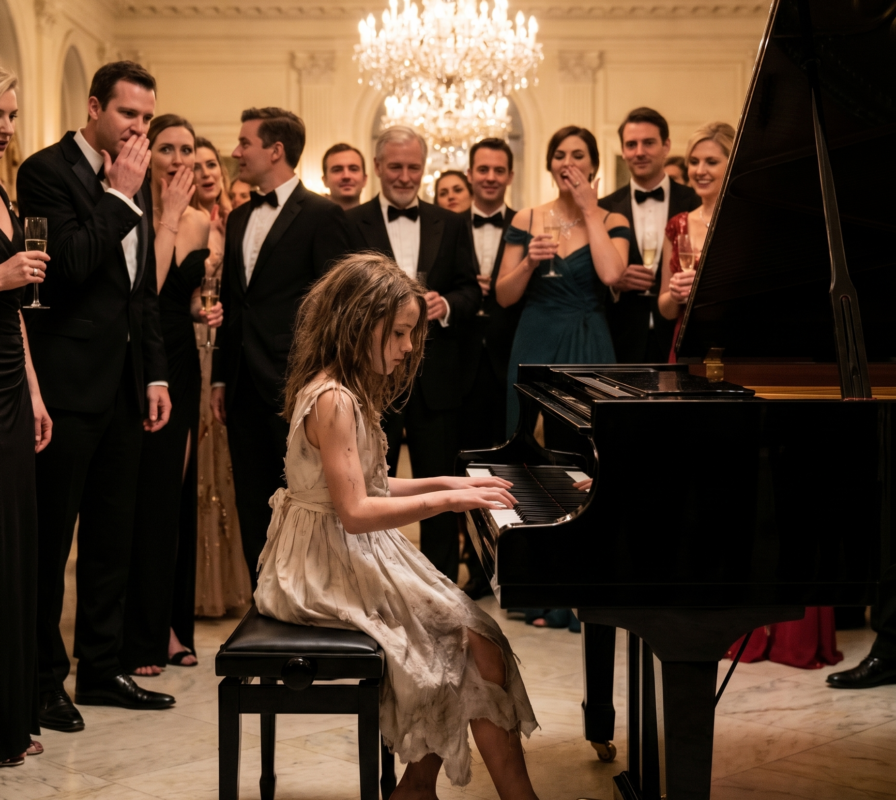
sat a girl who did not belong.
Not even close.
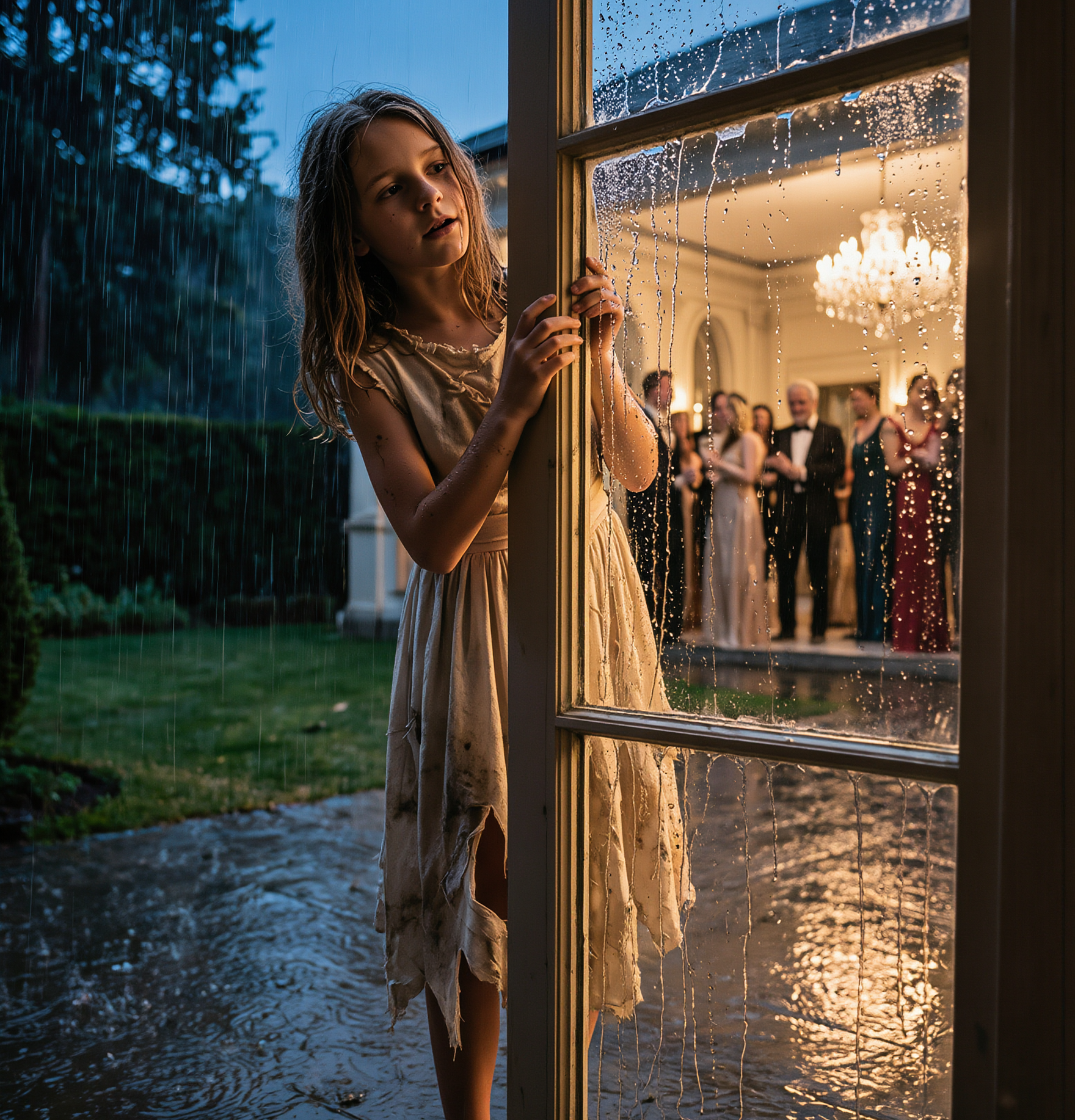
She was barefoot.
Not delicately so—not by choice or style—but in a way that exposed the truth. Her feet were marked by the world outside this room, by roads and dust and places where no one would ever wear silk.
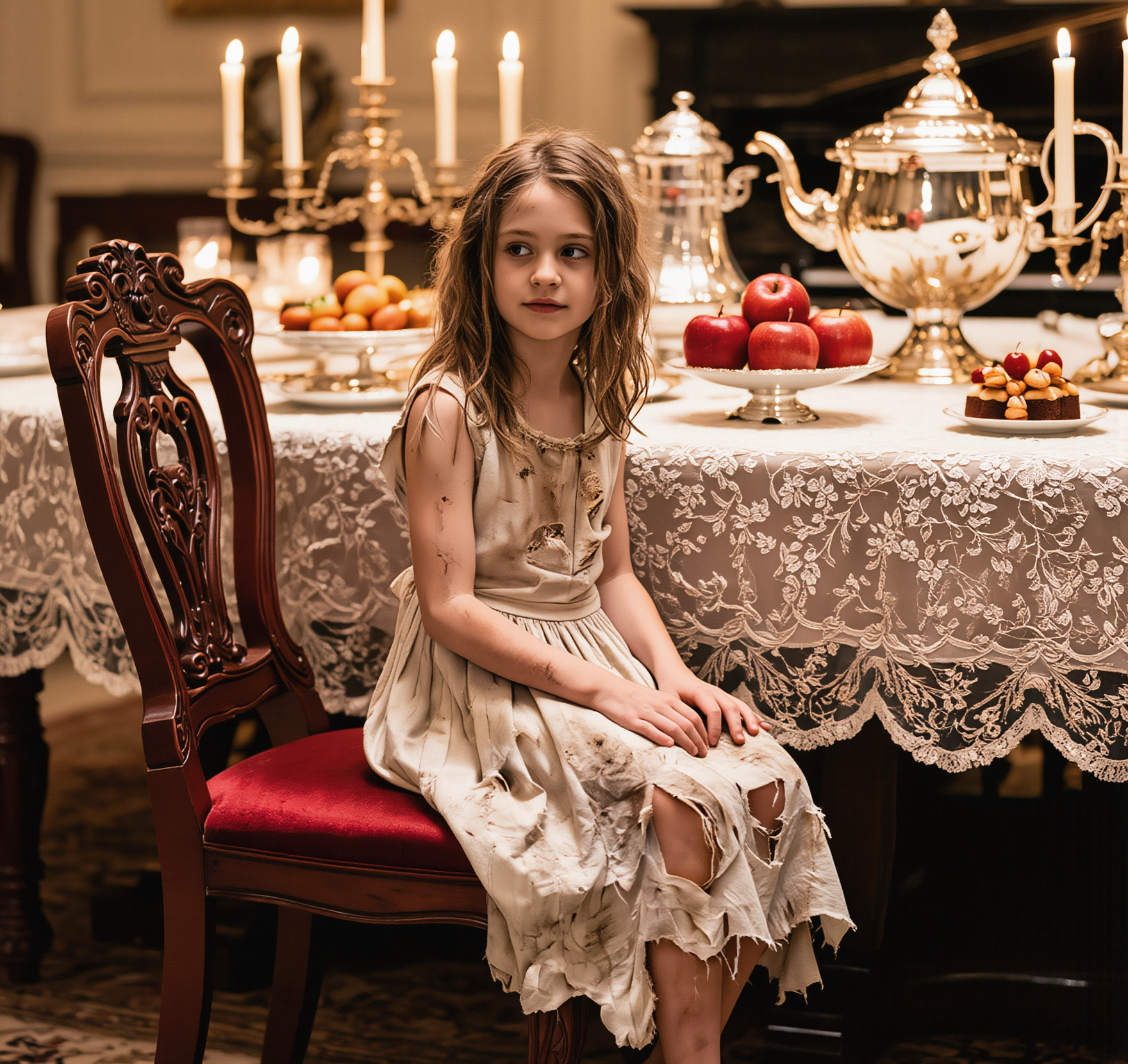
Her white dress—if it could still be called that—hung loosely from her small frame, torn at the hem, stained with time, with survival. Dirt traced the lines of her arms, her knees, her face—evidence of a life that had never known polished floors or golden light.
Her hair fell unevenly around her shoulders, as though it had been cut without care… or without time.
And yet—
she sat still.
Not small.
Not broken.
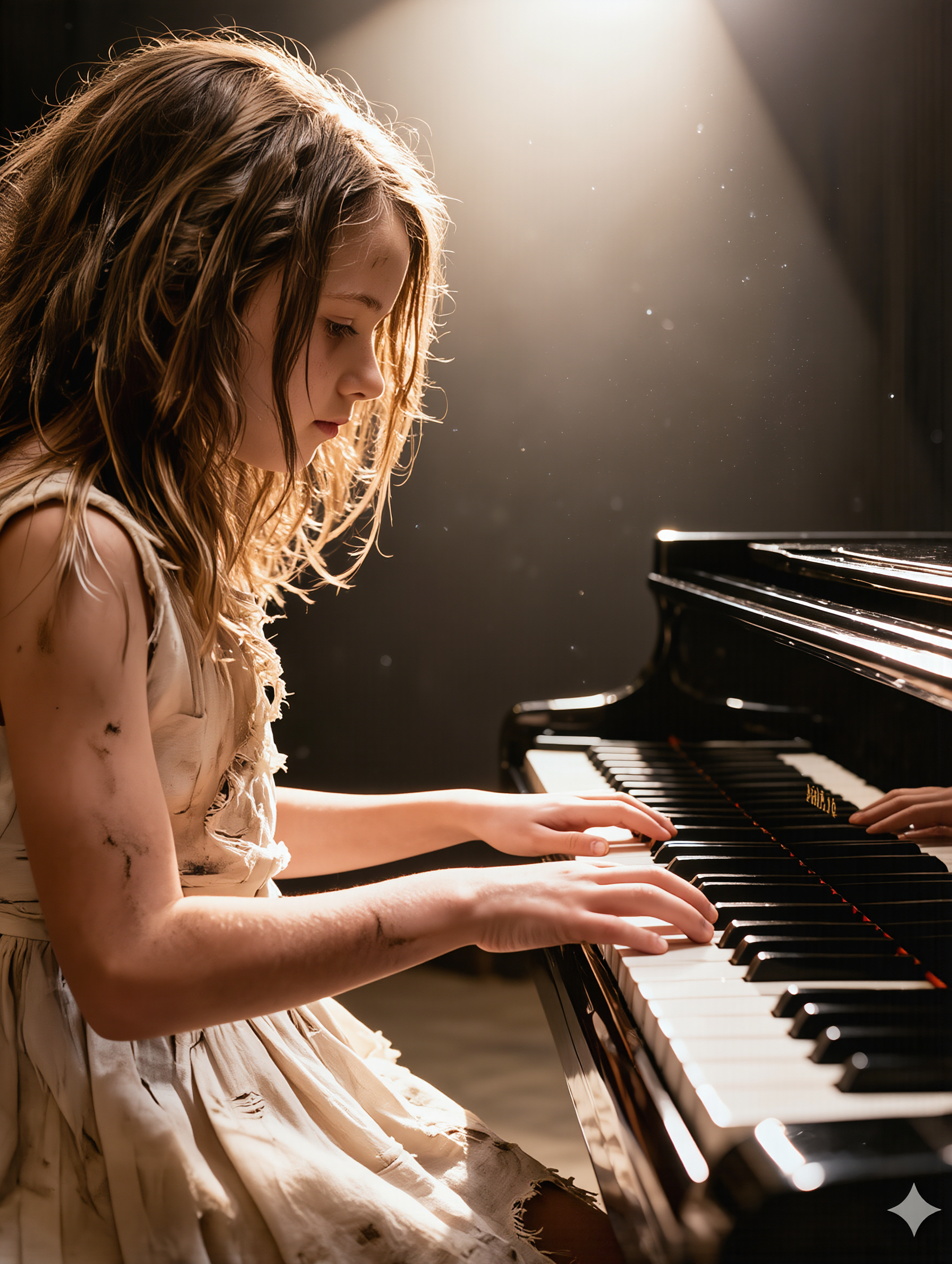
Her hands hovered above the keys with a steadiness that did not match her appearance. There was something in the way she held herself—something quiet, something unshakable—that refused to bow to the room around her.
Her eyes moved across the crowd.
Taking it all in.
The gowns.
The jewels.
The distance between her world… and theirs.
And then she spoke.
“Can I play for a plate of food?”
Her voice trembled.
Not weak—
just honest enough to reveal the cost of asking.
The cost of standing there, exposed, in a place that had never made space for someone like her.
For a single, suspended moment—
the ballroom froze.
But it was not compassion that held them still.
It was disbelief.
And then—
the laughter came.
Soft at first.
A ripple.
Then sharper.
Stronger.
More confident in its cruelty.
A woman lifted her glass to her lips, hiding her smile behind crystal as her eyes sparkled with amusement. Another leaned closer to her companion, whispering something that dissolved into a quiet, delighted laugh.
A man in a perfectly tailored tuxedo smiled.
Not kindly.
Not thoughtfully.
But with the smooth precision of someone who had never been denied anything—and mistook that for superiority.
He stepped forward.
His shoes clicked lightly against the marble, each step measured, controlled, echoing louder than it should have.
“This isn’t a shelter,” he said.
His voice was calm.
Polished.
Dismissive.
And the laughter grew.
Encouraged.
Fed.
The girl didn’t react immediately.
Her face didn’t crumble.
Didn’t flinch.
But something behind her eyes… dimmed.
Not from surprise.
From recognition.
As if she had heard this before.
As if she knew exactly how heavy laughter could become when it settled on your skin.
Still—
she didn’t move.
Didn’t run.
Didn’t ask again.
Instead—
she lowered her gaze.
To the piano.
Her fingers lifted.
Trembling—just slightly.
Just enough to show the storm beneath her stillness.
For a moment—
it looked like she might stop.
Like she might decide it wasn’t worth it.
That the humiliation weighed more than the hunger.
But then—
she pressed the keys.
The first notes were soft.
So soft they felt like a secret.
Like something not meant to survive in a room like this.
But they did.
And they were—
beautiful.
Not in the shallow, decorative way the ballroom understood beauty.
But in a way that carried weight.
Memory.
Truth.
The sound didn’t scatter like laughter.
It gathered.
It pulled the air inward.
Wrapped itself around every ear, every breath.
One by one—
conversations died.
A woman in gold froze mid-sip, her glass suspended inches from her lips as if time itself had paused.
A man near the back turned fully toward the piano, his expression unraveling—amusement slipping into uncertainty… then something deeper.
The laughter faded.
Not all at once.
But piece by piece.
Until—
it was gone.
Even the man in the tuxedo stopped smiling.
Because he knew that melody.
Not vaguely.
Not distantly.
But completely.
It wasn’t just music.
It was memory.
It was a ghost that had never truly left this room.
Years ago—
that song had lived here.
Played by a young pianist whose presence had once filled the ballroom the way light did now.
A woman who had vanished one winter.
After whispers.
After scandal.
After a truth no one dared speak aloud anymore.
The man stepped closer.
Slower now.
Careful.
Like he was approaching something fragile—
or dangerous.
“Who taught you that?” he asked.
The girl’s fingers hovered above the keys.
The final note still trembling in the air between them.
Then she looked up.
“My mother.”
The words didn’t echo.
They sank.
Heavy.
Final.
Color drained from his face.
The room seemed smaller suddenly.
Tighter.
Like the walls themselves were listening.
“She said she played it here…” the girl continued, her voice softer now—
but sharper.
A quiet gasp rippled through the crowd.
The man took a step forward.
Unsteady.
“What was her name?”
He already knew.
Some part of him had known from the first note.
The girl opened her mouth—
and as she did—
the truth caught the light.
A thin silver chain shifted against her skin.
And there—
a small key.
It gleamed under the chandelier like something alive.
The man saw it.
And everything inside him collapsed.
Because the music could be explained.
Learned.
Passed down.
But the key—
the key could not.
Years ago—
they had told a story.
A simple one.
A clean one.
She had stolen, they said.
Jewelry.
Money.
Documents.
She had run.
Disgraced.
Erased.
And everyone believed it.
Because neat stories are easy.
But the truth—
the truth had never been neat.
Only three people had known.
The pianist.
The man.
And the owner of the estate—
now buried with his silence.
That key opened something hidden.
Something buried beneath the piano bench.
Something dangerous.
Letters.
Documents.
Proof.
A marriage certificate.
She had not been a thief.
She had been his wife.
Secret.
Legal.
Inconvenient.
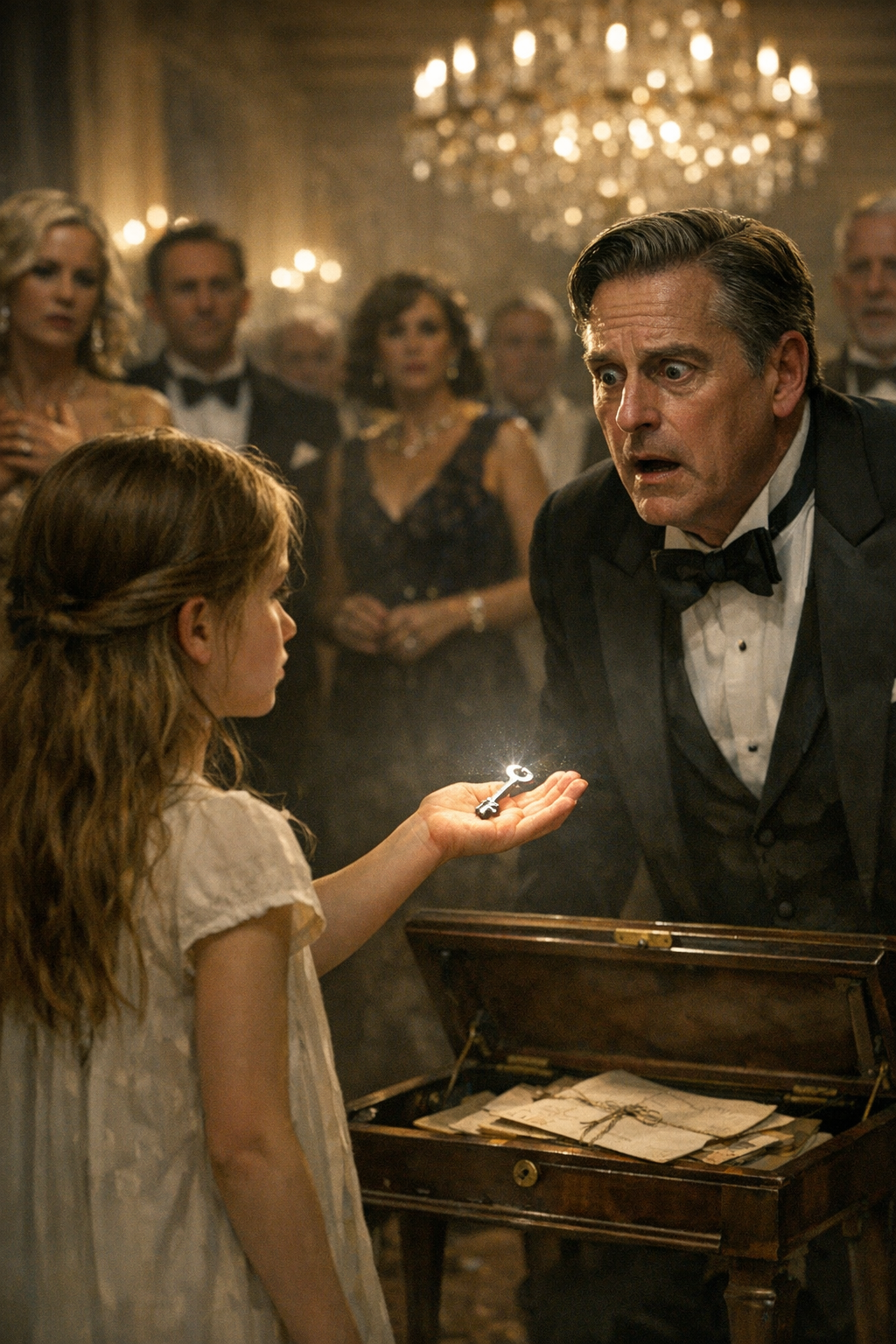
The girl’s voice broke through the silence like a blade.
“My mother said if you saw the key first… you’d know I was telling the truth.”
And the silence changed.
It deepened.
It sharpened.
It became—
fear.
Because this was no longer about a hungry child.
This was blood.
This was legacy.
This was something that refused to stay buried.
The man tried to speak—
but nothing came.
Because the girl was no longer a stranger.
She was his daughter.
The daughter he had buried in memory.
The daughter he had been told was gone.
The daughter he had chosen—
not to find.
The girl leaned forward.
Calm.
Certain.
Her hands reached beneath the bench.
Found the keyhole.
No hesitation.
No doubt.
She inserted the key.
Click.
The sound cut through the room like judgment.
Someone flinched.
Maybe more than one.
She opened the compartment slowly.
Carefully.
Pulled out a bundle wrapped in faded cloth.
Held it—
tight.
As if it was the only truth she had ever been given.
She unfolded it.
Inside—
a note.
A woman’s hand.
Steady.
Final.
If she returns here hungry, then none of you deserved us.
The words settled over the room like dust over something long forgotten.
The man broke.
Not loudly.
Not dramatically.
But enough.
Enough for everyone to see.
Enough to understand.
He had not stepped forward to dismiss a beggar.
He had stepped forward to face the life he abandoned.
The girl held the bundle close.
Her fingers trembling now—
not with fear.
With something heavier.
Then she looked at him.
“My mother told me to ask you one thing,” she said.
The room held its breath.
“Before I took the food.”
He didn’t move.
Didn’t blink.
Didn’t breathe.
And then—
she asked:
“Why did you leave us in the dark… while you kept the lights?”
No echo.
No need.
Because the question landed exactly where it was meant to.
And suddenly—
the chandeliers felt cold.
The gold felt hollow.
The laughter that once filled the room felt—
ashamed.
The ballroom—
for all its beauty—
looked guilty.
Note: This story is a work of fiction inspired by real events. Names, characters, and details have been altered. Any resemblance is coincidental. The author and publisher disclaim accuracy, liability, and responsibility for interpretations or reliance. All images are for illustration purposes only.
