
Stories
My Uncle Hid More Than Rice in That Sack—And It Changed Our Lives Forever
Apr
I was twelve that winter—old enough to understand hunger, but still young enough to believe one full meal could fix everything.
We lived on the edge of a small Arizona town, in a house patched with tin and hope, where the wind always slipped through the cracks. After my father died in a construction accident, my mother was left to raise three children alone.
From then on, every day became a quiet fight—against empty shelves, unpaid bills, and a kind of exhaustion that no longer felt temporary.
Our meals were always the same.
Rice stretched thin with beans.
Cornmeal watered into something like soup.
Wild greens my mother gathered from the dry field behind our house.
Enough to survive.
Never enough to forget.
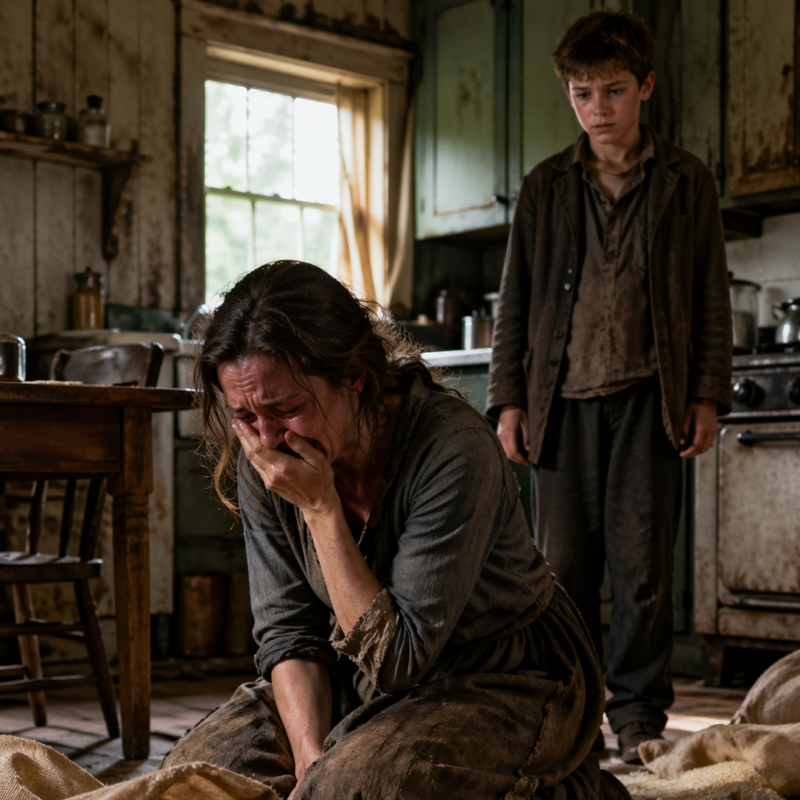
That morning, I found her at the table, tilting the rice jar and scraping the last grains out with her fingers. The faint scratching against the glass filled the silence.
She stared at the few grains for a moment, then looked up.
“Go to your Uncle Victor’s,” she said softly. “Ask if he can lend us a little rice. Just for today. I’ll return it tomorrow… somehow.”
She said somehow the way adults do when they don’t have a plan—but need hope to sound like one.
I grabbed the worn cloth sack by the door and stepped outside.
It was only a few houses away, but the walk felt endless. Cold air cut through my thin shirt. Dust shifted under my worn shoes. Somewhere nearby, music played from an old radio, and for a moment, I wished I could just keep walking—past his house, past everything.
There’s a special kind of shame in being sent to ask for food.
Not just embarrassment.
The feeling that your family’s hunger is written all over you.
By the time I reached his door, my heart was pounding. I knocked once, almost hoping he wouldn’t answer.
But he did.
He stood there in an old flannel shirt, gray hair unkempt, his face lined with quiet fatigue. His eyes dropped to the empty sack in my hands, and he understood immediately.
“My mom was wondering if maybe…” I started, my voice catching. “If maybe you could lend us some rice. Just for tonight.”
He didn’t sigh.
Didn’t question me.
Didn’t make me repeat myself.
He just looked at me—with something in his eyes I didn’t understand then. Not pity. Not surprise. Something heavier. As if he had been waiting for this moment.
Without a word, he turned and went inside.
I expected a small portion, maybe wrapped in paper.
Instead, he came back carrying a full sack of rice.
A real one—thick, heavy, the kind stacked in store corners.
He lowered it into my arms, and the weight nearly pulled me forward.
I stared at him. “Uncle… this is too much.”
“Take it,” he said.
“But—”
“Take it to your mother,” he repeated, steady. Then he placed a hand on my shoulder. “And listen to me, son… don’t be ashamed.”
Something shifted inside me when he said that.
I nodded quickly, thanked him over and over, and started back home, clutching the sack to my chest. My arms burned within seconds, but I didn’t care.
For once, I wasn’t bringing home lack.
I was bringing relief.
All the way back, I imagined my mother smiling. My sisters laughing. Steam rising from a pot of real rice. What it would feel like to sleep with a full stomach.
That sack felt like a miracle.
When I pushed the door open, my mother turned so fast her chair scraped the floor.
She froze.
“Victor gave you all that?”
I nodded, breathless. “The whole sack.”
My sisters ran over, circling it like treasure. Even in that dim kitchen, the room felt brighter. My mother placed both hands on the rough fabric, as if she needed to confirm it was real.
Then she smiled.
A real smile.
One I hadn’t seen in weeks.
“Tonight,” she whispered, “we’ll eat well.”
She pulled the sack closer, grabbed a knife, and cut through the stitching at the top.
Then she stopped.
Her hands froze.
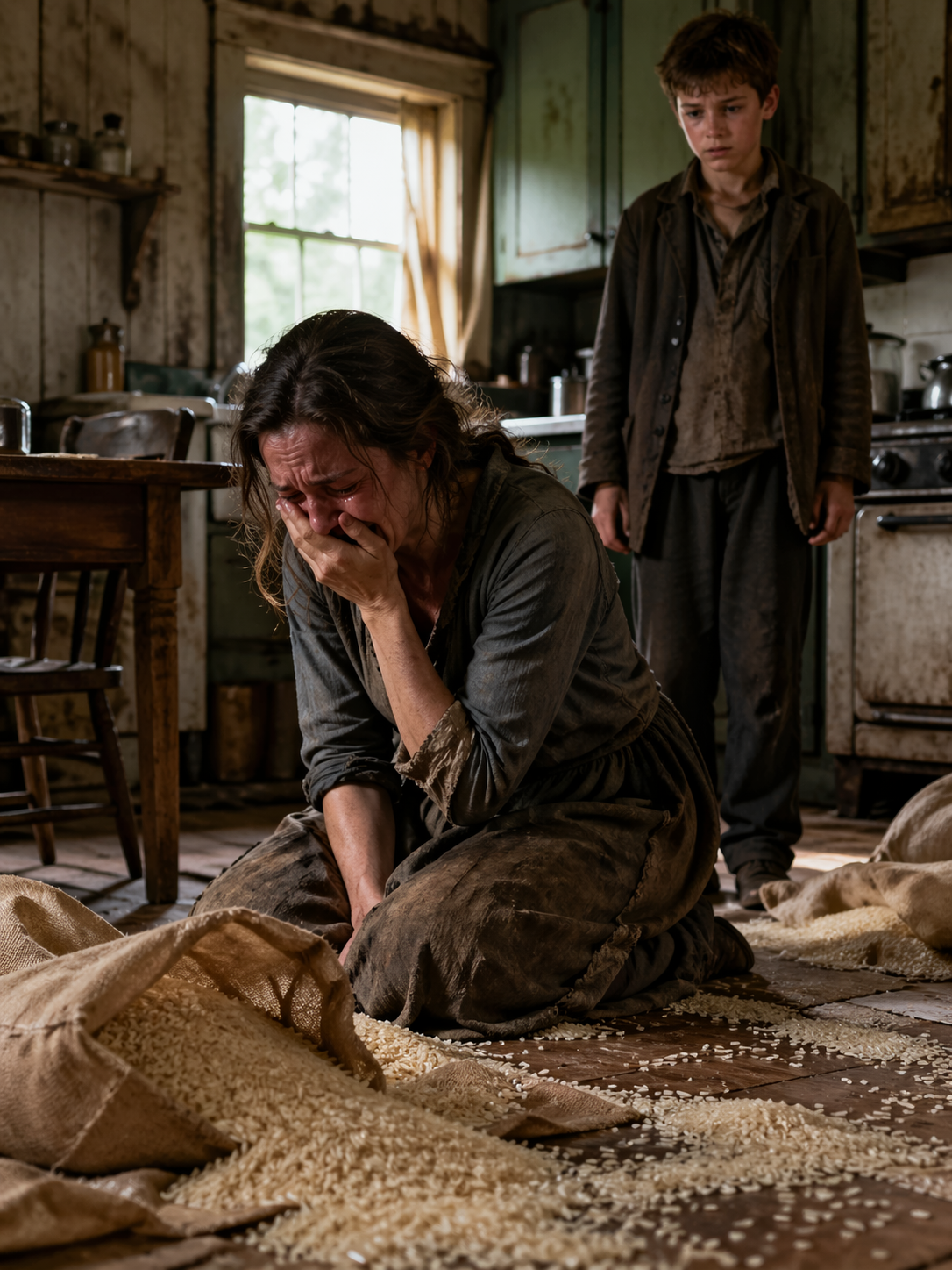
At first, I thought she had hurt herself. But then I heard it too—a strange sound from inside.
Not grains shifting.
Something heavier.
Something wrapped.
She frowned, widened the opening, and reached inside.
When she pulled her hand out and saw what she was holding, all the color drained from her face.
The bundle slipped from her fingers.
And she collapsed to the floor, sobbing.
I dropped beside her. “Mom? What is it?”
She shook her head, unable to speak.
My sisters started crying because she was crying, and suddenly the room filled with fear and confusion.
Then my mother picked up what had fallen.
It was my father’s red handkerchief.
I recognized it instantly. He used to carry it everywhere. On Sundays, he folded it neatly beside his hat. When I was little, he’d snap it in the air and pretend it turned into a bird just to make me laugh.
My mother pressed it to her mouth and cried harder.
Inside it was a thick stack of cash—more than I had ever seen. There was also a small envelope and a worn bank booklet with my father’s name on it.
She stared at them as if they had come back from the dead.
Then she opened the envelope.
When she finished reading, she closed her eyes and cried—not just from grief, but from relief, disbelief, and the kind of exhaustion that breaks when someone realizes they don’t have to carry everything alone anymore.
When she could finally breathe, she handed me the note.
It read:
Elena,
This is Michael’s unpaid wages, the compensation from the company, and the savings he left with me. They tried to give less. I didn’t let them. It took time, but it belongs to you and the kids. I added what I could.
Feed the children first.
Pay what cannot wait.
Say nothing to anyone.
And forgive me for taking so long.—Victor
I read it twice.
Then looked at her. “The company paid?”
She nodded, wiping her tears. “Your uncle fought for it.”
That’s when she told me everything.
After my father died, the company tried to settle quickly and quietly—offering almost nothing. My mother, overwhelmed with grief, nearly accepted.
But Victor stopped it.
He went to the city. Argued. Filed claims. Took buses he could barely afford. Fought for every dollar—wages, compensation, and the savings my father had left behind.
And he told no one the full amount, so no one could take advantage before it was safe.
He hid it in rice—because no one steals rice from a poor family.
That night, we ate until we were full.
Real food.
Rice, beans, eggs, fresh tortillas.
My mother made us sit at the table—not out of habit, but so we would remember what dignity felt like.
The next morning, we went to thank him.
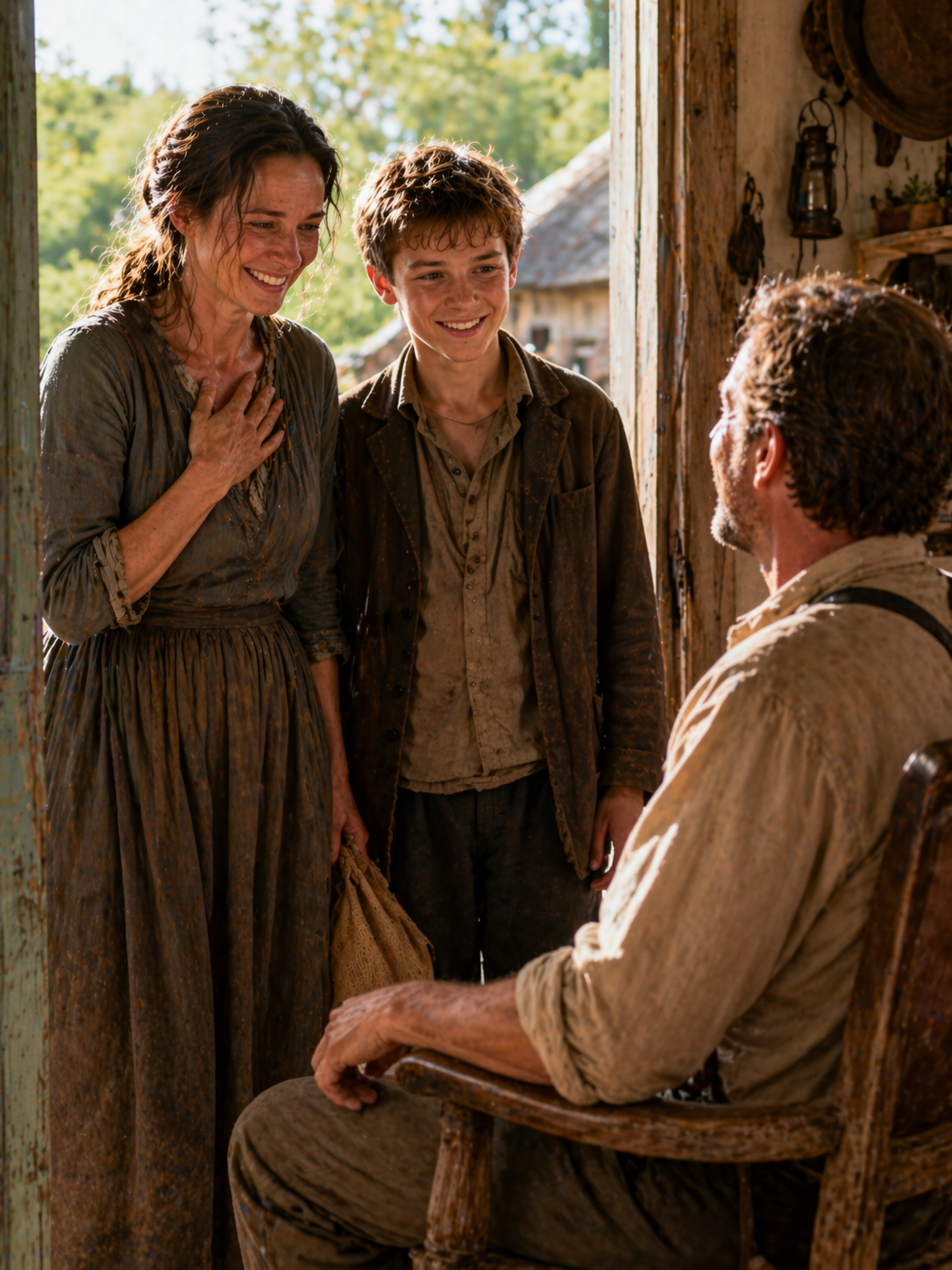
He was outside repairing an old tool. He looked up, saw the handkerchief, and understood.
My mother began crying before she could speak. “Why didn’t you tell me?”
He set the tool aside. “Because if I told you early, you would have hoped every day and suffered every delay. Better to carry one heavy thing all at once.”
Then he added quietly, “And your husband asked me not to let you beg.”
My mother sat down right there in the dirt and cried into her hands.
That money didn’t make us rich.
But it changed everything.
Debts were paid. The roof was fixed. We got proper shoes. My father’s grave finally had a real stone.
And my mother bought a sewing machine.
That machine became our future.
At night, we’d hear it running—steady, rhythmic, like a heartbeat. Slowly, we climbed out of desperation.
We didn’t become wealthy.
But we were no longer trapped.
Years passed.
My sisters stayed in school. I finished college—the first in our family.
Victor never let us call him a hero.
“It was your father’s money,” he’d say. “I just made sure it reached you.”
But that wasn’t the whole truth.
He had added his own savings.
Sold a pig.
Given more than he ever admitted.
When he grew old, I cared for him as best I could. He complained every time.
But I knew.
He died in 2010.
At his funeral, I told the full story—the rice, the handkerchief, the silent fight he carried for us.
Someone said, “I thought he was just a quiet man.”
I answered, “He was. Quiet about everything… except love.”
Now I have children of my own.
And every December, I buy full sacks of rice.
Not small bags.
Full ones.
I give them to families in need—and inside each one, I tuck an envelope.
Sometimes for food.
Sometimes for school.
Sometimes for a bill that can’t wait.
I never sign my full name.
I always write one line:
Don’t be ashamed.
People call it charity.
It isn’t.
It’s inheritance.
When I was twelve, my mother sent me to borrow a little rice.
My uncle gave me a full sack instead.
Inside it, we found money, a bank book, a letter—and proof that someone loved us enough to fight for us in silence.
My mother expected food.
She found rescue.
And that was the day I learned something I’ve never forgotten:
Being fed keeps you alive for a night.
But being carried… changes your entire life.
Note: This story is a work of fiction inspired by real events. Names, characters, and details have been altered. Any resemblance is coincidental. The author and publisher disclaim accuracy, liability, and responsibility for interpretations or reliance.
