
Stories
They Treated Me Like a Useless Old Man Living Off Their Kindness… Until I Walked Out and Took Everything With Me

Apr
My name is Langston King, and for three years my daughter believed I was nothing more than a worn-out old man with grease-stained hands and a barely surviving pension. That was the version of myself I allowed her to see. To Nia and her husband, Hunter, I was a retired machine repairman—a widower with a quiet voice and a single suitcase, grateful for a room in their polished suburban home outside Atlanta.
What they didn’t know was that I owned King Enterprises, a business empire built over four decades. The house they lived in, the luxury SUV in the driveway, the private school tuition they bragged about paying, even the wine Hunter served his clients—every piece of it was funded through companies under my control.
I didn’t hide the truth for amusement. I did it because money can disguise character better than any lie. Nia had grown up in comfort, but I tried to raise her with discipline. After my wife died, I watched her drift—toward appearances, toward status, toward a life where gratitude became optional. When she married Hunter, that drift turned into something stronger.
Hunter loved expensive watches, loud opinions, and confidence built on money he never earned.
So I moved into their guest room and played my part. I wore old thrift-store work shirts. I let Hunter joke about my “rust-bucket generation.” I listened when Nia complained about how hard it was to “carry the family.”
Meanwhile, every month, I quietly paid their mortgage through a real estate holding company, cleared their credit card balances through a financial shell, and covered Hunter’s failed investments before anyone came knocking at the door.
I watched. I waited. I hoped.
I told myself that maybe one day my daughter would notice the small things—the way I folded her son’s laundry, fixed the sink without being asked, or stayed up late worrying about her life.
But instead, the entitlement grew.
One Saturday morning, Hunter stormed into the kitchen while I sat at the counter with a cup of black coffee. He kicked my chair hard enough to scrape it across the tile, then tossed an apron onto the counter with a smirk.
“Put that on,” he said. “If you’re going to live here for free, the least you can do is serve coffee like hired help.”
I turned to my daughter.
Nia crossed her arms, met my eyes, and said, “Dad, stop making everything difficult. You should be grateful we gave you a place to stay.”
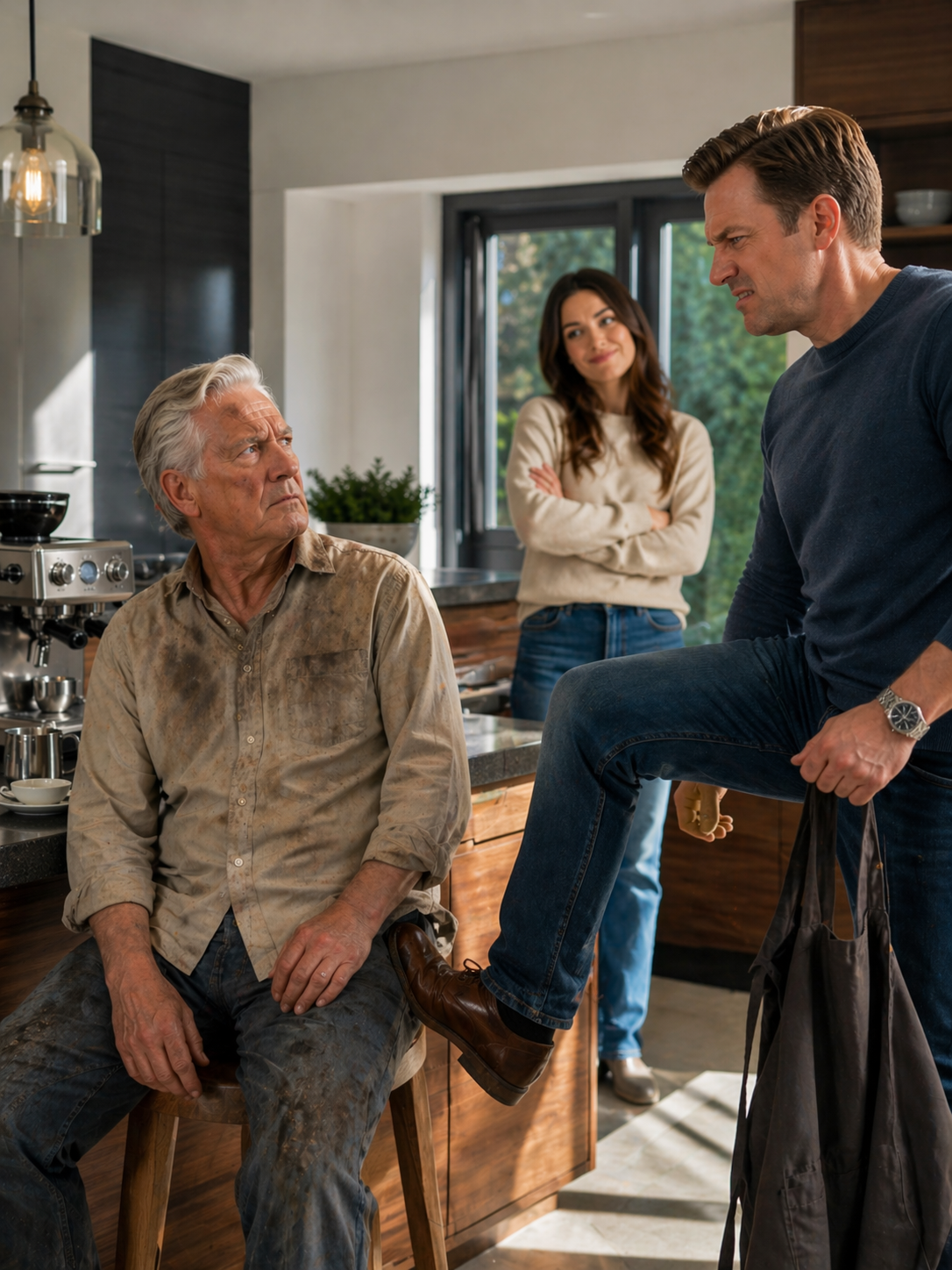
The room went quiet. The espresso machine hummed. The refrigerator clicked. Outside, a lawn crew trimmed hedges I had paid for.
It struck me then—how quietly humiliation arrives. Not with noise or anger, but with the moment your own child decides your dignity is negotiable.
I didn’t argue.
I set down my cup, folded the apron neatly, and placed it back on the counter. Then I walked to the guest room, picked up the suitcase I had packed three days earlier, and returned to the foyer.
Nia looked confused. Hunter looked entertained.
“You’re leaving?” she asked, as if this were an overreaction.
“I’m stepping aside,” I said.
Hunter let out a quiet laugh. “Probably for the best.”
I nodded once and walked out.
My driver was waiting two blocks away. Within forty minutes, I was sitting in the presidential suite of the Ritz-Carlton downtown—a property owned entirely by my company—looking out over the city I had helped build.
I removed my cheap jacket, called my chief of staff, and gave a simple instruction:
“Shut down all discretionary support.”

By noon, everything was in motion.
Corporate cards were frozen. Mortgage payments stopped. Utility accounts dissolved. The consulting retainer propping up Hunter’s struggling business expired. The payroll accounts covering landscaping, cleaning, and vehicle leases were shut down.
I didn’t break the law.
I simply stopped being the invisible foundation beneath their lives.
The first call came from Nia before sunset. I let it ring.
Then more calls followed. Messages shifted from annoyance to panic. Hunter left an angry voicemail about “bank errors” and “fraud.”
By the next morning, their reality had started to crack.
Cards declined. The mortgage office called. Lease payments flagged. Hunter finally realized that his success had been built on money that was never his.
Three days later, I received an email from Nia. The subject line read: Dad?
I didn’t respond.
Some lessons need distance. Some forms of love require stepping back.
For years, I had protected her from consequences, believing I was helping. In truth, I had only made it easier for her to remain dependent.
So this time, I let the storm reach her.
And I didn’t shield her from it.
The collapse was fast. The rebuilding was not.
Hunter disappeared within eight months, chasing another illusion somewhere else. The house was gone within a year. The SUV was repossessed. Their social circle vanished just as quickly.
People who celebrate with you rarely stand beside you when everything falls apart.
From a distance, I watched—not to gloat, but to understand. At first, it looked like she was breaking. Nia took a receptionist job, lost it, and moved into a small duplex in Macon with her son. She sold her jewelry, her bags, her furniture—piece by piece.
Her emails were angry at first.
Then, gradually, they changed.
Two years after I left that kitchen, my assistant placed an envelope on my desk. No return address.
Inside was a handmade card, drawn in colored pencil—a simple bowl of oatmeal with steam rising above it.
Childlike. Honest.
Inside, Nia wrote that she now managed a small diner. She had learned to stretch every dollar, grow tomatoes behind her home, fix things herself, and live without pretending to be someone she wasn’t.
For the first time in her life, every bill she paid came from her own work.
Enclosed was a check for fifty dollars—the first money she had saved after clearing her debts.
It wasn’t repayment.
It was respect.
At the bottom, she wrote:
I was cruel to you because I was empty inside. I thought comfort meant character. I was wrong. If you can forgive me, I’d like to buy you breakfast.
I went.
She met me at the diner wearing a simple denim apron, her hair tied back. No jewelry. No performance.
When she placed a bowl of oatmeal and a cup of coffee in front of me, she didn’t look ashamed.
She looked steady.

And in that moment, I realized this had become the greatest investment of my life.
Not a company. Not a deal. Not a building with my name on it.
My daughter had found self-respect—something no amount of money could ever buy.
A parent’s love isn’t proven by removing every hardship. Sometimes, it’s proven by teaching your child how to endure it.
Money can provide comfort. It can create an image. It can delay consequences.
But it cannot build character.
That must be earned—through effort, humility, and responsibility.
If this story stays with you, share it with someone who still confuses success with appearances.
Because sometimes, the lesson that saves a family is the one no one wants to hear—until life makes it impossible to ignore.
Note: This story is a work of fiction inspired by real events. Names, characters, and details have been altered. Any resemblance is coincidental. The author and publisher disclaim accuracy, liability, and responsibility for interpretations or reliance.
