
Stories
MY HUSBAND FORCED ME TO APOLOGIZE TO HIS MOTHER AT NOON — BUT WHEN THE DOOR OPENED, I HAD ALREADY CHANGED EVERYTHING…

Apr
That morning, my husband slammed the bedroom door so hard the wedding photo above the dresser rattled.
I had barely opened my eyes.
“Get up,” he snapped, yanking the blanket off me. “You think you can disrespect my mother and still sleep peacefully?”
I pushed myself upright, heart pounding. Cold winter light slipped through the blinds, but his face burned with anger—the kind that came after he had already decided I was wrong.
“I’m not giving your mother any more money,” I said, my voice still heavy with sleep. “I told you last night. That hasn’t changed.”
He laughed sharply. “Unbelievable. She just needed a temporary loan.”
“She needed eight thousand dollars.”
“She asked family for help!”
“She asked me because you don’t have it.”
That landed.
His jaw tightened.
For six years, I had watched Lorraine turn every problem into someone else’s burden—repairs, debts, emergencies that somehow always became my responsibility.
Twice, I helped.
Once because Graham promised it would be repaid.
Once because Lorraine stood in my kitchen crying, calling me “the daughter she never had.”
Both times, the money vanished.
Both times, the story shifted.
Both times, I was expected to smile and move on.
Not anymore.
“She’s coming at noon,” Graham said. “You’ll set the table and apologize.”
“For what?” I asked.
“For disrespect. For treating her like a scammer.”
I stood up. “If she doesn’t want to be treated like one, she should stop asking for money she never plans to return.”
His expression darkened as he stepped closer. I could smell stale coffee and last night’s whiskey.
“You don’t speak to my family like that in my house.”
“It’s our house,” I said. “And I pay half the mortgage.”
That’s when he shoved me.
Not hard enough to knock me down.
But hard enough to push me into the dresser.
Hard enough to change everything.
The room went quiet.
We both froze.

There was no apology in his eyes—only calculation. He knew exactly what he’d done.
He straightened his shirt like it could erase it.
“At noon,” he said quietly, “you’ll fix this.”
Then he walked out.
I stood there, breathing slowly, gripping the dresser.
Then I picked up my phone.
And for the first time, I asked for help.
By 11:40, the dining table was set exactly how he wanted.
At noon sharp, the doorbell rang.
I raised my voice deliberately. “Come in!”
And everything shifted.
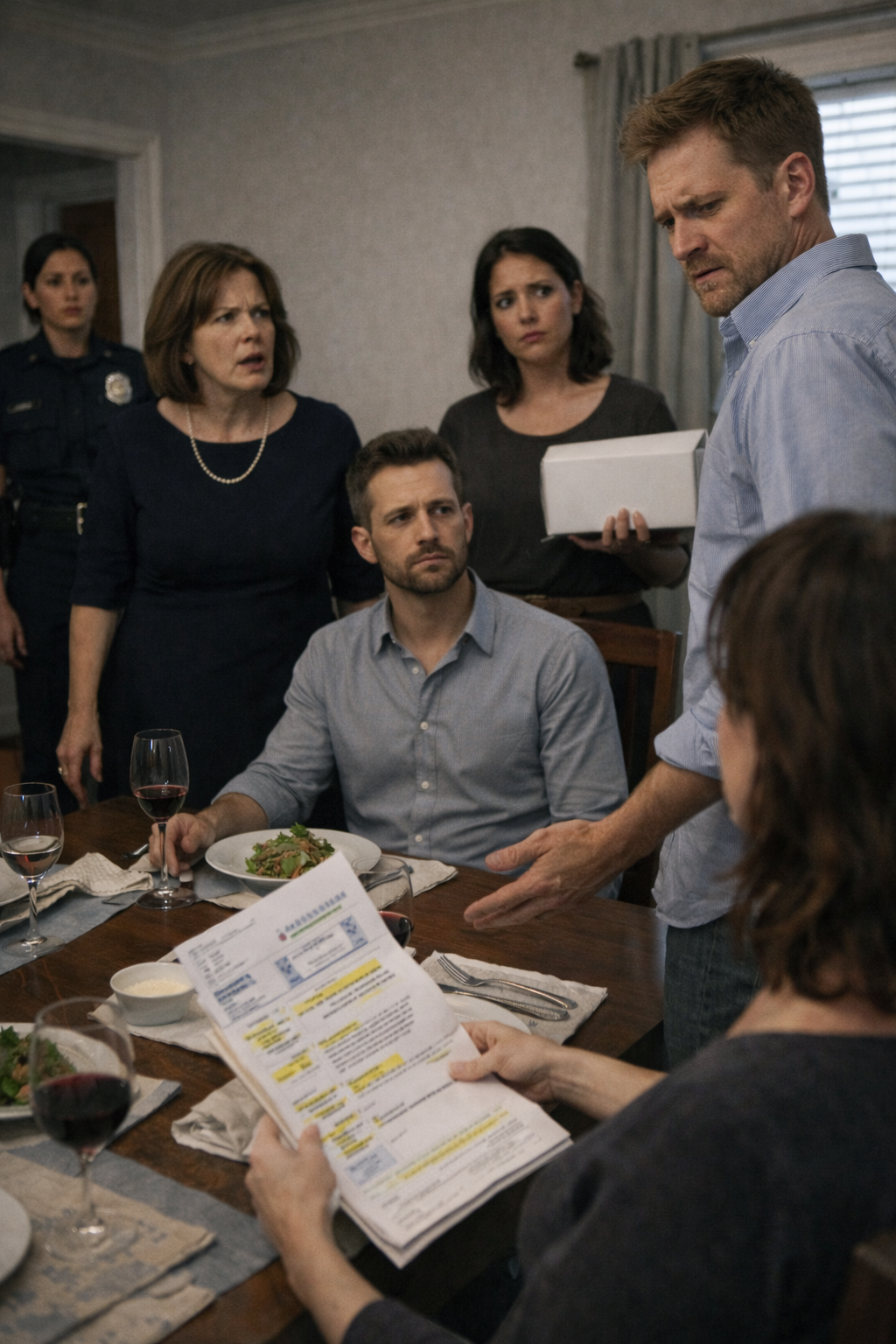
Lorraine entered first, perfectly dressed, as if she were the guest of honor. Behind her came Paige, carrying a bakery box, her expression uncertain.
Graham followed, confident—still believing he was in control.
Then Lorraine stopped.
Two people were already seated.
My brother Nathan sat calmly with his hands folded. Beside him was Diane Mercer, the lawyer I had quietly consulted weeks earlier.
Near the window stood Officer Lena Ortiz.
Graham’s face drained of color.
“What is this?” Lorraine demanded.
“Lunch,” I said evenly. “You said noon mattered.”
Graham turned to me. “What did you do?”
“I invited people who care about facts.”
Officer Ortiz stepped forward slightly.
“She called the police?” Lorraine snapped.
“No,” I said. “I called because your son put his hands on me this morning.”
Silence.
Paige stared at him. “You did what?”
“It was nothing,” Graham said quickly.
“Be careful with that word,” the officer replied. “It often becomes evidence.”
“I’m not trying to ruin you,” I said quietly. “I’m done pretending.”
Lorraine scoffed. “This is ridiculous. Families argue. She’s being dramatic.”
Diane spoke calmly. “I’m here regarding financial coercion and a potential separation.”
“Separation?” Lorraine repeated.
“Yes,” I said. “Because being shoved over money is not something I’ll accept.”
I handed them documents.
Bank transfers. Old “loans.” Messages.
A clear record of years of patterns.
Graham stared. “You kept records?”
“Yes,” I said. “Because I got tired of being rewritten.”
Then Lorraine made her mistake.
“If you had been a better wife,” she said coldly, “my son wouldn’t be under so much pressure.”
That was it.
No more shock.
Just clarity.
“I was waiting for you to say that out loud.”
The silence was heavy.
Paige looked sick. “Mom… what is wrong with you?”
Lorraine lifted her chin. “I won’t be judged in a house without loyalty.”
“Loyalty?” I said. “Is that what you call expecting me to fund your life and apologize for not doing it fast enough?”
Graham tried to regain control. “Can we stop this performance?”
“This isn’t a performance,” Diane replied. “This is documentation.”
Fear entered the room—and everything changed.
I looked at Graham.
“You’re leaving for a week,” I said. “If not, I’ll file for protection.”
“You can’t throw your husband out,” Lorraine protested.
“Yes, she can,” Diane said calmly.
Graham finally understood.
“You planned this.”
“Yes.”
“All this… because she asked for help?”
“No,” I said. “Because you chose her demands over my safety.”
That was the truth.
Not money.
Not arguments.
Choice.
And he had chosen wrong too many times.
Within twenty minutes, he packed a bag.
Lorraine left furious.
Paige stayed just long enough to whisper, “I’m sorry.”
Then the house fell quiet.
The divorce took eight months.
There were apologies, excuses, attempts to fix things.
But once you see clearly, you can’t unsee it.
A year later, I hosted lunch in that same dining room.
This time, it was calm.
No tension. No fear.
Just people who respected me.
At exactly noon, the doorbell rang.
I smiled and said, “Come in.”
Because now—
that space, that time, that life—
finally belonged to me.
Note: This story is a work of fiction inspired by real events. Names, characters, and details have been altered. Any resemblance is coincidental. The author and publisher disclaim accuracy, liability, and responsibility for interpretations or reliance.
